PageIndex vs Vector Databases: Choosing Relevance Over Speed
Vector databases optimize for semantic similarity at scale, but similarity isn't always relevance. PageIndex uses iterative LLM reasoning to achieve breakthrough accuracy on financial and legal documents, accepting higher costs and slower retrieval as an intentional trade-off. The question isn't which approach is better—it's which problem you're actually solving.
Your vector database returns results in 20 milliseconds. The chunks are semantically similar to the query. Your legal team still can't extract the covenant buried in page 47 of the acquisition agreement.
This is the ceiling PageIndex wants to break through. While Pinecone and Weaviate race to make semantic similarity faster and cheaper, PageIndex asks whether similarity and relevance are actually the same thing—when searching complex financial or legal documents that demand multi-step reasoning.
The Similarity Trap: Why Vector Search Struggles With Complex Documents
Vector databases solved real problems. Embedding-based search brought semantic understanding to retrieval at scale, letting systems find conceptually related content even when exact keywords differed. For customer support tickets, product recommendations, or general knowledge bases, this works.
But semantic proximity has limits. A financial analyst asking "What was the adjusted EBITDA margin trend across Q2-Q4?" doesn't just need chunks containing those terms. They need a system that understands margin calculations, recognizes temporal sequences, and pieces together figures scattered across income statements, footnotes, and MD&A sections. Traditional vector RAG relies on similarity rather than relevance, falling short when domain expertise and reasoning enter the equation.
The 50-page contract scenario: vector search might surface the section mentioning "change of control provisions," but miss that the actual trigger condition is defined three pages earlier under a different heading, with exceptions outlined in an appendix. Similarity found the words. Relevance requires reading comprehension.
PageIndex's Bet: LLM Reasoning Over Embedding Speed
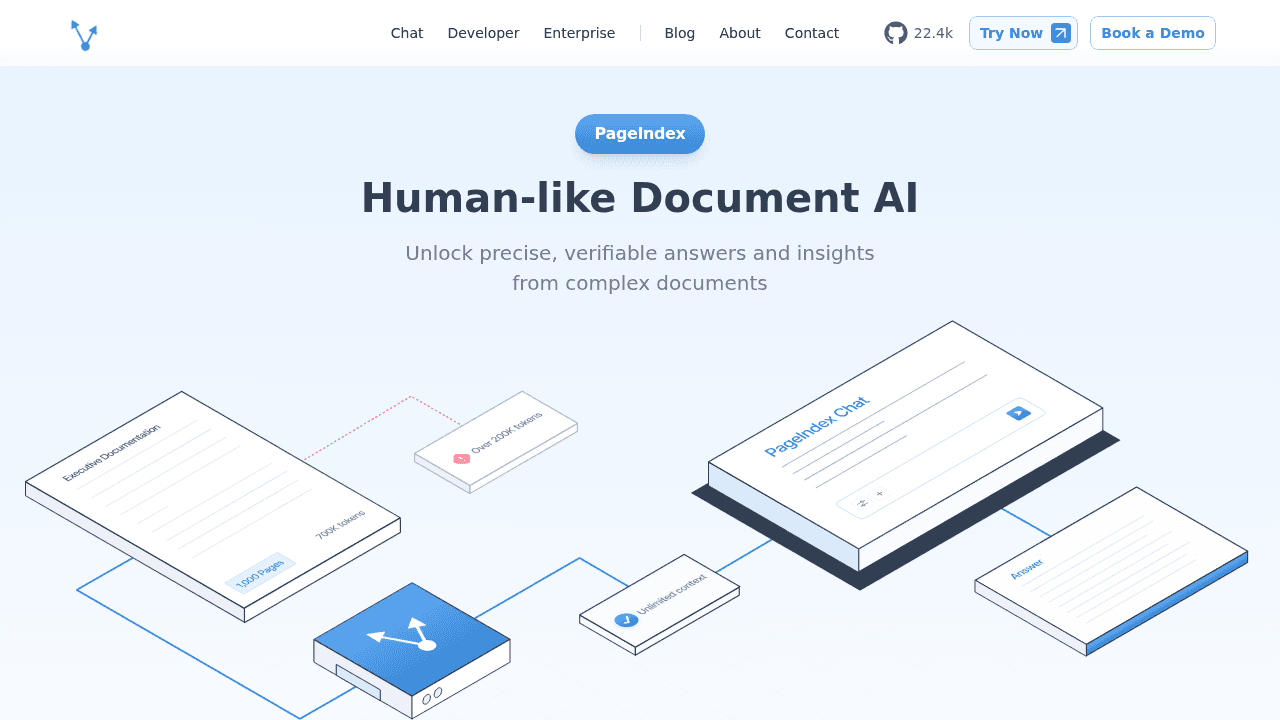
PageIndex makes an architectural choice that looks counterintuitive: it uses iterative LLM calls for both indexing and retrieval instead of embedding vectors. The system doesn't just encode documents—it has language models read them, extract structured information, build relationships between concepts, and reason about what matters for different query types.
This is slower. It costs more than vector-based methods. The team isn't apologizing for either.
Their proof point: Mafin 2.5 achieved 98.7% accuracy on FinanceBench, the financial RAG benchmark where vector-based systems struggle. When documents require genuine understanding—reading tables, tracking definitions across sections, applying domain rules—LLM-powered retrieval delivered accuracy that similarity matching couldn't reach.
The Cost Trade-off: When Slower and Pricier Makes Sense
PageIndex costs more per query than a vector database. Indexing takes longer. If you're building a chatbot answering 100,000 simple questions daily, this doesn't work.
But consider the alternative: a legal team spends three hours manually reviewing documents because their RAG system surfaced 40 "similar" chunks that weren't relevant. An investment analyst misses a material risk factor buried in footnotes because embedding search didn't understand the relationship between covenant violations and early redemption clauses.
For complex professional documents where accuracy determines business outcomes, the question isn't "Can we afford LLM-based retrieval?" It's "Can we afford to get the answer wrong?"
Pinecone and Weaviate remain strong choices for scale, speed, and straightforward semantic search. They've earned their position by solving real problems efficiently.
Complementary Tools, Not Competing Religions
The decision framework isn't "PageIndex vs. vector databases." It's matching tool to problem.
Use vector search when you need fast semantic retrieval at scale for straightforward questions. Customer support, content discovery, general knowledge retrieval—these remain vector database territory.
Consider PageIndex when accuracy on reasoning-intensive tasks justifies the cost premium. Multi-step financial analysis, legal document review, medical literature synthesis—domains where missing the right answer has consequences.
The Mafin 2.5 deployment shows what this looks like: a system accepting higher per-query costs because the accuracy improvement delivered measurable value to financial analysts working with complex disclosures.
Implementation Reality: What Switching Actually Means
Adopting PageIndex means rethinking cost models. Budget for LLM API calls during indexing and retrieval. Expect slower response times—this won't power real-time chat widgets.
The payoff comes in reduced manual review, fewer missed insights, and higher confidence in retrieval quality for documents where reasoning matters. Teams working with long-form professional documents report that the accuracy gain outweighs the speed penalty when users need correct answers more than they need instant responses.
Neither approach wins universally. The question is which trade-off your problem needs.
VectifyAI/PageIndex
📑 PageIndex: Document Index for Vectorless, Reasoning-based RAG