SuperClaude Framework: Structure Layer for Claude Code
Claude Code excels at AI-assisted code generation but wasn't built for project lifecycle management or team coordination. SuperClaude Framework layers structured workflows, specialized agents, and systematic protocols onto Claude Code without replacing it—30 commands for PR reviews that check guidelines, behavioral modes for different dev phases, and MCP integrations for tool connectivity.
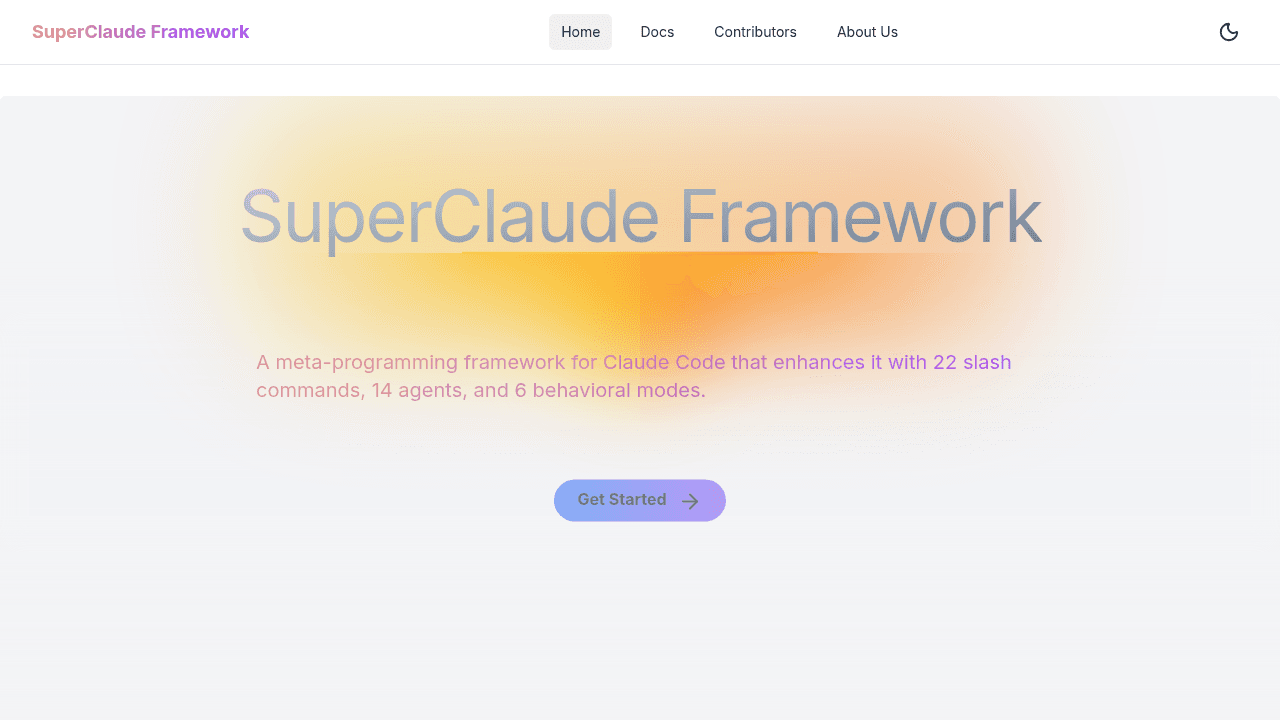
Claude Code generates code. But when you need a PR review that checks your project's actual guidelines, or specialized agents for security analysis, or structured workflows that map to development phases—you run into a wall. SuperClaude Framework fills that gap with 30 slash commands, 16 specialized agents, and 8 MCP server integrations that layer professional workflows onto Claude Code.
The Gap Between Code Generation and Project Management
AI coding assistants like Claude Code, Cursor, and GitHub Copilot excel at their core tasks: Cursor handles contextual editing, Copilot suggests lines of code, and Claude Code generates substantial code blocks. What they don't provide is project lifecycle structure—the coordination layer that professional teams need for reviewing work against guidelines, orchestrating domain-specific analysis, or managing different behavioral modes across development phases.
That's where SuperClaude Framework comes in. It's not competing with these tools; it builds on top of them.
What SuperClaude Framework Actually Adds
The framework breaks down into three architectural layers. First, 30 slash commands that extend Claude Code's command palette—things like PR reviews that check project guidelines, which users requested because native reviews miss project-specific validation.
Second, 16 specialized agents for domain expertise: security, performance, architecture, testing. These aren't general-purpose code generators; they focus on specific analysis tasks that require domain knowledge.
Third, 7 behavioral modes that align with different development phases—planning mode behaves differently than debugging mode, which behaves differently than refactoring mode. The AI's behavior matches the workflow stage.
How It Works: MCP Integration and Command System
SuperClaude implements 8 MCP (Model Context Protocol) server integrations for tool connectivity. The framework is available as a PyPI package with pipx and pip installation options for Python environments, plus an official Node.js wrapper on npm for cross-platform teams.
Installation follows standard package manager flows—you're adding a layer to your existing Claude Code setup, not replacing your toolchain. The commands integrate into Claude's interface as extensions of what's already there.
Real Usage: PR Reviews and Specialized Agents
Developers use the PR review workflow to validate code against internal standards—the kind of checking that requires project context beyond syntax correctness. The v4.1.9 release added commands like spec-panel for specification management, showing how the framework evolves around professional workflows.
The specialized agent system handles focused analysis: the security agent runs threat modeling, the performance agent analyzes bottlenecks, the architecture agent reviews structural decisions. Each agent carries domain-specific prompts and evaluation criteria.
Growing Pains: Lazy Behavior and Categorization Issues
Open source projects ship with rough edges. Some users have noted lazy behavior causing analysis errors, and the performance agent has categorization issues. These are active development challenges in a project that's iterating quickly—v4.1.9 dropped a year ago in November 2024 with bug fixes and new commands, showing consistent attention to issues as they surface.
For teams evaluating the framework, these open issues matter. They're typical of a rapidly growing project finding its footing.
How This Differs from Cursor, Copilot, and Config Projects
SuperClaude sits in a different category than alternatives. Cursor optimizes for contextual code editing. Copilot focuses on line-level autocomplete. Projects like everything-claude-code provide basic configuration tweaks. SuperClaude provides full lifecycle command systems and agent orchestration—it's architectural, not incremental.
The framework respects what Claude Code does well and adds the layer that professional teams need for coordination and specialization.
Who This Is For
This is for professional developers and engineering teams who already use Claude Code and need more than code generation. If you're coordinating PR reviews across guidelines, running specialized security or performance analysis, or managing different workflow phases with distinct behavioral needs—SuperClaude provides that structure.
If you're happy with standalone code generation, you probably don't need this layer. But if you've hit the ceiling of what pure AI assistants offer for project-level work, the framework is worth examining.
SuperClaude-Org/SuperClaude_Framework
A configuration framework that enhances Claude Code with specialized commands, cognitive personas, and development methodologies.