OpenAI's Terminal Agent Marks the End of IDE Plugins
OpenAI released Codex CLI—an open-source terminal coding agent—the same week as o3 and o4-mini, forcing the AI tooling market to choose between walled gardens and interoperability. Engineering leads now face a choice: consolidate around proprietary agents or fragment across open tools as the category matures from demos into production.
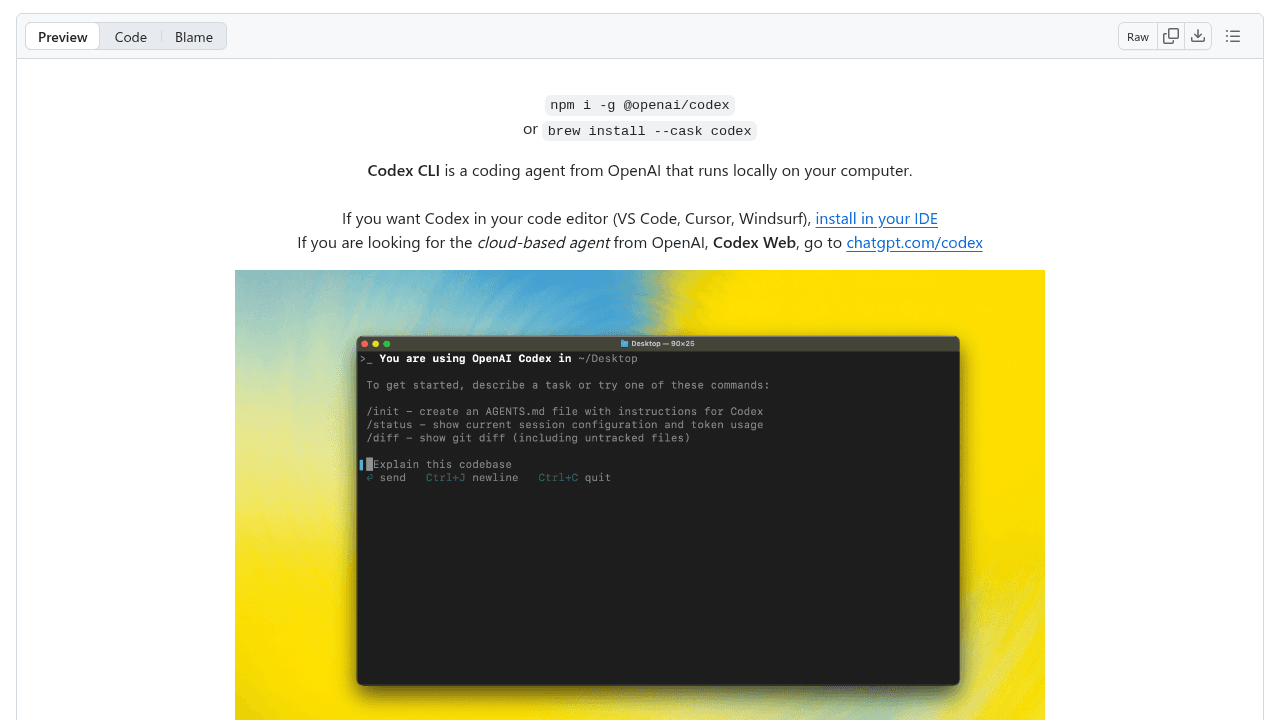
OpenAI open-sourced Codex CLI, a terminal coding agent that lets you drive file edits, shell commands, and project changes with natural-language prompts—no copy-pasting between ChatGPT and your editor. Released alongside the o3 and o4-mini models in mid-April, it's OpenAI's first official play for the terminal agent category, with a $1M API credit program to accelerate adoption.
The timing matters. Claude Code has momentum. Cursor has controversies. Developers are spread across Aider, Plandex, and a dozen other agentic tools. Codex CLI is OpenAI's answer: an open-source, bring-your-own-key agent that works with any OpenAI-compatible host, including Ollama and self-hosted models via a single --oss flag.
From IDE plugins to terminal agents
AI coding tools have graduated from autocomplete helpers to agents that read codebases, apply patches, execute commands, and iterate under version control. Codex CLI marks the inflection point where ChatGPT-level reasoning meets local shell workflows—no browser tab required.
The tool runs in a git-backed, sandboxed directory with network disabled. You can set approval modes: suggest-only for exploration, read/write for supervised edits, or full-auto for CI pipelines. Every session generates telemetry logs, letting teams replay and audit what the agent changed. It's built for developers who live in the terminal and want control alongside automation.
Why OpenAI shipped this now
The launch timing—same week as o3 and o4-mini—signals intent. OpenAI positioned Codex CLI as the "first in a series" of agentic tools, competing with Claude Code's terminal integration and Cursor's IDE approach. The $1M credit program is infrastructure to pull developers and tooling vendors into OpenAI's orbit.
Codex CLI is Apache-2.0 license. You can inspect the prompt, modify the agent loop, and wire in Model Context Protocol (MCP) tools. The multi-provider support—via configuration file or command-line flag—hedges against lock-in. You can start with OpenAI's models and switch to Anthropic or a local Llama instance without rewriting workflows.
What Codex CLI actually does (and doesn't)
Codex CLI is minimal. It offloads planning entirely to the model, running a simple agent loop with no heavy orchestration layer. You give it a task; it reads files, proposes changes as patches, and waits for approval before executing shell commands.
Developers are already using it beyond demos. GitHub mirrors and forks (imsrv/codex-openai, ymichael/open-codex) show adoption. CI integrations—like the example GitHub Actions workflow that auto-updates changelogs—prove teams are moving it into production pipelines. Tutorials cover scaffolding new apps, explaining legacy codebases, and running on Windows, macOS, and servers.
The reliability and cost concerns
Hacker News users report rough edges. The default model sometimes fails with OpenAI rejection errors, requiring manual switches on each run. Some developers describe hallucinations on unfamiliar codebases, slow recovery when the agent breaks code, and token burn with o3-tier models.
Security-minded users worry about exporting API keys into the shell environment, where other utilities can access them. There's discussion of safer patterns—passing keys inline or wrapping invocation in scripts. Others criticize the Node.js-based TUI for flickering and odd input behavior, suggesting a Go or Rust implementation might be more stable.
These aren't deal-breakers. They're signs the market is maturing past hype into production scrutiny.
How it stacks up against Claude Code, Aider, Cursor
Claude Code offers strong context management and tool use but ties you to Anthropic's stack. Cursor provides an AI-augmented IDE with flat-rate pricing but has raised transparency concerns. Aider commits every change and supports multiple models with different cost profiles. Plandex targets large, complex projects with very large context windows.
Codex CLI is the official OpenAI agent—open-source, provider-agnostic, and built for terminal workflows. It's lighter on orchestration than some competitors, which is a feature for teams that want transparency over magic.
The bigger question: consolidation or fragmentation?
Engineering leads now face a fork. Will teams converge on a few proprietary agents with polished UX and strong context handling? Or will the open tooling—Codex CLI, Aider, Plandex—enable fragmentation and customization?
Watch how vendors respond to the multi-provider model. If lock-in softens and context portability improves, the terminal agent category could mirror the IDE wars: a few dominant players, an open middle tier, and constant pressure to interoperate. If not, we're heading for a messier landscape where every team builds its own wrapper.
Either way, the category just shifted. Plugins are the past. Agents are the present.
openai/codex
Lightweight coding agent that runs in your terminal