PewDiePie's Odysseus: Self-Hosted AI vs. ChatGPT
Odysseus is a self-hosted AI workspace that unifies chat, agents, research, and productivity tools while keeping your data on your own infrastructure. Backed by PewDiePie and trending at 86,000 GitHub stars, it's built for developers who want control over their AI workflow without sacrificing integration breadth—but a recent critical RCE vulnerability shows the reality of fast-moving open source.
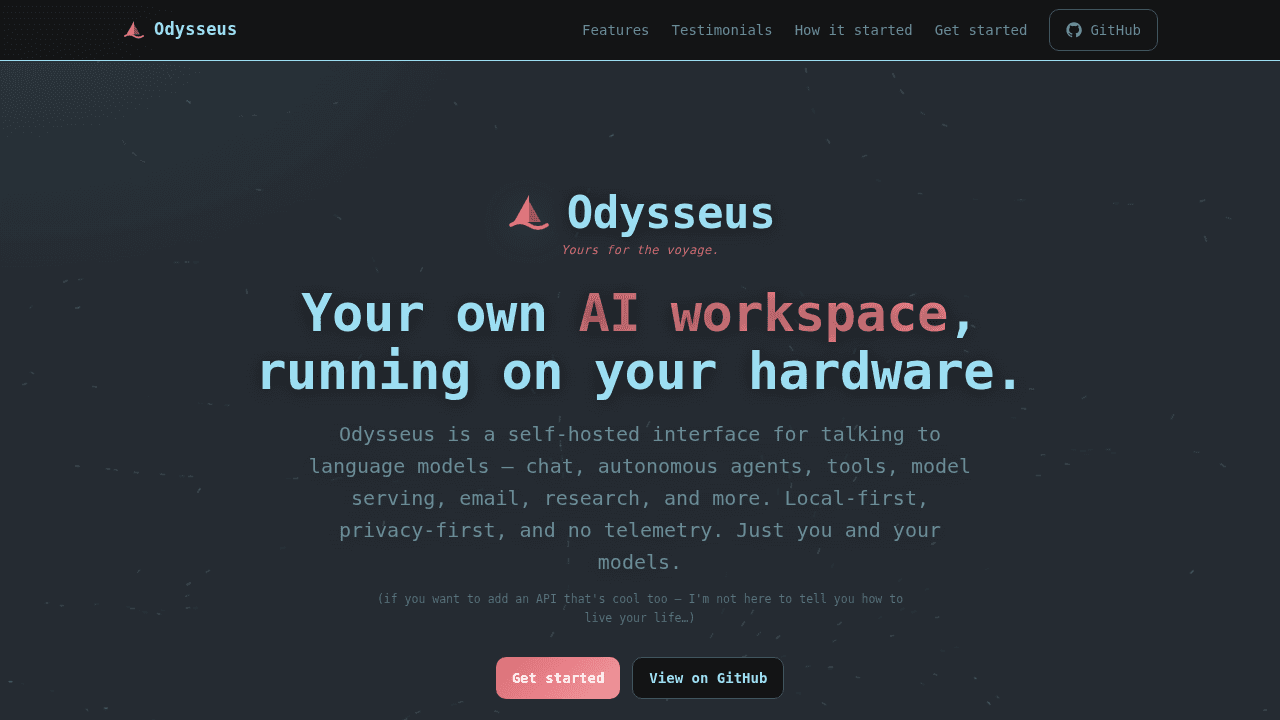
When Felix Kjellberg—better known as PewDiePie—decides to back an open-source AI workspace, the internet pays attention. Odysseus has climbed to 86,000 GitHub stars by offering something the major AI platforms don't: complete control over where your data lives and which models you run. ChatGPT and Claude are exceptional products with world-class engineering. Odysseus addresses a different user: developers and power users who need their data on their own machine or server, who want to route computation through their own infrastructure, or who have compliance reasons that make hosted services non-starters.
The philosophical split: convenience vs. sovereignty
The tension here isn't technical—it's philosophical. OpenAI, Anthropic, and Google have built polished, zero-setup experiences that serve billions of users. They handle the infrastructure, security patches, model updates, and scaling challenges so you don't have to. For most people, that's the right choice.
Some users need their data on their own infrastructure. They have compliance requirements, or they want to run models locally without external dependencies. Both approaches are valid. The question is which trade-offs you're willing to make.
What Odysseus actually does
Odysseus unifies chat, autonomous agents, research tasks, documents, email, notes, calendar, and local model workflows into a single self-hosted web application. Instead of juggling multiple tools and APIs, you get one interface that handles the full workflow.
The technical differentiators: bring-your-own-models support (OpenAI, Anthropic, local via Ollama/llama.cpp), MCP integration for tool servers, IMAP/SMTP email, CalDAV calendars, and zero telemetry. A Windows 11 setup guide on Reddit walks through connecting the app to a locally running llama.cpp HTTP server, showing that real users are deploying this in practice—not just starring the repo and moving on.
Android Authority's hands-on coverage details the breadth of integrations: email protocols, calendar sync, MCP tool servers, and custom APIs. For a project this young, the feature surface is wide.
The critical vulnerability (CVE, CVSS 9.9)
Fast-moving open source breaks things, and Odysseus hit that reality hard. Security researchers at Manifold Security disclosed a critical remote command execution vulnerability (CVSS 9.9) in versions through 1.0.1. Any authenticated non-admin user could execute OS commands with the privileges of the Odysseus process, potentially exposing API keys, SSH keys, databases, and stored credentials.
The flaw was patched in version 1.0.2. The incident is a reminder that self-hosting means owning the security posture. Hosted services handle this for you—vulnerabilities get patched server-side, often before users even know about them. When you run your own infrastructure, you're responsible for updates, monitoring, and threat mitigation. That's the trade-off.
Why a YouTuber is building this
Kjellberg and the Odysseus team aren't claiming the hosted giants are bad—they're arguing users deserve a choice. The project's momentum (86,000 stars, coverage in mainstream tech media) validates that demand exists. Developers want the option to run local models, keep sensitive data on-premises, and integrate tools without routing everything through a single external provider.
Who this is actually for
Odysseus targets developers who value privacy, need to run local models, require integration flexibility, or face regulatory constraints that make self-hosting non-negotiable. If you're happy with ChatGPT or Claude—and most users are—there's no reason to switch. Those products are excellent at what they do.
If you've ever thought "I wish I could run this on my own server with my own models and no data leaving my infrastructure," Odysseus is built for you. It's about having the choice, and respecting that different users have different priorities.