Taste-Skill: Teaching AI Agents to Ship Better UIs
AI coding agents can generate functional UIs instantly, but they default to generic, boilerplate aesthetics. Taste-Skill addresses this by packaging design judgment as portable SKILL.md files that agents load at runtime—teaching them layout principles, typography rules, and motion patterns without shipping any actual code. Early adoption signals developers recognize the gap between speed and taste.
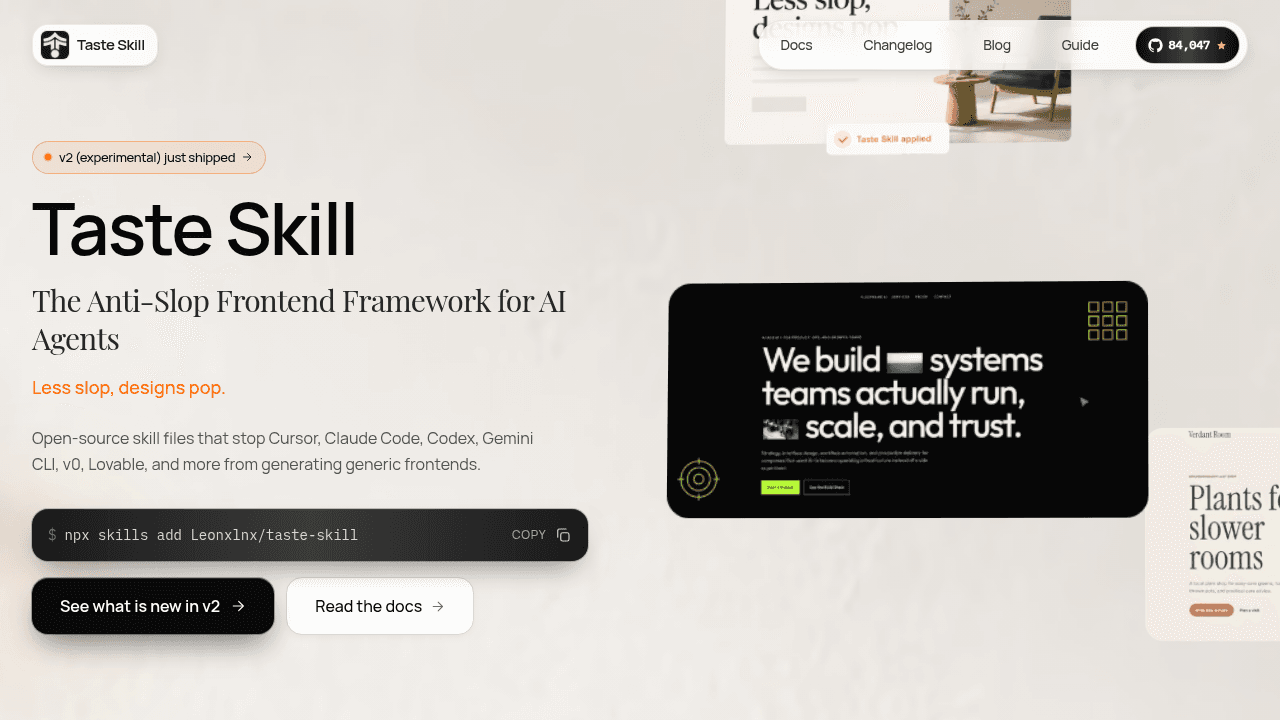
AI agents can generate a landing page in thirty seconds. The problem: every one looks the same. Centered layouts, default spacing, generic typography. The output works, but training data skews toward boilerplate. Agents ship what they've seen most often—templates.
A developer built a fix that doesn't involve writing code.
The templated look problem
When you ask an AI agent to build a UI, you get functional results fast. But the aesthetic ceiling is low. Taste-Skill's repository frames itself as an "Anti-Slop Frontend Framework" designed to upgrade AI-built interfaces beyond boilerplate—targeting stronger layout variance, intentional typography hierarchies, and purposeful motion patterns. The documentation describes the core problem agents face: reading a brief, inferring the right design direction, and shipping interfaces that don't look templated requires design judgment, not just code generation. Most agents default to what's statistically common in their training corpus, which means visually safe but aesthetically generic output.
The gap isn't a lack of skill—it's that agents optimize for speed and functional correctness, not taste.
Design judgment as a text file
Taste-Skill addresses this by packaging design rules into a SKILL.md file that agents load at runtime. The skill file itself contains guidance on layout systems, typography scales, spacing audits, and motion choreography—written as instructions, not code. It's not a component library or a set of design tokens. A Medium breakdown clarifies that Taste-Skill ships agent skills—portable text files that coding agents load before generating UI—operating at a different layer than frontend frameworks. Instead of shipping React components or Tailwind utilities, it teaches agents how to think about design trade-offs.
The constraint is the advantage: because it's text rules rather than compiled dependencies, any agent that supports Anthropic-style skill files can use it.
How it works in practice
A developer blog from GMO Internet Group walks through installing the design-taste-frontend v2 skill via npx and compares AI-generated UI output with and without Taste-Skill. The workflow is straightforward—add the skill, let the agent read the brief, watch it apply pre-flight checks for spacing and hierarchy before writing any markup. AI Heartland's explainer notes that Taste-Skill sits on top of the Anthropic-style Agent Skills layer, not as a standalone app or library—it's a set of rule bundles agents consult during generation.
The before-and-after comparisons show measurable differences in layout variety and typographic intentionality, though formal benchmarks are still emerging.
Portable across agents
Because Taste-Skill is text-based rather than framework-specific, it works across any agent that supports the SKILL.md format. The Tessl skill registry lists design-taste-frontend as a registered skill with an impact rating, though it notes that no evaluation scenarios have been run yet. The portability matters: developers can use the same taste rules whether they're working with Cursor, Windsurf, or any other agent that reads skill files.
This isn't about locking into a single toolchain—it's about teaching agents a shared design vocabulary.
Where it stands now
The repository has issues typical of a fast-growing project. One public bug report flags a naming inconsistency in v1, where LAYOUT_VARIANCE should have been DESIGN_VARIANCE in an anti-center bias rule. There are no formal evals yet, and the community is still testing edge cases across different agent configurations.
But the signal is clear: the repository hit 84,000 stars in weeks. A tweet by Vaibhav Sisinty describes it as "a text file with no code that teaches AI coding agents what not to build," and the framing resonated immediately. Developers recognized the gap between speed and taste—they just hadn't seen a systematic fix until now.
Why this matters now
As AI agents handle more UI work, the aesthetic bottleneck becomes more visible. Functional output isn't enough if every landing page feels like it came from the same template. Taste-Skill offers a way to close that gap without abandoning the speed agents provide. It complements existing tools rather than replacing them, operating at the layer of agent behavior instead of UI primitives.
For developers who've shipped AI-generated interfaces and felt the ceiling, this is a missing piece worth watching.
Leonxlnx/taste-skill
Taste-Skill - gives your AI good taste. stops the AI from generating boring, generic slop