NeoPass: When Exam Software Locks Down Too Hard
Exam proctoring software like NeoExamShield locks down browsers so tightly that students can't access basic functionality. NeoPass, a Chrome extension with 25,000+ GitHub stars, bypasses these restrictions by masquerading as the proctoring software itself. The tool's popularity reveals a tension: when academic integrity tools restrict too much, students engineer workarounds.
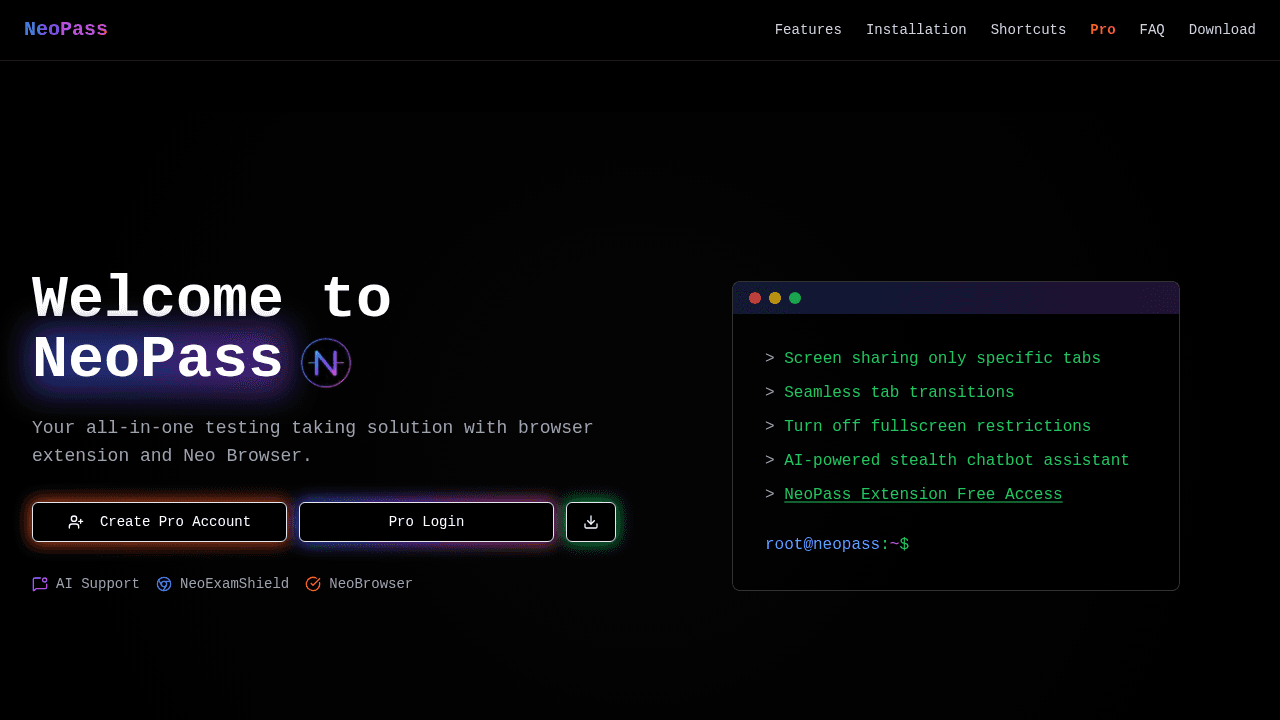
NeoExamShield blocks all browser extensions, prevents copy-paste, forces fullscreen mode, and requires screenshare during exams on the Iamneo portal and NPTEL. The security measures don't distinguish between prohibited tools and legitimate study aids. NeoPass, a Chrome extension with over 25,000 GitHub stars, exists because that distinction matters to students.
The Restriction Problem
NeoExamShield implements lockdown measures designed to prevent cheating: no unauthorized extensions, no tab switching, mandatory screenshare, no copy-paste. These are reasonable security measures for high-stakes testing. But they also block everything else—reference materials for open-book exams, note-taking tools, accessibility extensions, or AI assistants that instructors might explicitly allow.
The blanket approach creates friction. When a student needs functionality that the proctoring software treats as a security threat, they face a choice: accept the restrictions or find a workaround.
How NeoPass Works
The technical approach is interesting. NeoPass masquerades as NeoExamShield itself—same extension name, identical description—to avoid detection by the very software it circumvents. It's not trying to hide; it's wearing the uniform of the system it's bypassing.
The functionality goes beyond simple access restoration. Recent releases added features like Alt+Shift+Q shortcuts for automated MCQ and coding solutions with claimed 100% accuracy, plus Alt+Shift+T for "stealth typing" of coding answers. Version 1.3.0 brought UI refinements, toast opacity controls, and bug fixes for the stealth chatbot feature.
This isn't subtle. It's purpose-built for exam scenarios where NeoExamShield operates.
The Gap It Fills
Twenty-five thousand stars on GitHub suggest something beyond a fringe tool. That level of adoption points to a real gap—though not necessarily a legitimate one.
The charitable interpretation: some students use NeoPass for open-book exams where AI assistance or reference materials are explicitly permitted, but NeoExamShield's blanket restrictions prevent access. The proctoring software can't distinguish between an exam that forbids outside help and one that allows it, so it locks down everything.
The less charitable interpretation: students use it exactly as the keyboard shortcuts suggest—to automate answers and bypass academic integrity measures.
Both likely happen. The tool doesn't enforce intent.
The Response
NeoPass isn't alone. FkNeo exists as a similar bypass tool, though its creator frames it as a "hobby project for experimentation" and disclaims support for cheating. The disclaimer doesn't change the functionality—it just acknowledges the ethical territory.
Proctoring software vendors face a challenge: every restriction they add creates friction for legitimate use cases. Every workaround students develop forces another round of detection measures. It's an arms race where both sides have legitimate concerns, and neither can fully win.
Students want flexibility for scenarios where restrictions feel punitive. Institutions want confidence that exams measure actual knowledge, not search engine proficiency. The gap between those needs creates space for tools like NeoPass.
What This Reveals
The existence of NeoPass—and its adoption—exposes a tension in educational technology. When security tools assume all students are threats, some students respond by proving that assumption correct. When legitimate needs go unmet by official systems, unofficial systems emerge.
This isn't endorsement. It's observation of a cycle that serves neither students nor institutions well. Restrictive proctoring software creates demand for bypass tools. Bypass tools justify more restrictive proctoring software. The technical work on both sides increases while the tension remains unresolved.
EdTech developers watching this might note: when security measures block everything to prevent anything, the demand for workarounds becomes predictable. The question isn't whether students will engineer solutions—it's whether those solutions will respect the boundaries they're supposed to.
NeoPass answers that question clearly. Whether that's a problem with the tool or with the restrictions that made it necessary depends on which part of the cycle you're examining.
Max-Eee/NeoPass
Your Essential Exam Companion for the Iamneo Portal & NPTEL Exams Disguised as NeoExamShield bypass