Multica: Coordinate AI Coding Agents Like Teammates
Managing multiple AI coding agents means juggling terminal windows, copy-pasting prompts, and losing context between sessions. Multica treats Claude Code, Codex, Cursor, and 17+ other agents as teammates you can assign issues to, @-mention, and track through a structured collaboration layer—earning 10,588 stars in one week.
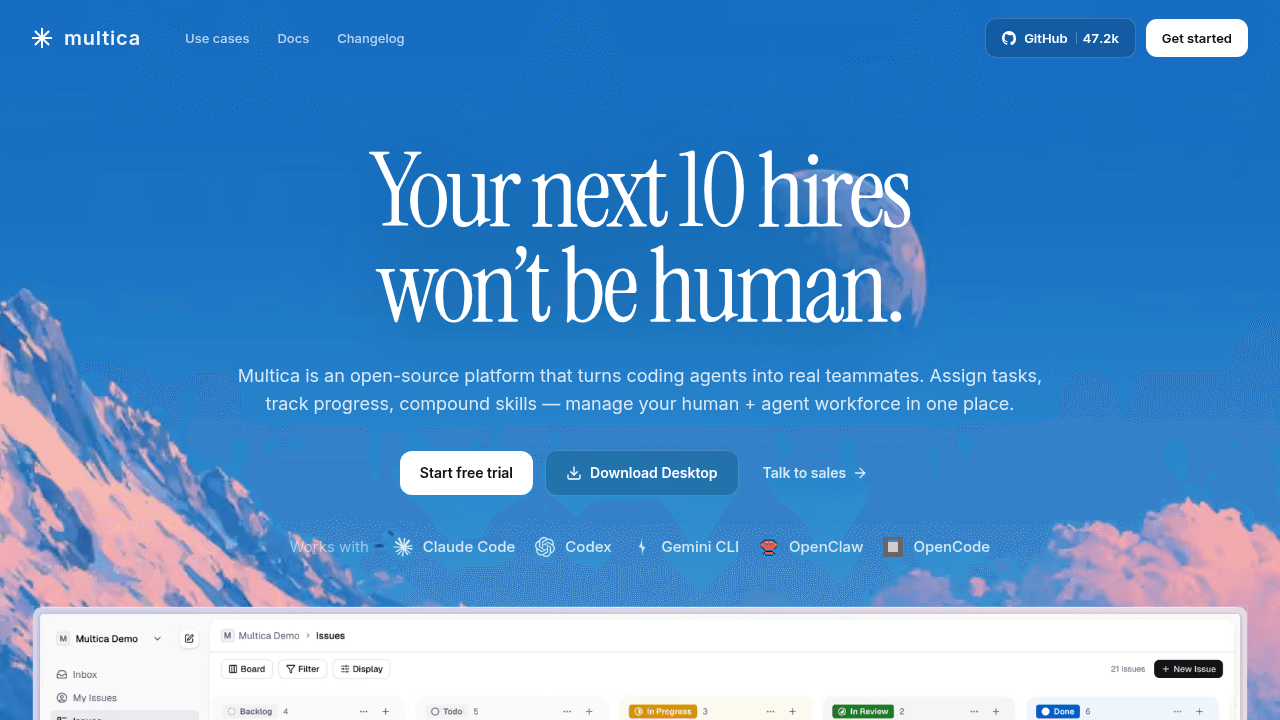
You're running Claude Code in one terminal, Codex in another, and Cursor somewhere else. You copy-paste the same context into each session, manually track which agent finished what, and lose the thread when one hits a blocker. Multica solves this by treating Claude Code, Codex, Cursor, and 17 other AI coding agents as teammates you can assign issues to, @-mention, and track through a coordination layer.
The Terminal Window Shuffle
Most developers managing multiple AI coding agents juggle separate terminal sessions, each running its own isolated instance. You finish a prompt in Claude Code, switch windows, paste adjusted context into Codex, then manually check whether Cursor's output conflicts with what Claude already wrote. ShareuHack's analysis describes the core problem: coordinating concurrent sessions that developers previously managed by manually switching terminals, losing context between handoffs.
The friction compounds when agents need to work on interdependent tasks. You want Claude to build the authentication module while Codex handles the database schema and Cursor writes the frontend. Without coordination, you're the integration layer—copying output, resolving conflicts, and restarting sessions when one agent's work blocks another.
How Multica Treats Agents as Teammates
Multica wraps existing CLI tools rather than replacing them. You assign GitHub-style issues to specific agents, @-mention them in comments to add context, and let them report blockers autonomously. The tutorial workflow shows agents collaborating on a personal website: one handles layout, another manages styling, and they update status in a shared issue tracker.
The system requires at least one AI coding tool installed—Claude Code, Codex, GitHub Copilot CLI, or Cursor Agent. Once connected, agents act as workspace participants who respond to assignments, post updates, and signal when they need input. Instead of babysitting three terminal windows, you coordinate through issue assignments the same way you'd manage human teammates.
Developers Digest contrasts this with single-agent wrappers that only drive one tool, or task queues that lack the @-mention context and blocker reporting that make multi-agent coordination work.
10,588 Stars in One Week
Multica gained 10,588 stars in one week to reach 14,826 total, ranking #3 on GitHub Trending for week 16 of 2026. The velocity suggests developers already using multiple AI tools recognized the coordination headache immediately—this wasn't solving a theoretical problem but a daily frustration.
Over 400 open issues and nearly 600 closed show deployment in the wild. Feature requests for runtime failover and bug reports for Hermes and self-hosting indicate users are pushing the system into production scenarios, not just experimenting locally.
Growing Pains: API Validation and Stress Tests
Issue #3563 reports that the GET /api/issues endpoint doesn't validate the limit parameter, allowing negative or extremely large values that can cause 500 errors or unbounded result sets. For a tool scaling from zero to 15,000 stars in weeks, these edge cases are normal growing pains—evidence that users are stress-testing the system hard enough to expose validation gaps.
With hundreds of issues tracking Windows compatibility, deployment edge cases, and API hardening, the maintainers are working through the stabilization phase that follows fast adoption.
When Coordination Beats More Agent Power
If you're already managing two or more AI coding agents manually, Multica solves a different problem than switching to a "better" agent. Agent capability matters less than coordination overhead when you're juggling multiple sessions. The coordination layer makes existing tools work better together rather than replacing them—treating Claude Code, Codex, and Cursor as complementary specialists instead of competing soloists.
For developers running a single AI agent in one terminal, the overhead of issue tracking might outweigh the benefit. But once you're copy-pasting prompts between sessions, the coordination layer addresses friction that raw agent power can't.
multica-ai/multica
Assign issues to Claude Code, Codex, Cursor, and 17 more coding agents like teammates — open-source and self-hostable.