Docling: IBM's PDF Parser That Actually Works
Most PDF parsers fail on real-world documents like machine manuals with complex tables and layouts. Docling emerged from IBM Research to solve this specific pain point, trading speed for accuracy. Red Hat integrated it into RHEL AI and InstructLab, while IBM embedded it across watsonx—enterprise adoption that signals this tool solves problems companies will pay to fix.
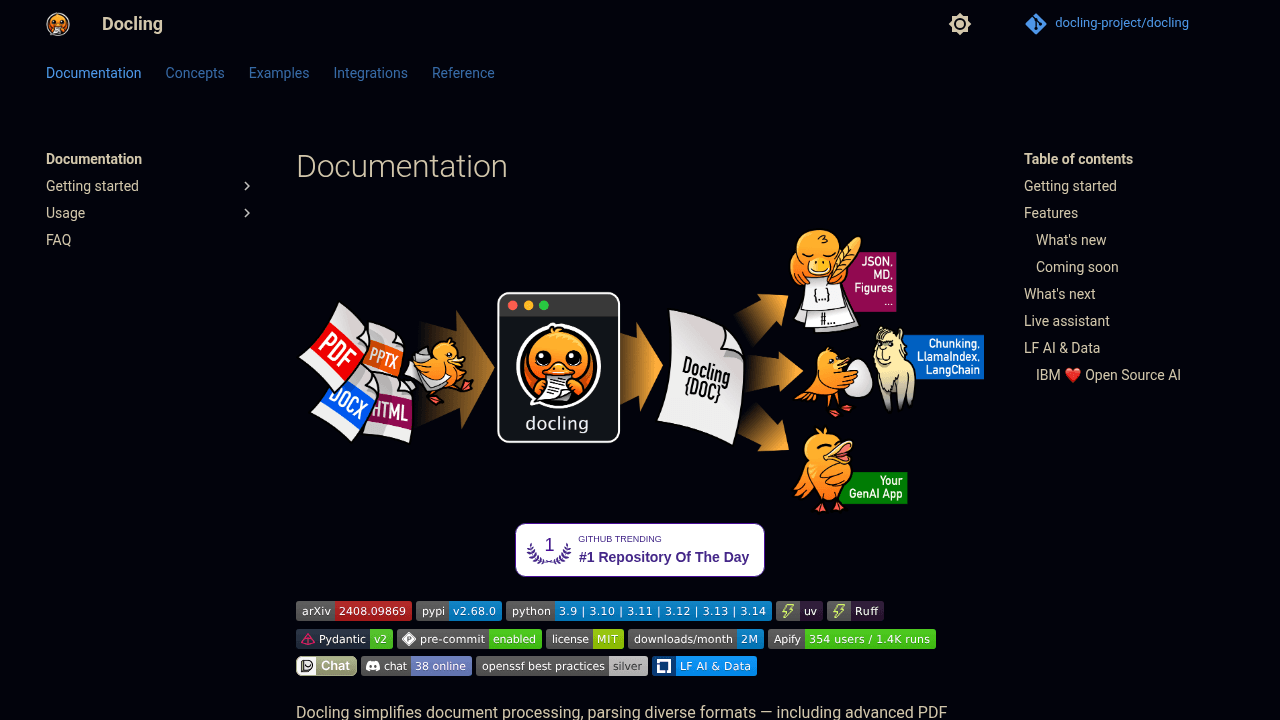
A machine learning engineer at a Fortune 500 company spent three weeks manually extracting tables from equipment manuals because every PDF parser failed on nested layouts and scanned pages. Another team abandoned their RAG pipeline after their parsing library delivered garbled text from 19 out of 20 technical documents. These failures aren't edge cases—they're what happens when real-world PDFs meet most parsers.
IBM Research built Docling to handle this chaos. Within months of its Fall 2024 open-source release, Red Hat integrated it into RHEL AI for document ingestion and InstructLab fine-tuning. IBM embedded it across watsonx. That kind of enterprise adoption doesn't happen for experimental tools—it signals a solution to a problem companies will pay to fix.
The PDF Parsing Problem
The challenge isn't clean PDFs with simple text. It's machine manuals with tables inside tables, scanned procurement documents with coffee stains, technical specifications where reading order doesn't follow visual layout. Traditional parsers work fine on academic papers but fail on over 95% of diverse real-world documents without throwing errors.
For AI teams building document ingestion pipelines, those failures cascade. Broken parsing means corrupted training data. Garbled tables mean hallucinating chatbots. Manual extraction means bottlenecks that kill RAG projects before they ship.
What Docling Does Differently
Docling uses layout understanding models to preserve document structure—heading hierarchies, table boundaries, reading order—in a unified DoclingDocument format. It supports vision-language models for complex visual content and runs on local infrastructure, avoiding the compliance headaches of cloud-based parsing.
The tradeoff: Docling is slower than GROBID, which prioritizes speed over feature completeness. It handles fewer file types than Unstructured.io. Docling chose accuracy on nightmare PDFs over raw throughput.
That matters for specific use cases. When you're preparing training data for fine-tuning or building retrieval systems where garbage-in means garbage-out, the speed penalty beats manual cleanup or failed pipelines.
Enterprise Adoption: Red Hat and IBM's Bet
Red Hat's RHEL AI uses Docling for document preparation in production systems. IBM consulting teams deploy it for client AI agents. Cloudera and watsonx embed it as infrastructure, not experiment.
The integrations: LangChain, LlamaIndex, Crew AI, Haystack. These aren't one-off demos—they're the connective tissue of agentic AI applications where document understanding determines whether your system works.
The Speed Problem (And Why They Accept It)
The GitHub issues are blunt: "Terribly slow on PDFs". Hangs on complex DOCX files with tables. VRAM exhaustion on dense content. EasyOCR struggles with handwriting and low-quality scans.
This is the reality of a tool that traded speed for layout accuracy. Teams choose Docling when parsing failure costs more than processing time. When you're ingesting thousands of technical documents for a legal AI system, overnight batch jobs beat three weeks of manual table extraction.
Momentum: 50k Stars and 1.5M Monthly Downloads
Docling hit 49.7k GitHub stars and 1.5 million monthly downloads by catching generative AI's document preparation wave. Trending on GitHub in November 2024, hosting by LF AI & Data, a new Heron layout model for faster parsing, and MCP server support for agents all signal sustained development.
IBM Research open-sourced it when enterprises were building RAG systems and discovering their parsers couldn't handle procurement contracts or engineering specs. The timing mattered.
Who Should Use Docling (And Who Shouldn't)
ML engineers building document ingestion for RAG systems with complex source material should evaluate Docling. AI platform architects needing reliable parsing for training data from diverse documents fit the profile. Teams burned by parsers that claim "99% accuracy" on benchmarks but fail on their actual PDFs should test it.
Skip Docling if you need real-time parsing for user uploads or process thousands of simple documents where speed matters more than layout preservation. Use GROBID for academic papers where faster processing and simpler layouts align with your needs.
The question: Does parsing failure cost you more than processing time? If your answer involves manual extraction or abandoned AI projects, Docling solves a problem worth its tradeoffs.
docling-project/docling
Get your documents ready for gen AI