DeepSeek-OCR Compresses Vision Tokens 10x for Long Context
Document images explode into thousands of vision tokens when fed to LLMs, crushing context windows. DeepSeek-OCR uses SAM + CLIP-Large + convolutional compression to shrink them 10x while maintaining 97% OCR accuracy—but 9.2% failure rates on historical documents show the limits of this approach.
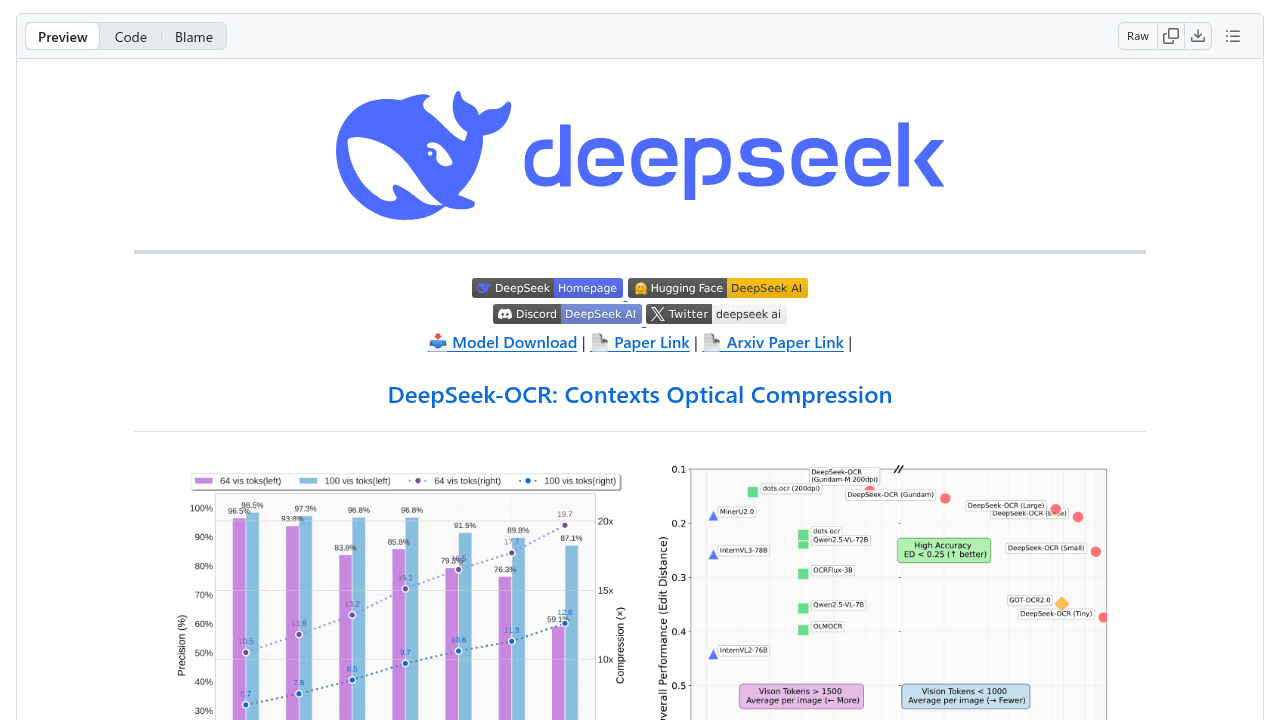
Processing 200,000 pages of documents for LLM training shouldn't require burning through your context window before you've analyzed a hundred. Feed a complex table or diagram to most vision models, and it explodes into hundreds—sometimes thousands—of vision tokens. DeepSeek-OCR compresses those images by 10x while maintaining 97% OCR accuracy, turning what was a bottleneck into something usable for ML practitioners working with document-heavy pipelines.
The Vision Token Bottleneck
A single high-resolution document image can consume 576 tokens in a standard vision encoder. Multiply that across a training dataset or a long-form document understanding task, and you're fighting your context window instead of your actual problem. Traditional OCR engines like Tesseract output raw text, but they strip away the layout information that LLMs need to understand tables, formulas, and spatial relationships. The compression challenge isn't just about shrinking files—it's about preserving document structure while keeping token budgets realistic for long-context workflows.
The Compression Architecture
DeepSeek-OCR uses a two-stage transformer approach that merges the SAM vision transformer with a CLIP-Large encoder, then applies convolutional compression layers. The architecture treats document understanding as a compression problem: how much spatial and semantic information can you retain while reducing the token footprint? At the default compression ratio, it processes layout-rich documents—tables, mathematical formulas, multilingual text—into 100 tokens instead of the 256 used by alternatives like GOT-OCR 2.0. Push it to 20x compression and you're still retaining 60% accuracy, enough for many training data generation scenarios where volume matters more than perfection.
Real-World Performance
A Rust implementation surfaced within weeks, offering CLI tools and an OpenAI-compatible HTTP server for local deployment across CPU, Apple Metal, and NVIDIA CUDA. The throughput: generating over 200,000 pages per day of LLM training data on a single A100 GPU. For ML engineers building document understanding pipelines, that's the difference between needing a cluster and running local experiments.
On standard benchmarks, DeepSeek-OCR outperforms GOT-OCR 2.0, Tesseract, and PaddleOCR on OmniDocBench while using fewer tokens per document. The speed advantage comes from the compression architecture—less data to move through the transformer means faster inference, which compounds when you're processing thousands of pages.
Where It Breaks
On a 600-image test set of historical newspapers, DeepSeek-OCR experienced 9.2% failures including loops and duplication despite guardrails. The failure mode is specific: degraded scans with inconsistent contrast and non-standard layouts push the model past its training distribution. Some users have noted CUDA errors and illegal memory access in vLLM 0.11.2, typical growing pains for a project scaling this quickly.
These limitations matter for sizing use cases. Modern documents with clean layouts work reliably. Archival material or heavily degraded scans need different tools—this is where Tesseract's pattern-matching approach or PaddleOCR's preprocessing pipeline might handle edge cases better.
Different Tools, Different Tradeoffs
GOT-OCR 2.0 prioritizes accuracy over token efficiency, using 256 tokens where DeepSeek-OCR uses 100. Tesseract and PaddleOCR optimize for raw text extraction without vision token concerns. Each tool made different engineering choices for different problems. If you're building a document search engine, raw text extraction works fine. If you're feeding thousands of documents into a long-context LLM for training or analysis, compression efficiency becomes the constraint that matters.
When Token Compression Matters
The 10x compression wins when context windows are your limiting factor—generating training data at scale, building document understanding agents that need to see dozens of pages simultaneously, or preprocessing pipelines where you'd rather compress once than re-OCR repeatedly. The 20x compression mode with 60% accuracy makes sense for training data generation where volume and diversity outweigh per-document perfection. For production document analysis where every character matters, the standard 97% accuracy mode or traditional OCR might be the right call. The engineering question is simple: how many tokens can you afford per document, and what accuracy do you need to keep?