Nano Banana Challenges OpenAI on Character Consistency
Nano Banana, built on Google's Gemini, solves a problem even well-funded competitors struggle with: keeping characters consistent across multiple generated images. Multiple research projects now build on its 150K dataset, and the GitHub repo has attracted 21K+ stars.
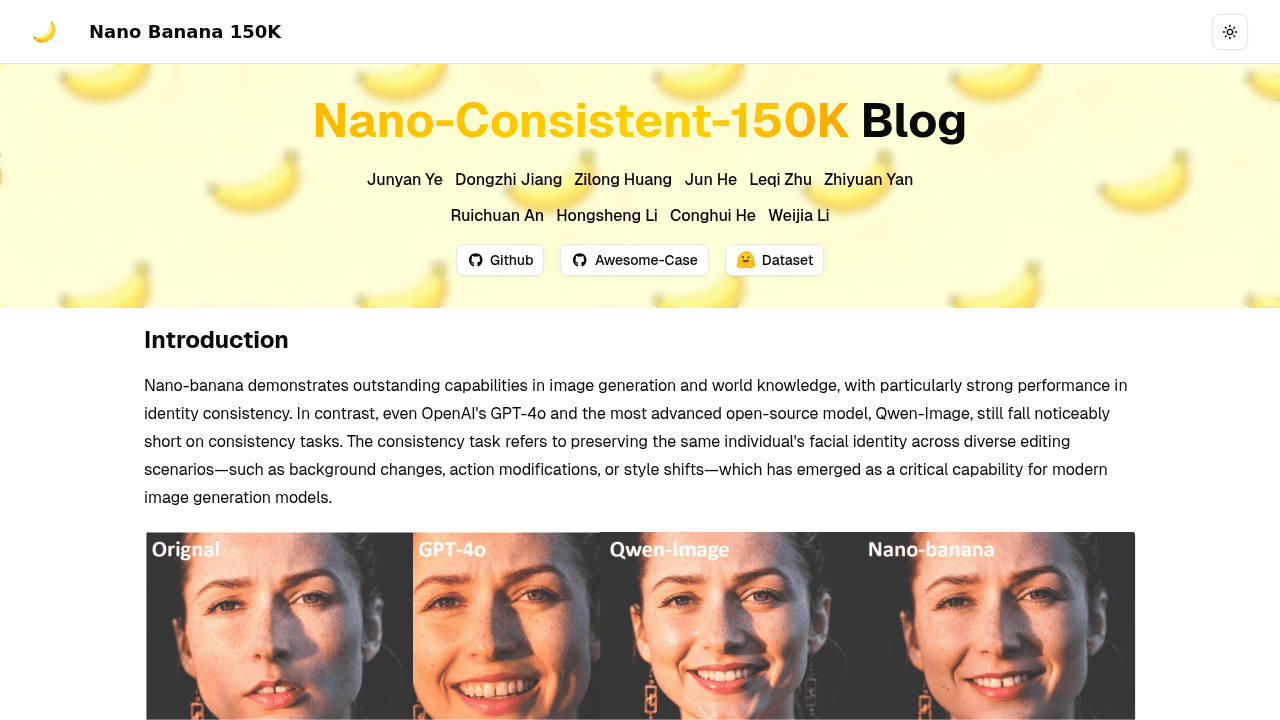
Character consistency remains one of image generation's hardest problems. Ask any AI model to create the same character across multiple images, and you'll get subtle drifts—different facial features, altered proportions, inconsistent details. Major players with big budgets still struggle here.
A community-built project called Nano Banana, built on Google's Gemini foundation, is addressing this head-on. The repository demonstrates its capabilities through the Nano-consistent-150K dataset, containing over 150,000 samples that preserve consistent human identity across complex editing scenarios. With 21,000+ GitHub stars and researchers already building downstream projects on top of it, the open-source effort shows what's possible when community innovation builds on big-tech infrastructure.
The Character Consistency Problem
Multi-image workflows demand the same character appear identically across scenes, poses, and contexts. Comics, storyboards, product mockups, research datasets—all require this reliability. Current generation models introduce small variations that compound across iterations. A character's eye shape changes. Proportions shift. Details that should remain fixed don't.
This isn't a niche concern. Research teams building datasets for training other models need consistent source material. Creators working on narrative projects need dependable character representation. The technical challenge involves maintaining identity embeddings while allowing flexibility in composition, pose, and environment.
What Makes Nano Banana Different
Built on Gemini's foundation, Nano Banana focuses on maintaining character consistency rather than trying to solve every image generation use case. The approach preserves identity across the 150,000-sample dataset, which speaks to both scale and quality control.
The project doesn't claim to replace established tools. It carves out a specific capability where consistency matters more than other factors. The dataset release matters as much as the tool itself—providing researchers with clean, consistent training data for downstream applications.
Real Research Projects Using It
Concrete adoption demonstrates practical value. The MICo-150K dataset project uses Nano-Banana to synthesize composite images for multi-image composition with identity consistency. The Echo-4o project references the Nano-consistent-150K dataset for samples. These aren't theoretical applications—researchers are building production datasets and training pipelines on top of Nano Banana's output.
The fact that multiple independent projects chose this tool for their data synthesis needs suggests it's solving a real pain point. Dataset quality directly impacts downstream model performance, so researchers don't make these choices lightly.
How It Compares to OpenAI and Others
Community perspectives suggest Nano Banana excels where competitors often warp details during iterations, particularly in maintaining consistent facial features and proportions. Some discussions position it as leading state-of-the-art models in adherence to character consistency requirements.
These comparisons represent one perspective rather than definitive benchmarks. Different tools optimize for different strengths. OpenAI's offerings handle broader use cases and scale across diverse requirements. Nano Banana specializes in this specific consistency problem. Both approaches have merit depending on workflow needs.
Growing Pains at Scale
Popular open-source projects encounter edge cases. Users have noted that certain examples in the repository don't work as expected. A reported issue involved content that was removed, as noted in community discussions. With over 21,000 stars and active usage across research projects, some rough edges are expected rather than concerning.
Every widely-adopted tool hits these moments. The active issue tracking and community engagement suggest normal project maturation rather than fundamental problems.
What This Means for the Field
Nano Banana demonstrates how open-source innovation can build on big-tech foundations to create specialized solutions. Google provides the Gemini infrastructure; the community builds targeted capabilities on top. This layered approach benefits everyone working on these problems.
Competition in character consistency pushes all players to improve. OpenAI, Google, and community projects each bring different strengths. Researchers gain more options for their specific needs. The 150,000-sample dataset alone represents a significant contribution to the broader field, enabling work that depends on consistent training data.
The project adds to the landscape rather than replacing existing tools—and that's exactly what healthy technical communities need.
PicoTrex/Awesome-Nano-Banana-images
A curated collection of fun and creative examples generated with Nano Banana & Nano Banana Pro🍌, Gemini-2.5-flash-image based model. We also release Nano-consistent-150K openly to support the community's development of image generation and unified models(click to website to see our blog)