CLI-Anything: Making Desktop Software Agent-Native
GUI automation is fragile, APIs don't cover professional features, and naively editing project files fails when effects render at runtime. CLI-Anything solves the 'rendering gap' by generating CLIs that call real software backends—Blender for rendering, LibreOffice for exports—instead of reimplementing features or scraping pixels.
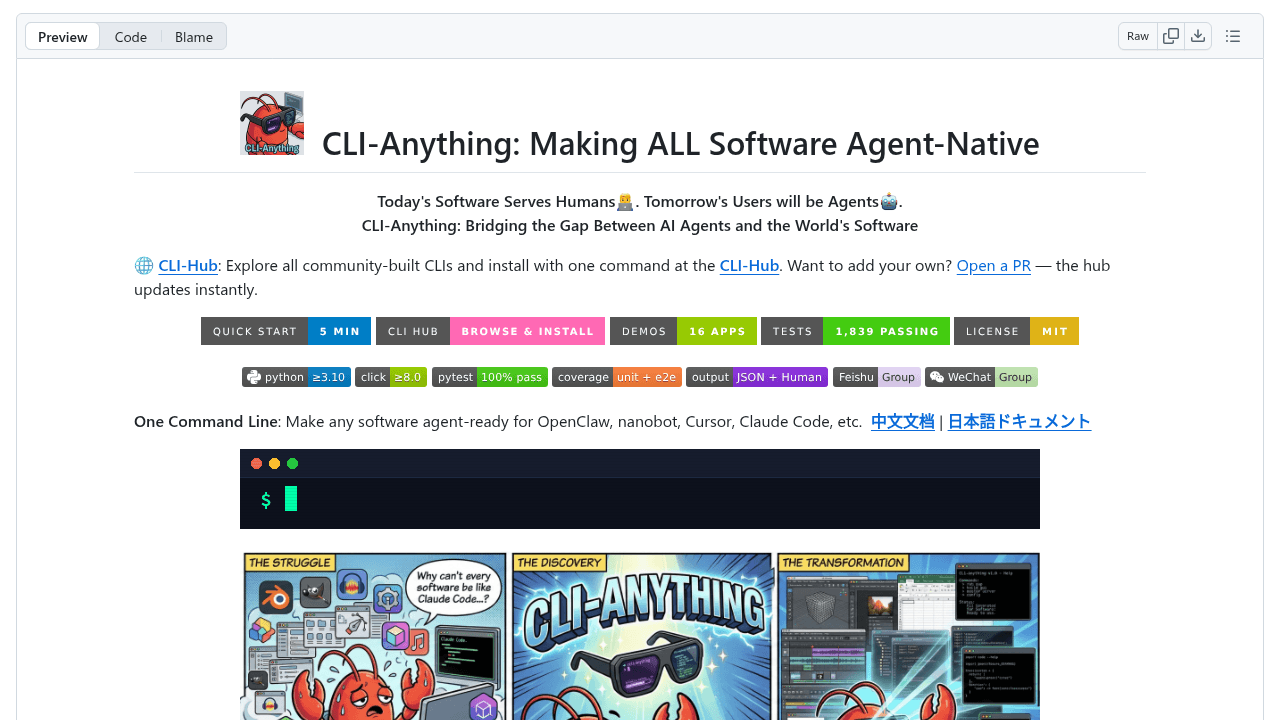
Your AI agent can parse PDFs but can't export one from LibreOffice. It can generate images but can't render a Blender scene. GUI automation breaks on theme updates. APIs don't exist for half the features you need. CLI-Anything bridges the gap by calling real software backends—24K+ stars in weeks suggests this problem is bigger than we thought.
The Rendering Gap: Why GUI Automation and File Manipulation Both Fail
Desktop software has three automation approaches, and each one breaks somewhere. GUI automation tools fail when developers change button colors or rearrange menus. APIs, where they exist, expose only common operations and ignore professional features. The third option—directly editing project files—looks promising until you hit what the CLI-Anything team calls the "rendering gap".
When you open a .blend file and modify vertex coordinates, those changes mean nothing until Blender's render engine processes them. Effects, transformations, and exports all happen at render time through the software's backend. An agent that edits the file directly never invokes that engine, producing either broken output or none at all. The pattern repeats across video editors applying transitions, audio tools processing effects, or office suites generating PDFs.
Calling Real Backends Instead of Faking Features
CLI-Anything generates command-line interfaces that invoke the actual software engines. For Blender, that means calling the same render pipeline a user triggers through the GUI. For LibreOffice, it means accessing the real PDF export functionality. For Kdenlive, it means using the actual video encoding backend.
This preserves the full capability of these tools. A solution that reimplements "export to PDF" from scratch will miss edge cases, font rendering quirks, and format compatibility that LibreOffice spent years refining. By wrapping the real backend, CLI-Anything lets agents access decades of software maturity without requiring anyone to rewrite it.
Demo Applications: GIMP, Audacity, Kdenlive in Practice
The difference shows up clearly in the demo suite. CLI-Anything has been demonstrated on GIMP, Blender, Inkscape, Audacity, Kdenlive, Shotcut, OBS Studio, Draw.io, LibreOffice, AnyGen, and Zoom.
Take Audacity: GUI automation would require an agent to locate the effects menu, navigate nested dialogs, and parse visual feedback—breaking whenever the UI changes. Directly editing an Audacity project file can modify clip positions, but applying reverb or compression requires the audio processing engine. CLI-Anything generates an interface that calls Audacity's backend with structured parameters, returning processed audio.
For video work in Kdenlive, the same principle applies. Transitions and color grading need the rendering pipeline. The generated CLI lets an agent specify those operations as typed commands, then invoke Kdenlive's backend to produce the final output.
Integration with AI Agent Frameworks
The generated CLIs plug into existing agent infrastructure without custom adapters. Integration works with Claude Code, OpenClaw, OpenCode, Codex, and Qodercli—agents identify when they need desktop tool capability, call the CLI-Anything interface with structured parameters, and receive structured output.
The discussion on HackerNews and rapid GitHub adoption reflect a specific developer pain point: teams building agents hit a wall when they need professional software features that aren't web-accessible. API coverage stops at basic operations, and GUI automation can't handle complex workflows.
Academic Team Solving Production Problems
CLI-Anything comes from HKUDS, the Data Intelligence Lab at Hong Kong University, which might initially suggest research-focused work with limited production applicability. The team's 83 public repositories span various research areas. But the breadth of demonstrated applications—eleven different tools with working integrations across multiple agent frameworks—suggests this isn't purely academic exploration.
The approach bridges two paradigms that haven't talked much: legacy GUI software designed for human interaction, and modern agent infrastructure expecting programmatic interfaces. Rather than criticizing professional tools for not being agent-friendly from the start, CLI-Anything retrofits them without requiring upstream changes or feature reimplementation. For developers who've struggled with this gap, that's worth paying attention to.
HKUDS/CLI-Anything
"CLI-Anything: Making ALL Software Agent-Native" -- CLI-Hub: https://clianything.cc/