Anthropic's Prompt Engineering Bootcamp: 26K Stars
Most engineers waste API credits on trial-and-error prompting. Anthropic's interactive bootcamp treats prompt engineering as a learnable skill with systematic techniques to eliminate hallucinations and inconsistent outputs. Available as Jupyter notebooks, Google Sheets, and AWS workshops—it starts with Claude Haiku to prove that good prompting works even on the smallest models.
Your LLM returns different answers to the same question. It hallucinates product details. It ignores half your instructions. You've burned through API credits trying every variation of "be more specific" and "think step by step."
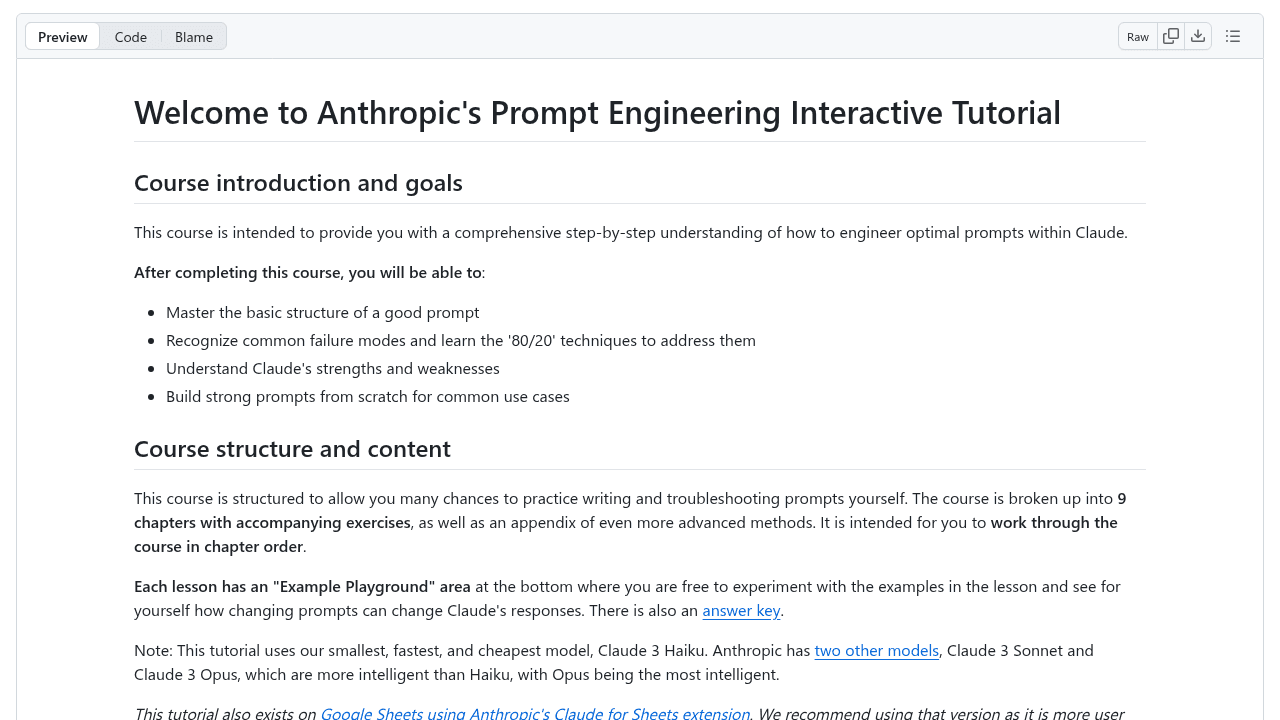
Anthropic built an interactive prompt engineering course that treats this problem as an engineering discipline, not trial-and-error guesswork. The repository has attracted 26.3k stars from developers implementing LLMs in production who need consistent outputs.
Why Your Prompts Fail
Most engineers approach prompts like search queries—throw words at the model, check the output, try again. This works for casual ChatGPT use. It falls apart when you're building a customer service bot that needs to follow compliance rules, or a code reviewer that must catch security issues without flagging false positives.
The failure modes compound: vague responses that require human review, hallucinated details that slip into production, inconsistent formatting that breaks downstream parsing. Each iteration costs API credits. Each bug costs user trust.
Interactive, Not Documentation
Anthropic structures this as a workshop, not a reference guide. The course is available in three formats: Jupyter notebooks for local experimentation, Google Sheets with the Claude for Sheets extension for non-coders, and an AWS Workshop version for enterprise teams.
You write prompts, test them against edge cases, and iterate based on actual model responses. The curriculum walks through structured instructions, few-shot examples, output formatting constraints, and handling ambiguous inputs—the techniques that separate guessing from engineering.
The Haiku Approach: Engineering on the Smallest Model
Here's the controversial part: the course uses Claude 3 Haiku, Anthropic's smallest and cheapest model. Critics note this doesn't showcase the capabilities of larger models. That misses the point.
If your prompts work on Haiku, they'll work better on Sonnet or Opus. You're learning techniques that don't rely on raw model intelligence to compensate for sloppy instructions. It's the difference between writing code that only runs on the latest hardware versus code that runs anywhere.
The discipline matters. Production systems need prompts that work reliably, not prompts that work when the model happens to guess your intent.
The 'Will Prompt Engineering Die?' Debate
Some developers argue that as models improve, prompt engineering becomes less necessary. Future models might handle vague instructions perfectly. This bootcamp might teach obsolete skills.
The pragmatic counter: enterprises are deploying LLMs now. Those systems need to work today, with current models, under real constraints. Systematic approaches reduce failure modes in production. Whether prompt engineering remains critical in five years doesn't change the necessity of engineering reliable outputs this quarter.
How It Compares to OpenAI and Google Resources
OpenAI offers documentation and a prompt library. Google provides Gemini resources. Anthropic's tutorial is more hands-on than alternatives focused primarily on documentation.
The difference is practice. You're not reading about techniques—you're applying them, seeing where they break, and learning why certain patterns work better than others.
When This Course Makes Sense (And When It Doesn't)
This bootcamp targets engineers implementing LLMs in production systems where consistent outputs matter. If you're building AI features for users, handling structured data extraction, or automating workflows with language models, the systematic approach directly addresses your problems.
It's not designed for casual ChatGPT users who want better conversation tips, or researchers building custom models who need to understand attention mechanisms. The value is in production reliability, not exploring model capabilities.
Access the course through GitHub, Google Sheets, or AWS. No waitlist, no credit card. Just prompts that work.
anthropics/prompt-eng-interactive-tutorial
Anthropic's Interactive Prompt Engineering Tutorial