LightRAG vs GraphRAG: Solving the 610K Token Problem
GraphRAG's architectural complexity creates scalability walls at 50K+ documents—multi-day ingestion, API saturation, and 610K token retrieval costs. LightRAG uses dual-level graph retrieval to cut tokens by 99%, speed updates by 50%, and maintain an 84.8% win rate on complex queries without the operational nightmares.
GraphRAG's entity graphs looked promising until production teams started feeding them real workloads. NashTech engineers hit a wall trying to ingest 50,000 PDFs—what should have taken hours stretched into days as embedding API calls saturated, tracking.json write locks queued up, and CPU utilization stayed low. The architecture that made GraphRAG powerful created operational problems at scale.
The token economics tell the story. GraphRAG's retrieval phase consumes 610,000 tokens per query, which works for research demos but breaks budgets in production. LightRAG's dual-level retrieval cuts that to under 100 tokens while maintaining an 84.8% win rate on legal queries.
The GraphRAG Scalability Wall
The breakdowns follow a pattern. Enterprise teams start with GraphRAG's knowledge graphs, then hit reality when ingestion jobs stretch across weekends. GitHub issue #1648 documents the typical cascade: API rate limits trigger retries, write locks serialize updates that should parallelize, and the system grinds forward at a fraction of available compute capacity.
Issue #2264 reveals another pressure point—initialization bottlenecks where concurrency limits force sequential processing even when direct vLLM calls would handle parallelism. These aren't implementation bugs; they're architectural consequences of maintaining GraphRAG's entity relationships.
How LightRAG's Dual-Level Retrieval Changes the Economics
LightRAG uses a two-tier graph structure: low-level nodes capture specific entities while high-level clusters aggregate thematic relationships. This simpler graph integration sidesteps the combinatorial explosion that makes GraphRAG thorough but expensive.
The performance gains compound. Queries run 20-30 milliseconds faster, update operations complete in half the time, and incremental indexing works without rebuilding entire graphs. The token reduction—from 610K to sub-100—transforms cost models for teams running thousands of queries daily.
Where LightRAG Still Struggles
The engineering tradeoffs cut both ways. Initialization remains slower than direct vLLM because concurrency constraints force sequential processing during setup. Batch ingestion still hits API saturation, though the breakpoint arrives later than with GraphRAG. CPU utilization issues persist at extreme scale.
These limitations matter for specific use cases. Research contexts with larger budgets and deep reasoning requirements might justify GraphRAG's approach. The simpler graph structure means LightRAG occasionally misses entity connections that more exhaustive graphs would capture.
Production Validation: Legal Dataset and NashTech's BonBon
Real deployments provide the stress test. NashTech integrated LightRAG into their BonBon platform for enterprise compliance and operations, choosing graph-based RAG for entity relationship queries. FastAPI teams built distributed architectures using Ray to handle document ingestion at scale.
The EMNLP 2025 acceptance validates the core thesis: simple and fast beats thorough for most production scenarios. The academic benchmark shows LightRAG matching or exceeding GraphRAG's comprehensiveness while delivering better operational characteristics.
Choosing Between GraphRAG and LightRAG
The decision framework maps to organizational constraints. Teams with cost sensitivities, tight production timelines, or frequent incremental updates will find LightRAG's tradeoffs favorable. The 27,000 GitHub stars in five months and rapid feature velocity—multimodal support, citation tracking, Postgres integration—signal where the engineering community is committing time.
GraphRAG has advantages where depth justifies expense. The question isn't which system is better, but which operational profile matches your production reality.
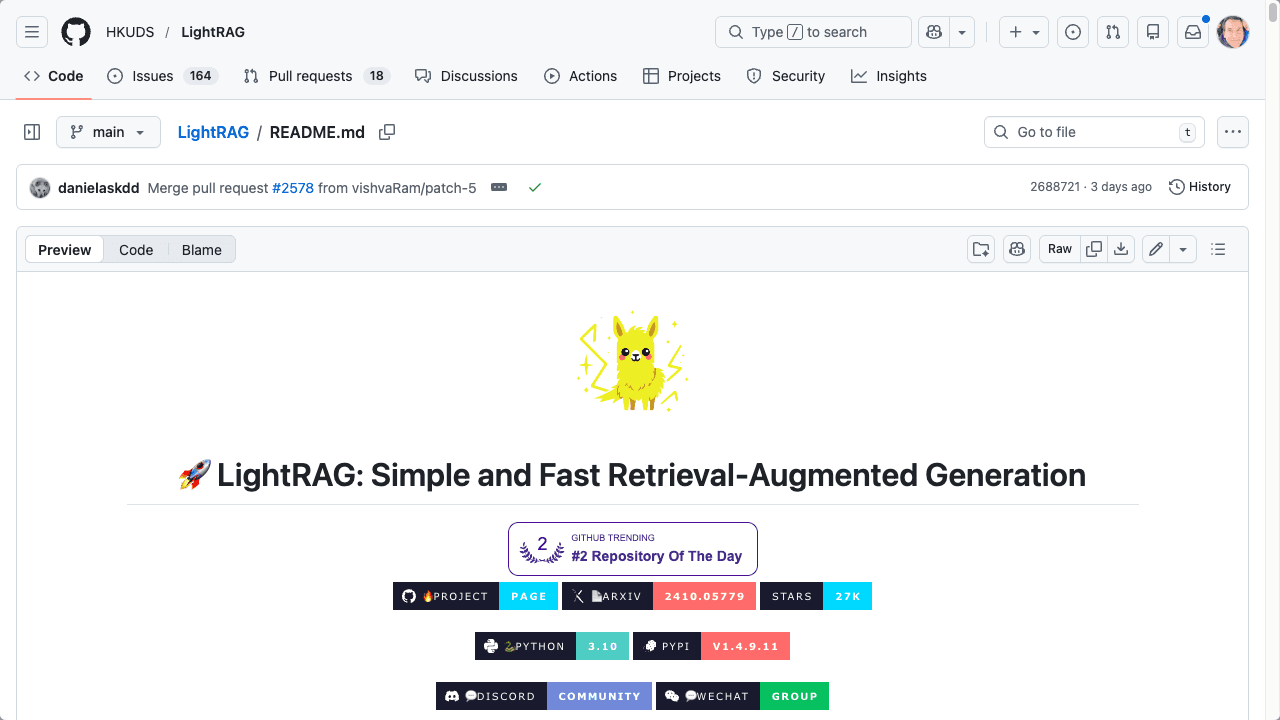
HKUDS/LightRAG
[EMNLP2025] "LightRAG: Simple and Fast Retrieval-Augmented Generation"