Agent-Reach: Web Access for AI Without the Integration Tax
Building AI agents that read the internet means wrestling with API limits, authentication, and anti-bot measures across Twitter, Reddit, YouTube, and dozens of other platforms. Agent-Reach provides a unified CLI that routes requests through multiple backends with capability-based fallbacks, turning platform chaos into a single interface.
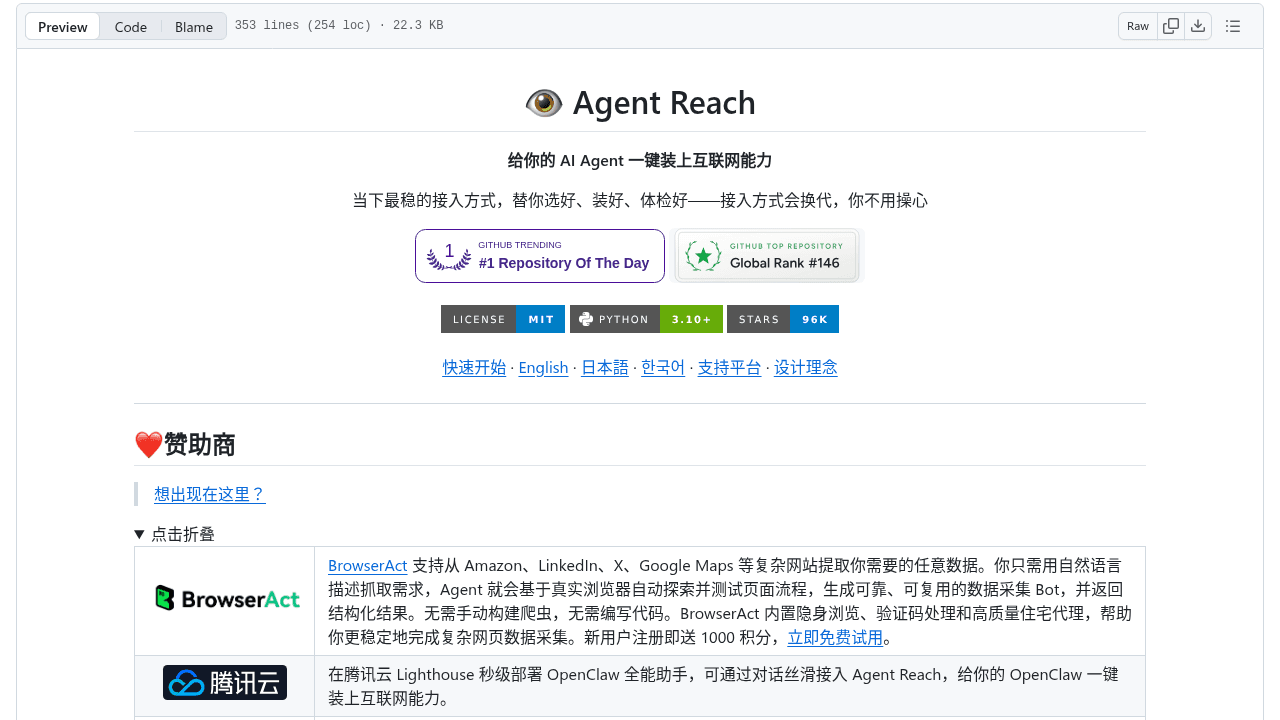
Your AI agent can parse legal documents, write SQL queries, and reason through multi-step problems. But ask it to fetch a Reddit thread or scrape a YouTube transcript, and you're suddenly deep in API documentation, authentication flows, and rate-limit headers—separately for every platform.
Agent-Reach attacks this problem with a CLI that routes requests across multiple backends. Instead of wiring up Twitter's API, then Reddit's, then GitHub's, then Bilibili's authentication system, you call one interface. The system checks which backends can handle each platform, tries the preferred option, and falls back when one hits a wall.
The Integration Tax Nobody Talks About
Each platform imposes its own friction: Twitter requires OAuth, Reddit rate-limits aggressively, YouTube serves messy HTML, XiaoHongShu blocks non-browser requests, GitHub throttles unauthenticated calls. Building an agent that reads across these sources means solving authentication, parsing, and anti-bot evasion dozens of times over—or paying API fees that scale with every request.
The alternative has been single-purpose tools that excel at one thing. Jina Reader cleans HTML. Firecrawl handles JavaScript-heavy sites. OpenCLI automates browser sessions. Stitching them together means writing your own routing logic, handling each tool's failure modes, and maintaining integration code that drifts as upstream APIs change.
One CLI, Multiple Backends, Runtime Routing
Agent-Reach routes each platform through an ordered list of backends, selecting the first one that passes a capability check—not just a config flag, but a real test of whether that backend can currently handle the request. When Jina Reader times out, it tries Firecrawl. When OpenCLI's browser session expires, it falls back to direct HTTP.
Most wrapper libraries route to a single backend and fail loudly. Agent-Reach treats backends as interchangeable resources with different strengths: some handle authentication better, others bypass bot detection more reliably, others return cleaner output. The system learns which combinations work and degrades when they don't.
A Crowded Problem Space
Hacker News commenters compared the project to Exa, SearXNG, and Scrapling—validation that this pain point has spawned multiple solutions. One developer mentioned that Claude Code now selects Exa over standard web search for certain queries. Another reported Agent-Reach didn't work for their use case but appreciated the attempt.
That diversity of approaches makes sense. Exa optimizes for semantic search with LLM-friendly output. SearXNG aggregates search engines with privacy focus. Scrapling excels at JavaScript rendering. Agent-Reach differentiates by treating backend selection as a runtime decision rather than a configuration choice, routing based on what's working right now.
Growing Pains in Complex Integration
Managing dozens of backends surfaces predictable friction. Issue #732 reports that agent-reach doctor --json can hang indefinitely, with four workers blocked for 43 minutes before manual termination. Issue #740 describes false disconnection reports with OpenCLI—the system claims all Chrome profiles are offline even when OpenCLI shows them connected and commands execute.
The web channel can report Jina Reader as available without testing network reachability, producing false-positive health checks when r.jina.ai is unreachable. YouTube subtitle handling doesn't distinguish -orig tracks, sometimes selecting machine-translated captions instead of the speaker's original language.
These are integration-layer problems. When you're orchestrating tools that each have their own failure modes, edge cases multiply. The reported issues read like a debugging log from a system under real-world load—which is what you want from an open-source tool gaining traction.
When You'll Feel This Pain
If you're building agents with Claude, Cursor, or similar AI coding assistants, you've hit this wall: the LLM generates code to analyze data from five platforms, then you spend two days wiring up authentication and parsing. Content aggregators, research agents, and monitoring tools all share this burden.
The project's 96,000 stars suggest the problem resonates. That's not surprising—every developer who's built "just fetch this Reddit thread" into an agent has discovered it's never one platform, and platform access is never simple. Agent-Reach doesn't eliminate that complexity, but it centralizes it behind one interface where the community can share the integration tax.
Panniantong/Agent-Reach
Give your AI agent eyes to see the entire internet. Read & search Twitter, Reddit, YouTube, GitHub, Bilibili, XiaoHongShu — one CLI, zero API fees.