AI Agents Generate Beautiful Diagrams. Are They Accurate?
AI-generated architecture diagrams look convincing but frequently diverge from the actual codebase. Archify tackles this trust problem by requiring typed JSON intermediates and validation before rendering, ensuring diagrams stay anchored to real code, tests, and traces rather than hallucinated architecture.
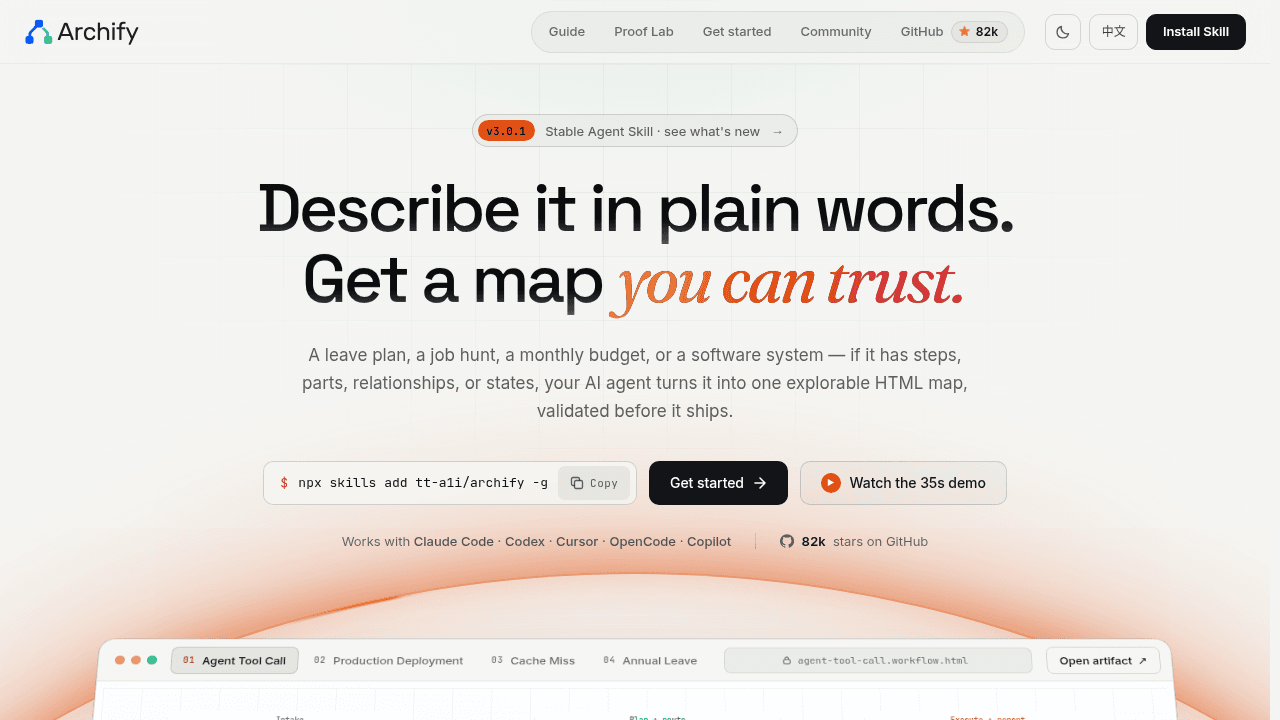
Your AI coding agent just produced a stunning architecture diagram. Clean boxes, elegant arrows, professional layout—it looks like something a senior architect spent hours refining. The database connection it shows doesn't exist in your codebase. That message queue it confidently illustrates was deprecated three sprints ago.
As AI agents become standard development tools, documentation artifacts must be grounded in actual code, tests, or execution traces—not plausible descriptions. Archify tackles this by requiring verification before rendering.
The Agent Documentation Trust Problem
Agents can draw diagrams. The problem is distinguishing between what should exist and what does exist. Traditional diagram tools assume a human author who understands the system. Agent-generated artifacts don't carry that assumption.
When these diagrams make it into documentation, technical debt reviews, or architecture decision records, inaccuracies compound. Engineering leads review them. Product managers reference them. New hires study them. The diagrams become canonical—whether they're accurate or not.
How Archify Grounds Diagrams in Reality
Archify's approach: require typed JSON intermediates and validation before generating the final artifact. Agents can't skip straight to a diagram. They must first produce structured data that anchors each component, connection, and layer to verifiable evidence.
This creates a checkpoint. The JSON schema enforces consistency—nodes must declare their relationships, data flows need explicit sources and destinations, deployment layers require concrete boundaries. If an agent hallucinates a component, it must also hallucinate supporting JSON that passes validation. The barrier is higher.
The approach mirrors how code review catches logic errors that pass syntax checks. You're not just asking "does this render?" but "does this match reality?"
The Cognitive Load Tradeoff
Early versions required agents to specify precise coordinates, positions, and exact field shapes across all five diagram modes, imposing high cognitive load and triggering JSON syntax errors. The project has since adjusted, but the tension remains. Verification layers add friction. Developers must decide whether that friction is worthwhile for their use case. For exploratory sketches during early design phases, maybe not. For documentation that guides production deployments? Probably yes.
Archify vs. Mermaid, D2, and Traditional Tools
Archify occupies a specific niche in the diagram tooling landscape. Mermaid optimizes for Markdown rendering, D2 for DSL-based generation, and Structurizr/C4 for maintaining architectural models across multiple views. Each serves different priorities.
Archify positions itself as an agent-driven communication artifact rather than a general-purpose editor or theming layer. Where Mermaid excels at human-authored diagrams embedded in documentation, Archify targets machine-generated artifacts that need verification before delivery.
The tools aren't competing—they're addressing different points in the workflow.
Integration Across Agent Environments
Installation paths exist for Cursor, Claude Code, Codex CLI, OpenCode, and GitHub Copilot, with dedicated DeepSeek Harness integration distributed as @tt-a1i/archify-dsh. Teams are using this in production workflows.
Open Questions and Active Development
With 93 pull requests, 103 discussions, and a recent 3.0.1 release adding update reminders, the project is moving. Open issues remain: rendering defects affect anti-parallel labeled connections, and platform-specific problems surface on Windows and macOS. These are typical growing pains for a project scaling quickly—areas to watch as the tool matures.
The broader question is whether verification layers become standard practice as agents generate more technical artifacts. Archify's bet: when machines produce documentation, humans need evidence it's grounded in truth.
tt-a1i/archify
Turn any idea, plan, or codebase into a beautiful interactive diagram. An agent skill for Claude Code, Codex, and more.