Void: The Open-Source AI Editor That Runs on Your Terms
Cursor and GitHub Copilot proved developers want AI in their editors. Void proves they don't want to sacrifice control to get it. Built by open-source believers who saw the trade-off between powerful tooling and data ownership, Void offers local-first architecture, model flexibility, and the transparency that 28,000 GitHub stars suggest the community was waiting for.
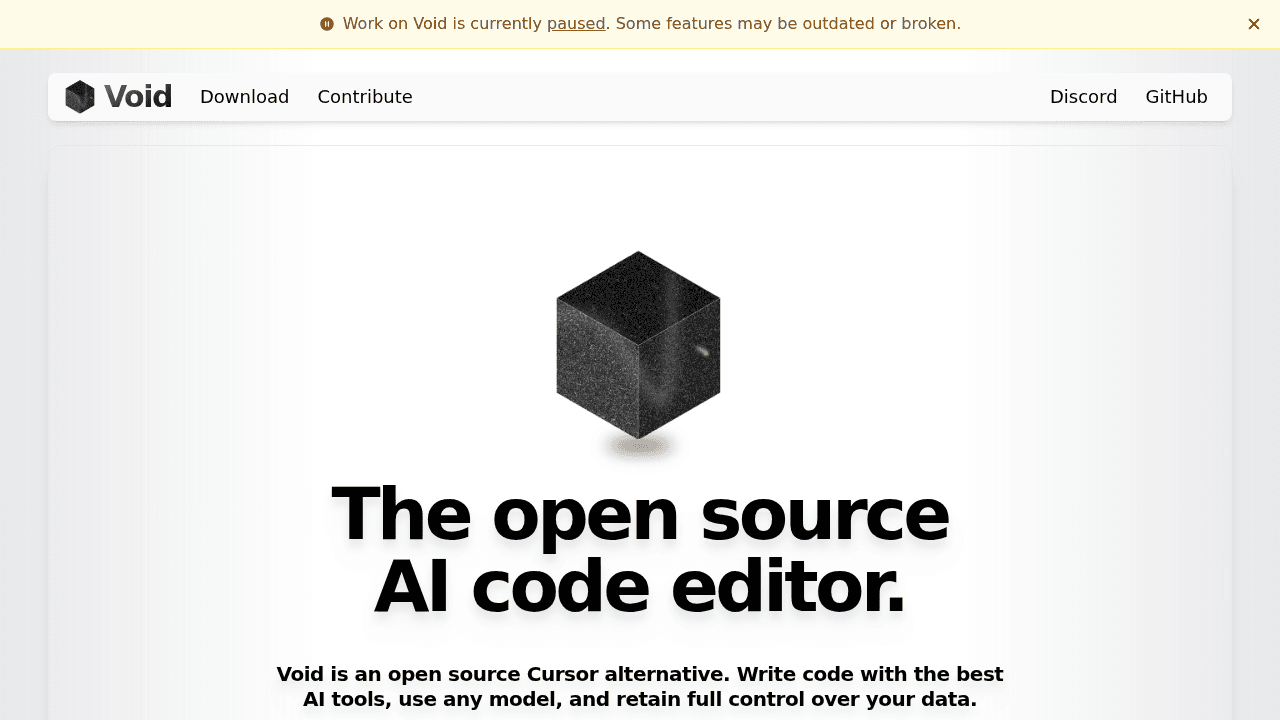
Cursor and GitHub Copilot proved developers want AI in their editors. But proving the market also revealed its cost: to get AI tooling, you had to accept proprietary infrastructure, cloud-dependent workflows, and someone else's rules about your code.
Void is the answer to a question the established players didn't ask—what if you could have both?
The Trade-Off Nobody Wanted to Make
Cursor and GitHub Copilot deserve credit for making AI code editing mainstream. They're well-funded products built by teams who understood what developers needed before most of us knew we needed it. But their architecture comes with constraints: your prompts run through their servers, your data flows through their APIs, and your workflow depends on their infrastructure staying available and affordable.
For many developers, that's fine. For others—those working on proprietary codebases, privacy-sensitive projects, or who refuse vendor lock-in on principle—it's a dealbreaker they've been forced to accept.
Until now.
What Void Solves
Void's technical philosophy is straightforward: prompt building and message handling logic run on your machine, not theirs. You can self-host models locally through Ollama and LM Studio, or connect directly to providers like OpenAI, Anthropic, and Google—but the middleman API layer disappears.
This isn't privacy theater. As a HackerNews commenter explained: Void lets users "self-host models locally or connect directly to foundational models without sending data through a middleman API." Your code never leaves your infrastructure unless you explicitly choose a cloud provider. Even then, you're dealing directly with that provider, not routing through Void's servers.
The open-source model flexibility means switching between Claude, GPT-4, or a local Llama variant is a settings change, not a subscription tier decision.
The Beta Reality Check
Void crashes occasionally with complex projects, though the maintainers respond quickly when issues surface. This isn't a polished product competing dollar-for-dollar with well-capitalized teams. It's an open alternative in active beta, built by developers who saw a gap and chose to fill it.
If you need production-grade stability today, Cursor is probably still your answer. If you need control over your data and infrastructure today, Void might be your only answer.
Who This Editor Is For
Not everyone. And that's the point.
Void is for developers who value transparency over polish, who need to self-host for compliance reasons, or who refuse on principle to let their editor become another walled garden. It's for teams working on proprietary code who can't justify sending context snippets to a third-party API, even encrypted. It's for the privacy-conscious who see "cloud-first" as a compromise, not a feature.
The fact that Void is open-source while Cursor and Copilot are closed matters to this audience in ways download counts will never capture. Some developers need this option to exist, even if most are fine with the alternatives.
The 28,000-Star Validation
GitHub stars aren't a perfect metric, but 28,000 of them suggest Void filled a gap rather than created noise. The recent beta release added checkpoints, Agent mode for OSS models, auto-updates, and Linux support—features that show development aligned with what the community uses.
The momentum isn't about displacing Cursor. It's validation that enough developers wanted an open alternative badly enough to tolerate beta-level stability in exchange for control.
Respecting Both Paths
Cursor and GitHub Copilot made AI editing possible for millions of developers. Void is making sure those developers aren't forced into proprietary infrastructure to access it. Both deserve to exist.
One path optimizes for features, funding, and frictionless onboarding. The other optimizes for transparency, control, and escaping the walled gardens. Neither is better—they serve different values, and developers shouldn't have to sacrifice one to get the other.
The fact that you can now choose says something about what open source still means.