Voicebox: Local Voice Cloning That Rivals ElevenLabs
Spacedrive creator Jamie Pine shipped Voicebox, a desktop app that clones voices and handles dictation entirely offline. It bundles seven TTS engines, supports 23 languages, and persists voice profiles across sessions—matching enterprise voice tools without the cloud dependency or recurring costs.
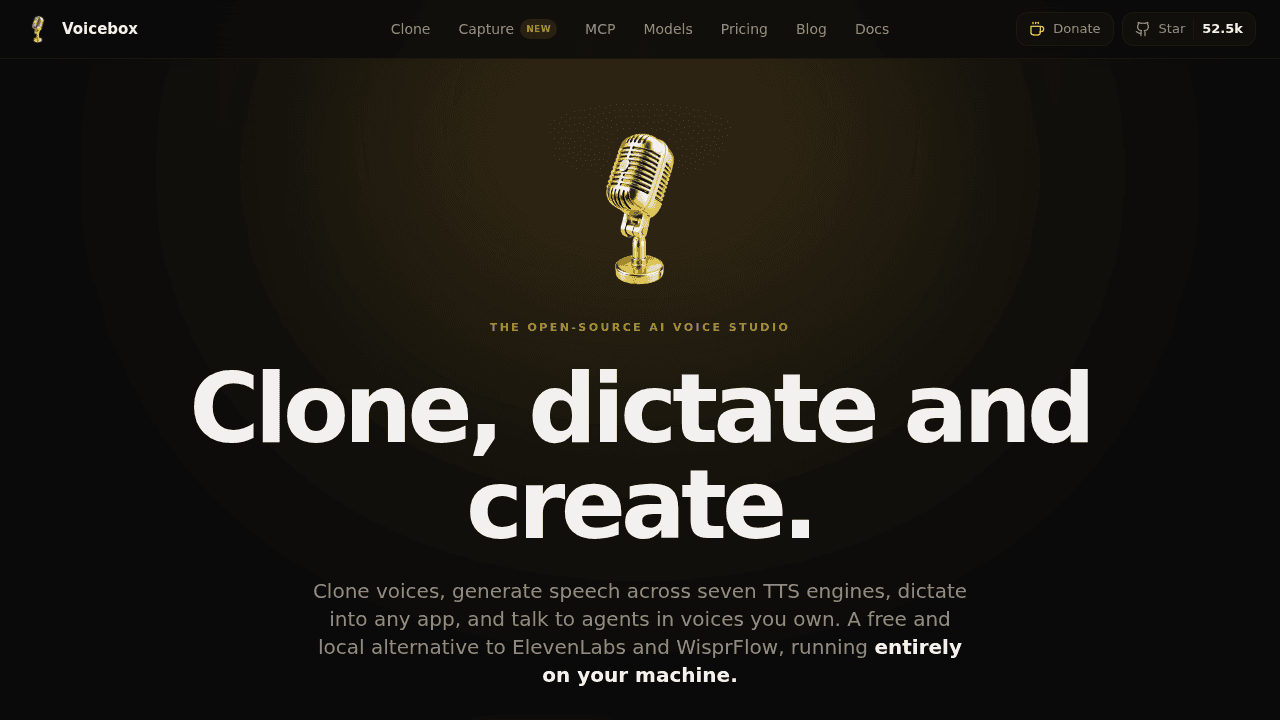
Jamie Pine ships Spacedrive file managers. Now he's shipping voices—cloned from seconds of audio, synthesized across seven TTS engines, and running on your machine.
Voicebox is a desktop app that does what ElevenLabs does for output and WisprFlow does for input, but local. No cloud dependency, subscription cost, or internet requirement. Clone a voice, hit a global hotkey to dictate, and your profile persists across sessions. No re-recording every time you restart.
What Voicebox Does
The problem Pine saw: cloud-dependent voice workflows create friction for privacy, cost, and offline use. Open TTS solutions forced users to re-clone voices every session—a frustrating loop for anyone building workflows around synthetic speech. Voicebox solves this by treating voice profiles as persistent assets.
The app handles voice cloning from short audio samples, dictation via hotkey, and REST API access for automation. Pine calls it "Ollama for voice"—a local inference runtime that works without wrangling dependencies or configuring cloud credentials.
The Technical Stack: 7 Engines, 23 Languages, One App
Voicebox bundles seven TTS engines and supports 23 languages, with voice cloning, dictation, and REST API capabilities—all packaged for desktop deployment. Each engine has its own quirks, dependencies, and performance characteristics. Pine wrapped them in a unified interface that abstracts the complexity.
The REST API means Voicebox can slot into existing toolchains. Pinokio's launcher project treats it as a backend service at localhost:17493, and Pinggy published a self-hosting guide for tunneling the API to remote workflows. This isn't just a GitHub star collector—it's infrastructure.
How It Compares: ElevenLabs, WisprFlow, and VoiceStudio
ElevenLabs and WisprFlow are solid services. They offer convenience, scale, and enterprise-grade reliability. Voicebox offers different trade-offs: privacy (your audio never leaves your machine), cost control (no per-character billing), and offline access (no internet required).
VoiceStudio occupies the same category—a local desktop voice AI studio with cloning, dubbing, dictation, and transcription. Both tools validate growing demand for on-device voice processing. Where VoiceStudio leans into dubbing workflows, Voicebox emphasizes persistent profiles and multi-engine flexibility.
The choice isn't one or the other. Cloud services optimize for reach and polish. Local tools optimize for ownership and control. Voicebox expands the menu for creators who want the latter.
Adoption: From Pinokio to Pinggy
The official site lists users including creators, podcasters, voice artists, writers, developers, and accessibility communities. Third-party integration happened fast: Pinokio added Voicebox as a REST backend within weeks of launch, and Pinggy's self-hosting guide demonstrates demand for tunneling local instances to remote clients.
With 15 open issues including Windows compatibility, the project is working through growing pains—typical for a repo growing this fast. But the infrastructure hooks are already in place, and the user base spans content creation and accessibility use cases.
Who Jamie Pine Is
Pine built Spacedrive, the file manager with 52K stars, establishing credibility in systems tooling and local-first philosophy. Voicebox applies the same principles to voice AI: own your data, run your stack, avoid vendor lock-in.
Local-first isn't just about file systems. It's about reclaiming control over every layer of the stack, including the models that synthesize your voice.
What This Signals for Local-First AI
Voicebox joins Ollama (LLMs) and VoiceStudio (voice) in a category that's no longer experimental. Third-party infrastructure integration validates demand for privacy-first, offline-capable AI tools. Developers and creators who prioritize ownership over convenience now have options that didn't exist two years ago.
The cloud still wins for most use cases. But for users who need privacy, cost predictability, or offline access, the local-first stack is ready.
jamiepine/voicebox
The open-source AI voice studio. Clone, dictate, create.