The 2,100-Skill Library Teaching AI Agents How to Code
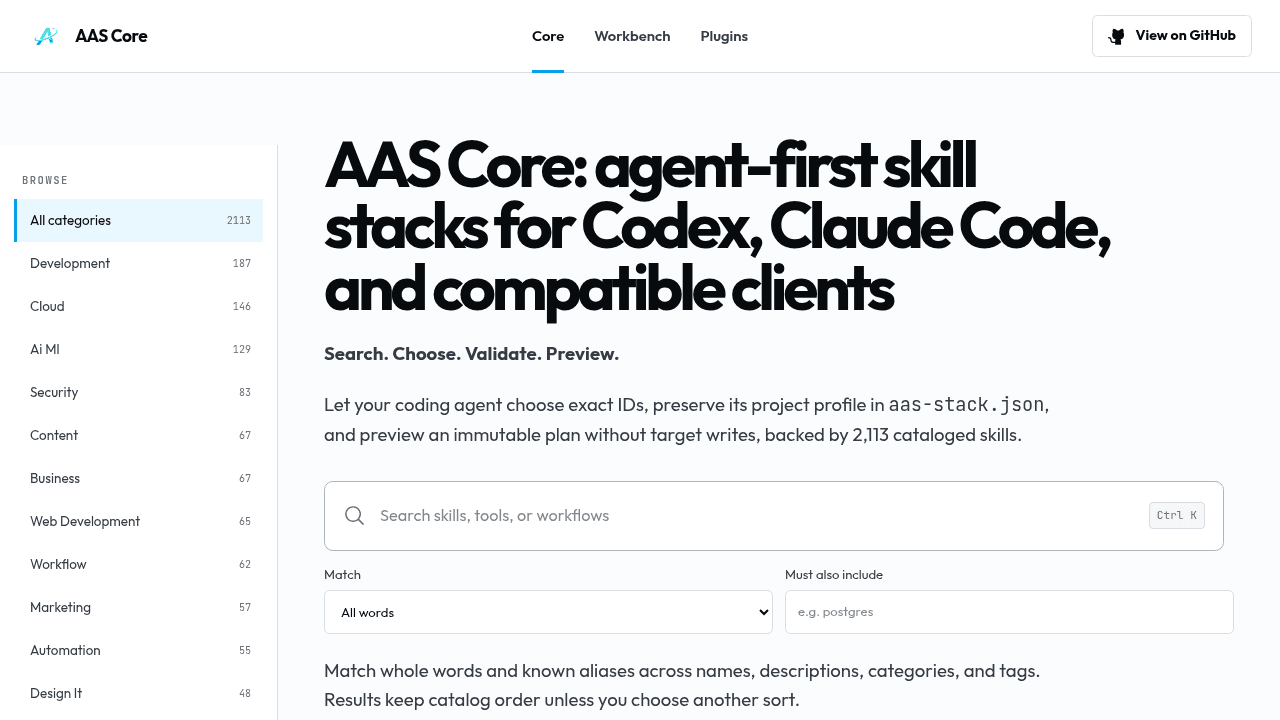
AI coding agents have raw capability but no structured operational memory. AAS Core fills that gap with a standardized catalog of 2,100+ SKILL.md playbooks that agents can load on demand—unglamorous infrastructure work that makes the flashy stuff possible.
Claude Code can write a React component. Cursor can refactor your TypeScript. But ask either one to do it the same way twice—or the same way your teammate's agent just did—and you're rolling the dice.
AI coding agents have raw capability but no operational memory. They improvise every time, rediscovering patterns your team already refined. Agentic Awesome Skills (AAS Core) fills that gap with a catalog of reusable skills that agents can load on demand, turning ad-hoc prompting into repeatable operational knowledge.
The Gap Between Smart and Effective
The problem isn't intelligence—it's infrastructure. An agent with access to GPT-4 or Claude 3.5 Sonnet can reason through almost any coding task. What it can't do is remember how your team prefers to structure API routes, or which testing patterns worked last sprint, or the fifteen gotchas in your deployment pipeline.
Ad-hoc prompting doesn't scale. Each developer reinvents instructions. Each session starts from scratch. The agent is smart, but it's flying blind without structured, tool-specific operating instructions.
AAS Core treats this as an infrastructure problem. Agents need a layer between raw model capability and effective execution—something that looks less like a chatbot and more like a package manager for operational knowledge.
SKILL.md: A Standard Format for Agent Instructions
The repository's core insight is simple: standardize how skills are packaged. A SKILL.md file is a discoverable, parseable format that agents can load the same way they'd import a library.
Each skill is a self-contained playbook—tool-specific workflows, framework patterns, operational procedures—that an agent can reference during execution. The format creates catalog infrastructure similar to npm or PyPI, but for agent behavior instead of code dependencies.
The standardization matters because it makes skills portable. Write once, use across Claude Code, Codex, Cursor, Gemini CLI, Copilot, and other agents. No per-tool rewrites. No vendor lock-in.
2,100+ Skills: Cataloging Operational Knowledge
The project's ambition goes beyond the format—it's building the catalog itself. Over 2,100 skills, covering everything from framework-specific patterns to deployment workflows to debugging playbooks. This is curated operational knowledge that reflects real development scenarios.
Individual skills like last30days are installable across multiple agents, showing production-like usage patterns. The library grows as developers contribute skills from their own workflows, building a shared knowledge base that agents can tap into on demand.
The hard part isn't writing a single skill—it's maintaining consistency, coverage, and quality across 2,100+ entries. That's catalog infrastructure work: unglamorous, time-consuming, and what makes this useful.
Agent-First Control Plane Architecture
What distinguishes AAS Core is its control philosophy. Instead of centralizing skill selection in some opaque backend, the project gives agents a local control plane for catalog discovery, skill stack selection, validation, and planning.
The agent still handles semantic decisions—which skill fits this task?—but developers control the catalog, the validation rules, and the available options. It's agent autonomy with human oversight, not black-box automation.
This "agent-owned" architecture contrasts with SaaS platforms where skill selection happens server-side. Developers get transparency and control. Agents get structured options instead of infinite possibility space.
The Skill Catalog Landscape
AAS Core isn't alone in this space. VoltAgent/awesome-agent-skills takes a different approach, emphasizing curated, human-created skills from development teams while explicitly avoiding bulk-generated content. ComposioHQ/awesome-claude-skills focuses on Claude workflows and SaaS app integrations.
These are different solutions to the same unsolved problem: how do you give agents structured operational memory? Multiple projects tackling it from different angles suggests the space is still figuring out what works.
Infrastructure Work in Progress
AAS Core is young. A single maintainer is driving most development. The repo is working through open issues around compatibility and tooling integration.
That's what foundational infrastructure looks like at this stage. This is the unglamorous catalog work that makes flashy agent demos possible. Someone has to build the layer between "smart agent" and "effective agent."
The catalog is growing. The format is stabilizing. The control plane architecture offers a blueprint for how agents can have operational memory without sacrificing developer control. That's the kind of infrastructure work the space needs—even if it doesn't get the same attention as the models themselves.
sickn33/agentic-awesome-skills
AAS Core is the local, agent-first control plane for complete catalog discovery, agent-owned selection, stack validation, and planning, backed by 2,100+ agentic skills. Includes CLI, local MCP, catalog, plugins, and Workbench.