virattt/ai-hedge-fund: Open-Source Multi-Agent Trading
Building an AI trading system means wiring LLM providers, financial APIs, and orchestration frameworks into a coherent pipeline—a maze most developers abandon. virattt/ai-hedge-fund provides a fully-wired "hedge fund team" of LLM agents (Buffett, Munger, sentiment analysts) that developers can inspect, modify, and learn from. But 42k stars doesn't mean production-ready: unresolved issues, crashes, and explicit "educational only" warnings come with the territory.
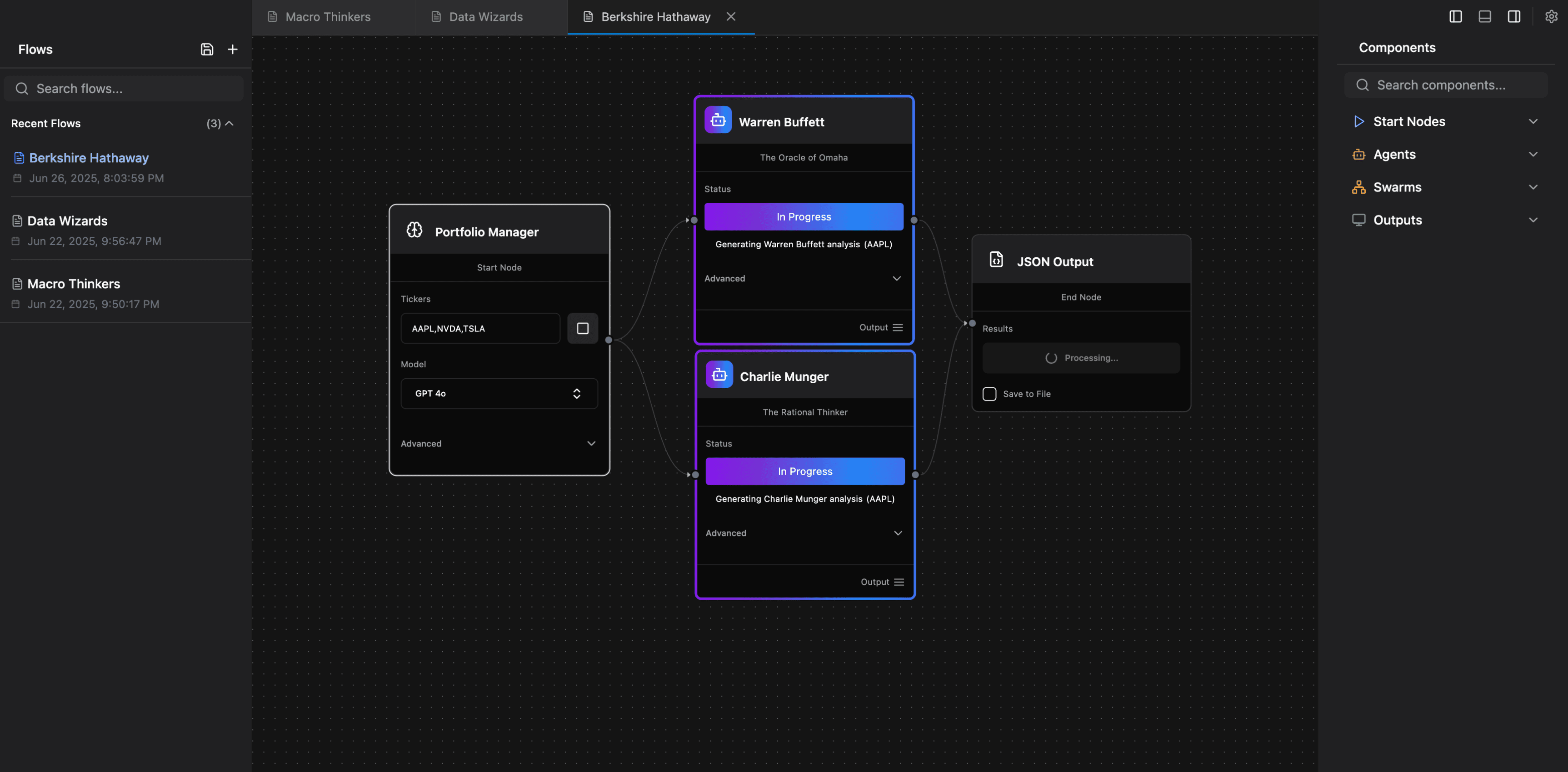
The Problem: Wiring a Multi-Agent Trading Stack from Scratch
Building an AI trading system means wiring together LLM providers, financial data APIs, and orchestration frameworks. You want to experiment with multi-agent trading strategies, but integrating OpenAI, Anthropic, Groq, DeepSeek, Mistral, Google Gemini, or Ollama with financial data sources like FinancialDatasets, then orchestrating it all through LangGraph and LangChain—most developers never reach a working prototype.
virattt/ai-hedge-fund ships a complete, ready-to-run "hedge fund team" of LLM agents. At 42,000 stars, it's a reference implementation for developers and students who want to inspect, modify, and learn from a fully-wired multi-agent trading architecture without building the plumbing themselves.
How virattt/ai-hedge-fund Works: A Hedge Fund Team in Code
The architecture mirrors an investment firm: named agents modeled after well-known investors—Buffett for fundamentals, Munger for long-term value analysis—work alongside portfolio and risk managers. The LangGraph-driven pipeline moves through fundamentals → technicals → sentiment → risk → trading signal, with each agent contributing its analysis.
The system supports pluggable LLM providers. Swap OpenAI for Ollama for offline experimentation, or test Anthropic against DeepSeek. A web UI visualizes the decision pipeline, and Discord notifications track agent activity. The value isn't in the trading signals—it's in being able to open the codebase and see exactly how multi-agent orchestration works in a financial context.
Who's Actually Using This (and How)
Apify's documentation lists virattt/ai-hedge-fund as a candidate integration, tracking it for potential inclusion. It appears in curated lists like georgezouq/awesome-ai-in-finance and wangzhe3224/awesome-systematic-trading as an off-the-shelf AI trading example.
riccardone/ai-hedge-fund-net ports the entire multi-agent investor architecture—Charlie Munger, Druckenmiller, Graham, Cathie Wood, Ackman, Buffett agents—into C# for signal generation. A separate crypto project, 51bitquant/ai-hedge-fund-crypto, adapts the concept for cryptocurrency markets. These aren't forks for production deployment; they're derivative frameworks reusing the agent design patterns.
The Controversies: Educational Only, Technical Debt, and Crashes
The repository explicitly states it's "for educational purposes only" and doesn't execute real trades. Independent analysis flags delivery risk: more issues opened than closed in recent windows, unresolved high-priority bugs about missing ticker data, and long-lived open PRs (#25, #11) suggest backlog friction.
Technical debt concerns include heavy dependence on the main author, insufficient test coverage for new integrations like Mistral and Gemini, and inadequate error handling that leads to crashes (issues #116, #95). External AI news coverage frames it as a simulation-oriented demo rather than an institution-grade system—real-world performance and reliability remain unproven.
Alternatives: TradingAgents, Crypto Ports, and RL Frameworks
TradingAgents offers a similar multi-agent financial trading framework but emphasizes research-grade benchmarks and experimental results over GitHub-first accessibility. ai-hedge-fund-crypto focuses on cryptocurrency strategy-ensembling. FinRL and MarS provide reinforcement-learning environments instead of the "hedge fund team" metaphor with pluggable LLM backends.
virattt/ai-hedge-fund is distinct for its named-agent architecture and LangGraph orchestration layer, positioned as a teaching tool rather than a backtested trading platform.
Why 42k Stars: Momentum, Integrations, and Educational Appeal
The repo ranks among the most popular AI-related GitHub projects, with large daily star gains. AI newsletters like Buttondown AINews and Agentic News spotlight it as an example of multi-agent LLM architectures applied to finance. Recent integrations—OpenAI, Groq, Anthropic, DeepSeek, Mistral, Gemini, Ollama, web UI, Discord—drive ongoing interest.
YouTube showcases and podcasts amplify visibility to indie developers and fintech engineers. The open-source model—inspect the wiring—resonates with students and practitioners exploring multi-agent systems.
What You Can Actually Do with It Today
Clone the repo and run the multi-agent pipeline locally. Swap LLM providers to test Ollama offline or compare Anthropic against DeepSeek. Inspect agent prompts and decision logic to understand LangGraph orchestration patterns. Fork it for a .NET or crypto variant if you want to adapt the architecture.
Set realistic expectations: use it to learn how multi-agent trading systems wire together, not to trade real money. For indie developers and AI/ML students, it lowers the barrier to understanding what a "hedge fund team" of LLM agents actually looks like in code.