STORM: Stanford's Fix for Shallow LLM Research Output
LLM-generated research reads like high school padding: lots of headers, zero depth, no sources. STORM's two-stage architecture—multi-perspective question generation followed by structured synthesis—tackles this by treating research as an engineering problem, not a prompt hack. We break down the methodology, examine the Hacker News criticism about shallow output, and explain what separates this approach from typical RAG systems.
Your team asks ChatGPT to research a topic. Ten seconds later you get 2,000 words with perfect headers, bullet points, and—when you actually read it—nothing of substance. Just surface-level claims strung together like a high schooler padding an essay to hit the word count.
Stanford's OVAL lab built STORM to fix exactly this problem: LLMs that generate impressive-looking text with zero depth and no source discipline.
The problem: ChatGPT research is high-school padding at scale
The failure mode is predictable. You prompt an LLM for a research summary. It spits out a well-structured document: introduction, three main sections, subsections with headers, a conclusion. Then you read the actual content and realize it's rehashing the same vague points in different words. No synthesis. No citations. No argument connecting the pieces.
Developers building knowledge tools keep hitting this wall. The output looks professional until someone with domain expertise reads it and finds it useless.
Why typical RAG doesn't solve research synthesis
Retrieve-and-generate pipelines can answer specific questions by pulling chunks from a vector database. What they don't do is explore a topic from multiple angles, build a narrative structure, or curate trustworthy sources.
Outline-driven RAG gets closer—generate a structure first, then fill in sections—but STORM's creators found it only marginally better. Without disciplined question generation and multi-perspective exploration, you still get shallow coverage with better formatting.
The architecture needed to change.
How STORM works: two stages, not one prompt
STORM treats research as an engineering pipeline with explicit phases, not a single black-box prompt.
Pre-writing stage: The system simulates a conversation between a "Wikipedia writer" agent and a "topic expert" agent. The writer asks questions from multiple perspectives, building an outline while gathering sources. This isn't generic search—it deliberately grounds queries in curated, Wikipedia-style references to reduce noise.
Writing stage: With the outline and vetted sources in hand, STORM generates a structured article with proper citations. The separation matters. Exploration happens before synthesis, not mixed together in one confused prompt.
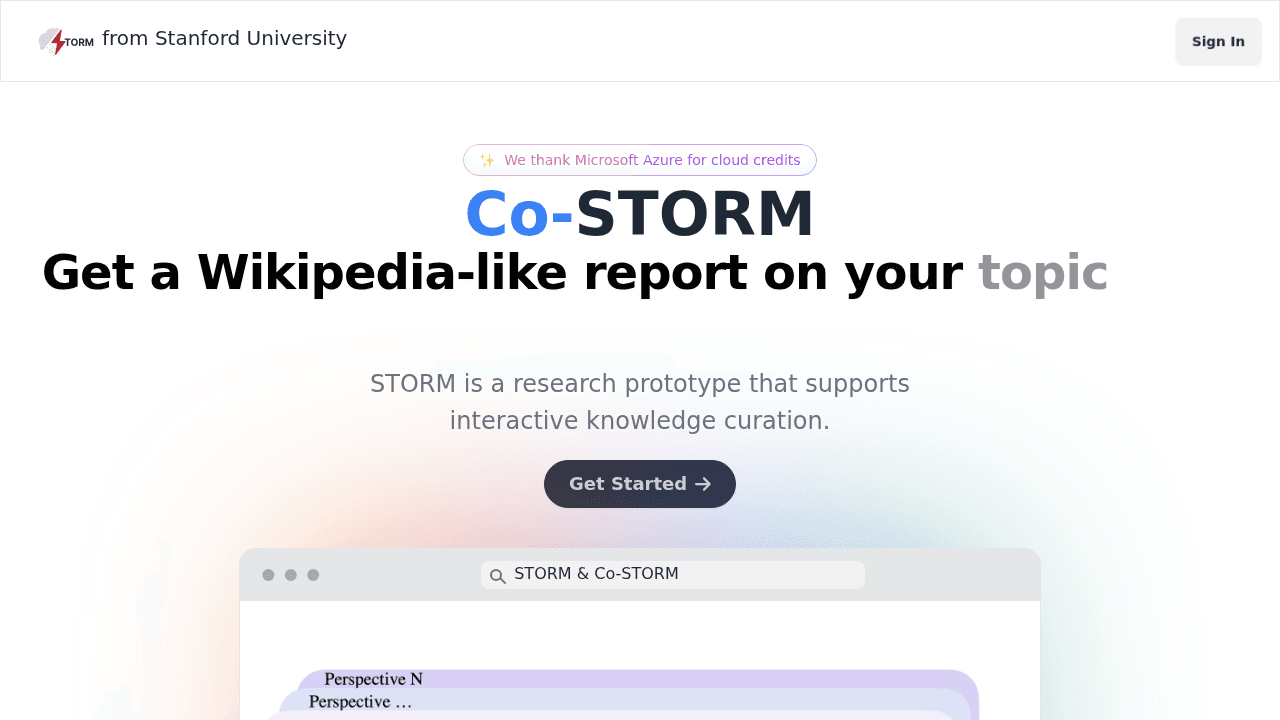
The Co-STORM variant adds multiple expert agents, a moderator, and a dynamic mind map that organizes information hierarchically—treating research as discourse between agents instead of single-agent summarization.
The counterintuitive move: trusted sources over search sludge
STORM intentionally limits itself to higher-trust sources—Wikipedia and similar vetted references—instead of scraping arbitrary web results. This narrows the search space but dramatically improves citation quality and reduces hallucinations.
Most RAG tools inherit all the garbage the web offers. STORM bets that curation beats comprehensiveness for research synthesis.
What Hacker News got right: it's still shallow
Users testing STORM on the Stanford demo reported outputs that are "lots of text, lots of headers, but extremely shallow." Another called results "too shallow and lacking a guiding thread."
Some questioned whether the extra machinery adds value over simpler outline-driven baselines. The honest answer: current output quality remains a real limitation. Don't expect GPT-4-level synthesis out of the box.
Why the architecture matters anyway
Even if v1 falls short, the design teaches something useful. The explicit separation of exploration (multi-perspective questioning, outline building, source curation) from synthesis (structured writing with citations) is an engineering discipline applied to a chaotic problem space.
Teams building research tools can lift this pattern—multi-agent simulation, staged pipelines, trusted-source grounding—regardless of STORM's specific implementation quality.
The hidden costs: maintainability and production risk
Look past the research paper and you find practical concerns. Project analyses flag accumulating technical debt, insufficient test coverage, and uncaught exceptions in retrieval code. Open issues and PRs pile up.
Users also raised privacy concerns: the web demo's "Discover" page can expose other users' research requests, despite claims about secure storage.
If you're evaluating this for production, those are red flags.
Who should actually use this
STORM makes sense for teams prototyping Wikipedia-like knowledge bases, researchers needing structured pre-writing pipelines, or educators building research demos. The two-stage architecture and source curation offer differentiation from RAG frameworks like LlamaIndex or Haystack.
Skip it if you need proven production reliability or expect polished output without iteration. Tools like Perplexity and Phind may better serve teams wanting plug-and-play research synthesis.
The framework matters more than the current implementation. The methodology—treating research as a disciplined pipeline instead of prompt hacking—is what separates serious attempts at LLM knowledge synthesis from the usual slop.
stanford-oval/storm
An LLM-powered knowledge curation system that researches a topic and generates a full-length report with citations.