Qwen3's 25K Stars Signal Open-Weight AI's China Challenge
Qwen3's rapid adoption reveals a strategic shift: engineering teams are choosing open-weight Chinese models over Western alternatives. Beyond GitHub stars, this reflects growing concerns about vendor lock-in, sovereignty, and the viability of truly local AI infrastructure. We examine the technical and geopolitical factors driving teams toward Alibaba's model.
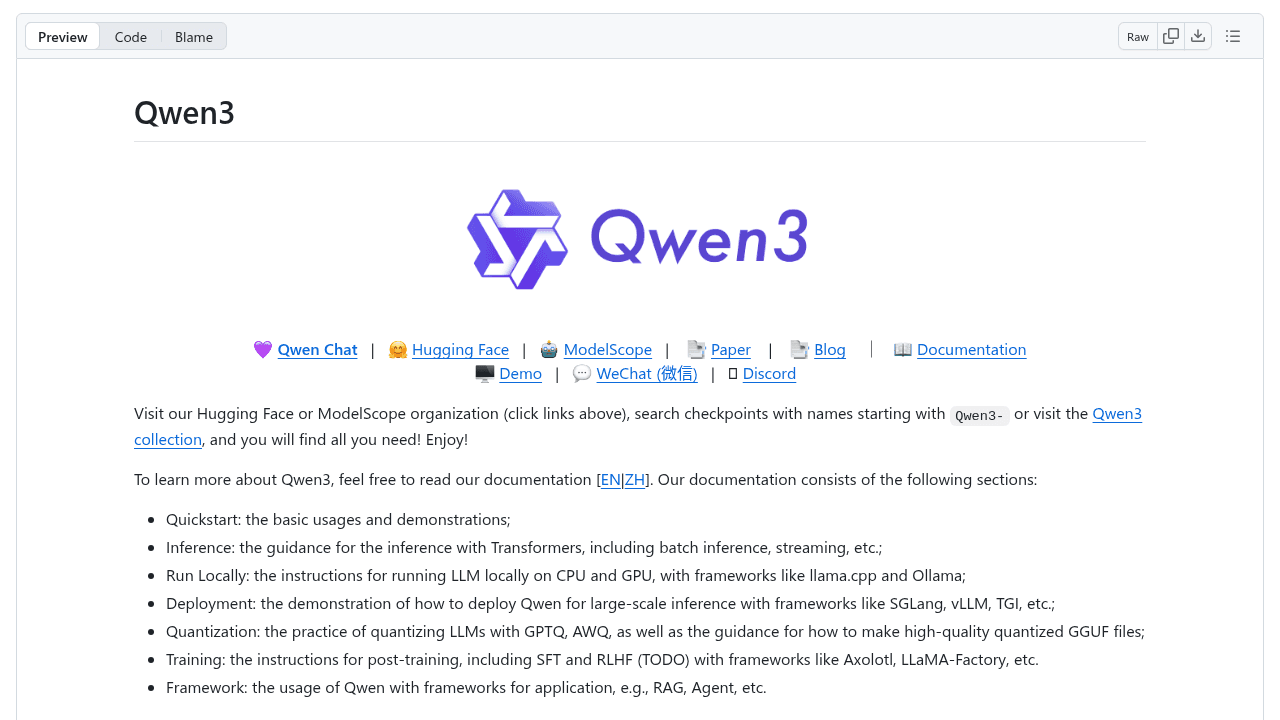
Alibaba's Qwen3 crossed 25,000 GitHub stars this month. The number matters less as a vanity metric and more for what it represents: engineering teams are choosing open-weight models from Chinese labs over API services from OpenAI and Anthropic.
The distinction between "open-weight" and "open-source" matters here. Qwen3 releases its model weights for download and local deployment, unlike OpenAI's API-only approach. You can run it on your own infrastructure, modify it, and never send data outside your network. For teams navigating data sovereignty requirements or dealing with vendor lock-in concerns, that changes the calculation.
The 25,000 Star Milestone: What Adoption Numbers Actually Tell Us
GitHub stars don't measure production usage, but 25,000 puts Qwen3 in the same adoption tier as Llama 2 and Mistral. The growth curve tells a clearer story: Qwen3 accumulated these stars in roughly ten months since its January 2025 release. That suggests technical interest rather than promotional noise.
The model family spans sizes from 7B to 72B parameters, with quantized versions that run on consumer hardware. Teams report deploying the 14B parameter version on single A100 GPUs for production workloads. GPT-4 is cloud-only with undisclosed parameter counts.
Why Teams Are Choosing Open-Weight Over API Dependency
The technical case centers on three factors: cost predictability, data control, and latency.
Running Qwen3 locally means fixed infrastructure costs instead of per-token API pricing that scales unpredictably with usage. For high-volume applications, the economics flip at low thresholds. A mid-sized e-commerce platform reported cutting LLM costs by 70% after migrating from GPT-3.5 to self-hosted Qwen3 for product description generation.
Data sovereignty concerns drive adoption in regulated industries. Financial services teams in Europe cite GDPR compliance as a primary factor. Sending customer data to U.S.-based API endpoints creates audit headaches that disappear with local deployment.
Latency matters for real-time applications. On-premise inference eliminates network round-trips. Gaming studios using LLMs for NPC dialogue report sub-100ms response times with local Qwen3 deployments versus 300-800ms for API calls.
Benchmark Reality Check: Where Qwen3 Delivers and Where It Doesn't
Qwen3's 72B model scores competitively with GPT-4 on MMLU and HumanEval benchmarks, though direct comparisons prove difficult since benchmark performance doesn't always translate to production utility.
Where it falls short: English language nuance, particularly for creative writing and complex reasoning tasks. Teams report noticeable quality gaps compared to GPT-4 for marketing copy and strategic analysis. Code generation performs well for Python and JavaScript but struggles with less common languages.
Where it excels: Multilingual support, particularly for Chinese, and structured data extraction tasks. Several teams report better performance than GPT-3.5 for parsing technical documentation and generating JSON from unstructured text.
The Geopolitical Layer: Multi-Polar AI Development
Competitive AI capabilities emerging from China force Western companies to recalculate risk. Dependence on U.S.-based AI providers creates a single point of regulatory and geopolitical failure. If trade restrictions or service disruptions hit OpenAI or Anthropic, what's your fallback?
Open-weight models from Alibaba, regardless of their origin, provide optionality. This isn't about choosing Chinese models over Western ones—it's about not being entirely dependent on either.
The sovereignty question cuts both ways. Running Qwen3 doesn't eliminate concerns about model training data, potential backdoors, or alignment decisions baked into weights. But it shifts the risk profile from ongoing API dependency to a one-time model evaluation and deployment decision.
What This Signals About AI's Next Phase
Multi-polar AI development—with competitive models from U.S., Chinese, and European labs—reduces the concentration risk that currently defines the industry. Whether that's stabilizing or destabilizing depends on your perspective.
Engineering leaders face new questions: Do you optimize for maximum capability or acceptable capability with operational independence? How do you evaluate the sovereignty-performance trade-off? What happens when regulatory environments diverge enough that different models become necessary for different markets?
Qwen3's adoption suggests teams are increasingly willing to accept performance trade-offs for operational autonomy. That shift matters more than any single model's benchmark scores.
QwenLM/Qwen3
Qwen3 is the large language model series developed by Qwen team, Alibaba Cloud.