The Missing Layer: Skill Libraries for AI Coding Agents
AI coding assistants are powerful but fragmented—each rebuilding capabilities from scratch. antigravity-awesome-skills introduces SKILL.md standardization and a cross-platform skill library that works with Claude Code, Cursor, Antigravity, and more. The v3.0.0 Governance Update signals the transition from experimental collection to production-ready infrastructure.
Claude Code writes pristine TypeScript. Cursor refactors legacy code like a veteran engineer. Antigravity IDE automates test generation. Each tool rebuilds the same capabilities—AWS deployment workflows, database migration patterns, API scaffolding—because they have no way to share solutions.
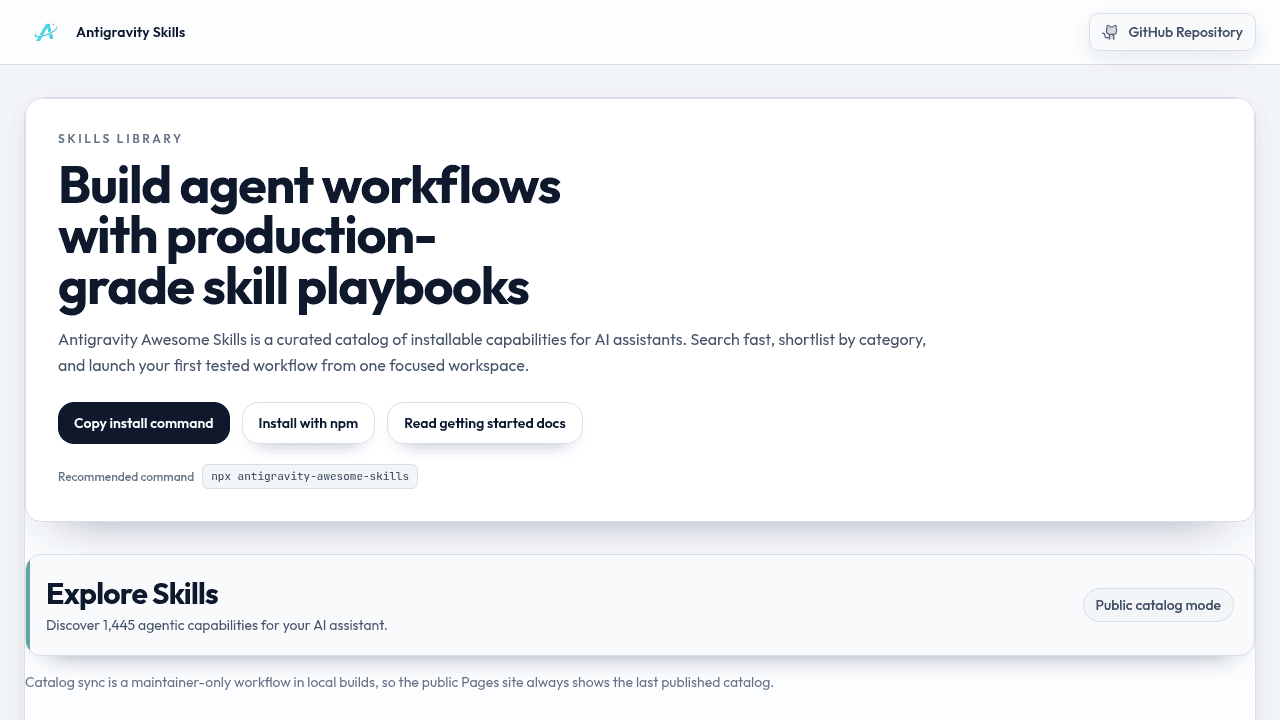
antigravity-awesome-skills is a standardized skill library that works across platforms. The repository contains 1,400+ installable skills compatible with Claude Code, Cursor, Codex CLI, Gemini CLI, and Antigravity IDE—all MIT-licensed, all interoperable. Developer sickn33 built what amounts to npm for AI agent capabilities.
The fragmentation problem
AI coding assistants suffer from an isolation problem. Each platform develops capabilities—Cursor's codebase search, Claude's architectural reasoning, Antigravity's autonomous testing—but those capabilities stay locked inside their respective environments. A prompt engineer might teach Claude Code to scaffold a FastAPI project with perfect conventions, but that knowledge dies when they switch to Cursor for refactoring work.
The debate over whether explicit skills even matter is still playing out. Reddit users question whether dedicated skill files provide value over simply adding context to prompts. The discussion itself reveals a deeper issue: developers are manually maintaining lists of capabilities across multiple tools, reinventing solutions their peers already solved.
Some AI platforms handle this better than others. Antigravity shows weaker skill awareness compared to Claude Code and Cursor, requiring users to manually remind the agent about available capabilities. That inconsistency makes portability valuable.
SKILL.md: The technical bet that enables interoperability
The repository's core innovation is deceptively simple: standardized SKILL.md files that serve as playbooks for AI agents. Each file defines inputs, expected outputs, and execution patterns in a format that any compatible agent can parse. Write a skill once for database migration workflows, and it works in Cursor's command palette, Claude Code's context menu, and Antigravity's autonomous execution mode.
This isn't magical abstraction—it's pragmatic standardization. The SKILL.md format doesn't try to hide platform differences or create a universal interface layer. It provides enough structure that agents can interpret intent while maintaining flexibility for platform-specific optimizations. Think less "write once, run anywhere" and more "document once, adapt naturally."
The npm comparison is tempting but imperfect. Package managers distribute code; skill libraries distribute knowledge patterns that agents execute differently based on their underlying models and tooling integrations. That distinction matters when debugging, but for day-to-day use, the effect is similar: install a skill, invoke it by name, watch the agent execute the workflow.
From collection to platform: The Governance Update
Version 3.0.0 launched January 24, 2025 with "The Governance Update" branding—a signal that the project has matured beyond experimental collection status. The release establishes contribution guidelines, versioning standards, and quality benchmarks appropriate for production infrastructure.
Google Antigravity's integration of the repository as a core capability validates the approach. When a major IDE adopts your skill library for autonomous testing workflows, you're infrastructure.
The emergence of VoltAgent's competing repository with 380+ skills deserves acknowledgment, not as fragmentation but as validation. Multiple teams independently concluded that skill libraries solve a real problem. The space is large enough to support different approaches—VoltAgent emphasizes official team contributions, antigravity-awesome-skills prioritizes community breadth. Both strengthen the infrastructure layer.
Why this matters for agentic coding adoption
Industry observers including Stephen Webb and DHH point to 2025-2026 as the tipping point for AI-native agentic coding. That future requires more than better models—it needs shared infrastructure that lets agents leverage collective knowledge instead of starting from scratch.
The choice to release this as MIT-licensed infrastructure rather than building proprietary tooling reveals something about how collaborative systems develop. When foundational layers stay open, competition happens at higher levels where differentiation matters—user experience, performance optimization, enterprise features. The skill library itself becomes commons that everyone can improve.
With 1,400+ skills spanning frameworks, deployment patterns, and testing workflows, antigravity-awesome-skills demonstrates that standardization creates abundance. The repository's public web interface makes browsing and installation straightforward, removing friction from adoption. What started as one developer scratching an itch became the infrastructure layer that lets AI coding agents share solutions.
sickn33/antigravity-awesome-skills
Installable GitHub library of 1,400+ agentic skills for Claude Code, Cursor, Codex CLI, Gemini CLI, Antigravity, and more. Includes installer CLI, bundles, workflows, and official/community skill collections.