42K Stars in Under a Year: The Claude Code Collection
A curated collection for Claude Code exploded to 42,000+ stars in less than a year, becoming essential infrastructure for developers building with AI coding agents. The taxonomy of tools—from skills to hooks to orchestrators—reveals how developers actually deploy agentic workflows in production.
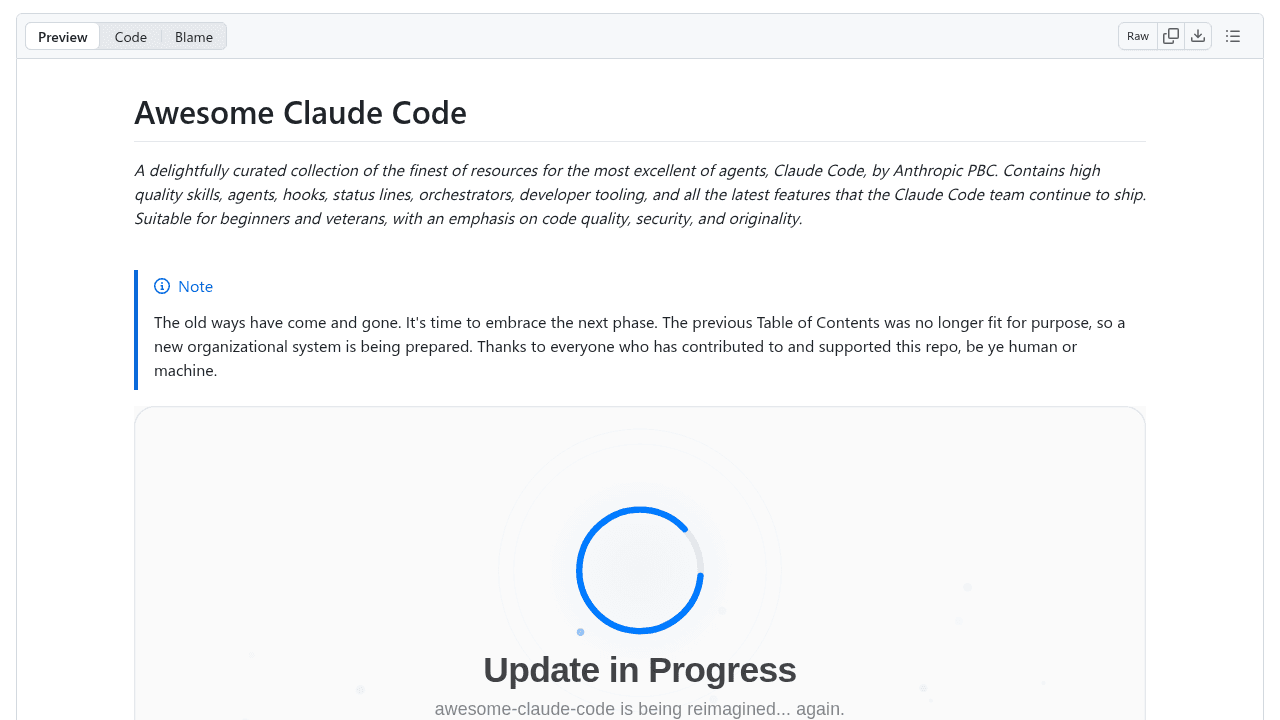
The awesome-claude-code repository crossed 42,000 stars on GitHub in just 11 months. Most community-curated lists take years to reach that milestone—if they ever do. Developers building with AI coding agents needed this kind of infrastructure, and they needed it now.
From Zero to 42,000 Stars: The Numbers Behind the Growth
Launched in early 2024, the repository gained momentum as Claude Code adoption accelerated throughout the year. By the time it hit 40,000 stars, it had become the go-to discovery mechanism for developers working with Anthropic's coding agent.
Most "awesome lists" grow steadily over multiple years as their underlying technology matures. This collection compressed that timeline because Claude Code itself was evolving rapidly—and because developers were shipping production tools at an unprecedented pace. The star count reflects both the curator's organizational vision and the explosive growth happening around the technology.
Why This Collection Became Infrastructure
This one solved a genuine discovery problem. As Claude Code matured and more developers began building extensions, skills, and integrations, the challenge shifted from "can we build this?" to "what has already been built?"
The curator organized the collection around functional categories that reflect real development workflows. Rather than an alphabetical dump of repositories, the taxonomy groups tools by how developers actually use them: skills that extend Claude Code's capabilities, hooks that integrate it into existing workflows, and orchestrators that coordinate multiple agents.
That organizational clarity transformed a GitHub list into something closer to a package registry. Developers can navigate by their specific need rather than scrolling through hundreds of loosely related projects.
The Emerging Taxonomy: Skills, Hooks, and Orchestrators
The categories themselves reveal how the community thinks about agentic development. Skills represent discrete capabilities—tools that teach Claude Code to interact with specific APIs, navigate particular frameworks, or handle specialized tasks. These are the building blocks of more complex workflows.
Hooks represent integration points. They're the adapters that let Claude Code fit into existing development environments, CI/CD pipelines, and toolchains. This category's growth reflects developers bringing AI agents into established workflows rather than rebuilding everything around the agent.
Orchestrators coordinate multiple agents or manage complex multi-step processes. Their presence in the taxonomy signals that developers have moved beyond simple prompt-and-response patterns into more sophisticated agentic architectures.
What Production Use Cases Reveal
The patterns in starred tools show where real-world adoption is concentrating. Developer tooling dominates—automation for testing, code review, documentation generation. DevOps integrations are growing, suggesting Claude Code is moving into infrastructure workflows.
Many highly-starred tools focus on narrow, well-defined problems rather than broad general-purpose solutions. Developers seem to value focused utilities that do one thing reliably over ambitious frameworks that promise everything. With 15 open issues on some popular tools including cross-platform compatibility questions, projects are working through the typical growing pains of tools moving this fast.
The Community Behind the Collection
The collection's success reflects collaborative knowledge-sharing at scale. Contributors don't just submit links—they write descriptions, categorize tools appropriately, and maintain quality standards. That curation work is what keeps the collection useful as it scales.
The curator reviews submissions to ensure they fit the taxonomy and represent meaningful additions. It's editorial work disguised as GitHub maintenance, and it matters. Without that gatekeeping, the collection would devolve into noise.
What You'll Find in the Collection
Navigate by your use case. If you're extending Claude Code's capabilities, start with the skills section. If you're integrating it into existing tools, check the hooks. For complex multi-agent workflows, explore the orchestrators.
Each entry includes a description and link to the repository. Most maintainers provide clear documentation, though some newer tools are still building out their examples. The star counts offer a rough signal of adoption, but newer high-quality tools may not have accumulated stars yet.
The collection represents the state of the Claude Code right now—messy, growing fast, and full of experiments that are becoming standards.
hesreallyhim/awesome-claude-code
A hand-picked collection of the finest of resources for the most awesome of agents, Claude Code, the undisputed champion of coding companions, from the unstoppable team at Anthropic PBC. A delectable showcase of top tier skills, ambidextrous agents, scintillating status lines, top notch developer tooling, and also we have plugins