RTK Cuts AI Coding Token Waste by 60-90%
AI coding agents treat every byte of git status and ls output as precious context, racking up massive token bills on noise that human developers instinctively filter out. RTK solves this with intelligent compression, with real-world usage showing 138 million tokens saved at 88.9% efficiency.
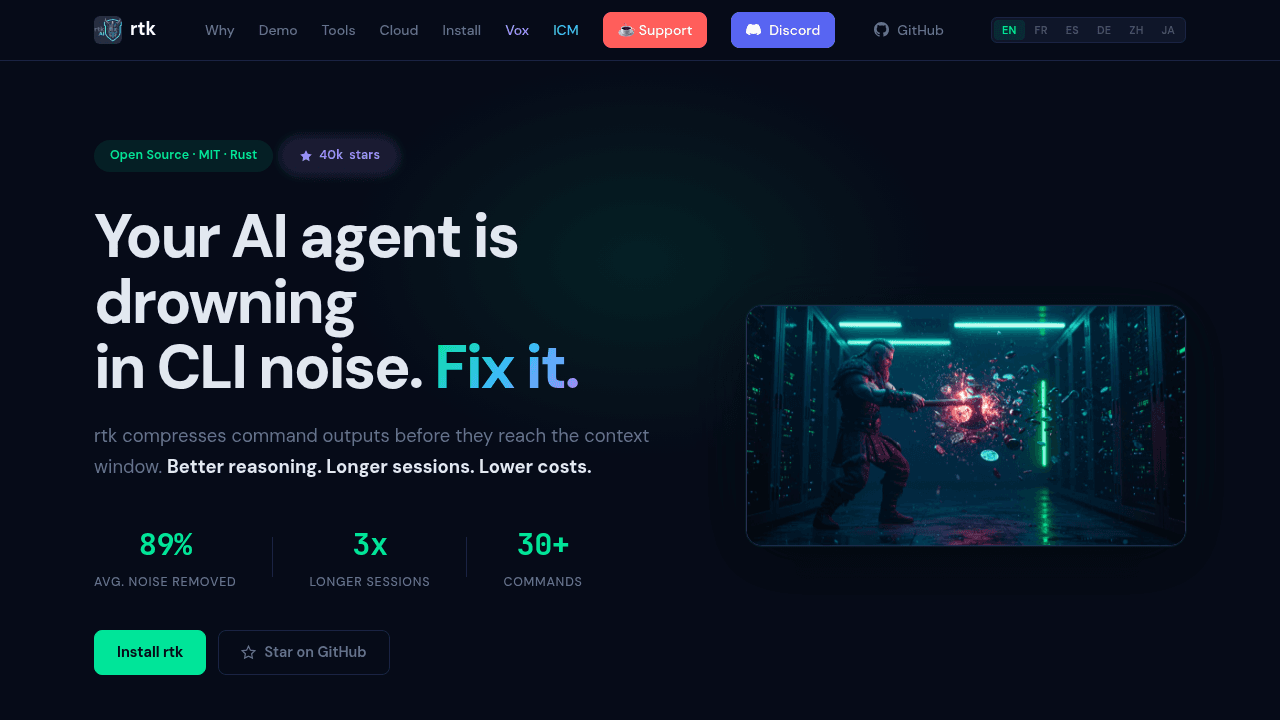
A developer analyzing their Claude Code command history discovered something expensive: their AI assistant was burning tokens on verbose outputs that any human would instinctively ignore. Directory listings from ls and find commands turned out to be massive token wasters, alongside git status and test results—the kind of noise developers glance at for two seconds before moving on. The AI agent treats every byte as context worth processing.
That frustration led to RTK, a Rust tool that filters and compresses CLI outputs before they reach the LLM. The pitch is straightforward: preprocessing that reduces token usage by 60-90% on the commands AI coding assistants run constantly. One developer reported processing 15,720 commands over weeks of daily coding, saving 138 million tokens at 88.9% efficiency.
How RTK Filters What Humans Ignore
The technical approach is focused: a single Rust binary that applies command-specific filters to CLI output. When an AI agent runs git status and gets back 200 lines of unchanged files, RTK compresses it to what matters—the modified files you'd care about. Same principle for directory listings that balloon to thousands of lines or test suites that repeat the same stack trace fifty times.
The tool preserves the information a developer would extract at a glance while discarding the repetitive cruft. Headroom uses rtk-ai/rtk under the hood to reduce token usage. The project entered the top 10 trending open-source repos with +846 GitHub stars in 7 days, suggesting plenty of developers recognize this pain point.
The Benchmark Training Trade-Off
There's a technical concern worth considering: LLMs haven't been trained on RTK-compressed output, which could risk degraded benchmark scores. You're saving token costs, but you're also feeding the model data in a format it hasn't seen during training.
The counterargument is that humans already compress this information mentally—we don't read every line of a 500-file directory listing either. Whether the cost savings justify the potential accuracy impact depends on your use case and tolerance for experimentation. For developers frustrated with their AI assistant bills, it's a trade-off worth testing.
A Growing Problem Space
RTK isn't alone in tackling token waste. Snip is a Go alternative that uses YAML data files for filters and supports composable pipeline actions like regex matching and deduplication. Distill takes a different angle as a secondary context compression layer, working after RTK's command output preprocessing. These aren't competing solutions—they're validation that token consumption is a problem developers are actively solving in different ways.
The approaches are complementary. RTK focuses on preprocessing at the command level, Snip offers more configuration flexibility, and Distill adds another compression pass. Pick the tool that matches your workflow, or chain them together if it makes sense for your setup.
Why a Single Binary Matters
What stands out about RTK is the engineering mindset behind it: someone saw a problem in their daily workflow, analyzed their command history to confirm the waste, and built a focused Rust binary to fix it. No framework, no complex architecture—just a tool that intercepts CLI output and makes it cheaper to feed to an LLM.
For developers using Cursor, Claude Code, or GitHub Copilot daily, token costs add up. RTK addresses that expense with a direct solution. The open-source contribution gives the community a starting point to refine the approach, debate the trade-offs, and adapt the filtering logic to their own workflows.
rtk-ai/rtk
CLI proxy that reduces LLM token consumption by 60-90% on common dev commands. Single Rust binary, zero dependencies