OpenSpec: Spec-Driven Development for AI Assistants
OpenSpec transforms chaotic AI coding workflows into predictable, auditable processes through spec-driven development. This article explores how Fission AI's framework addresses the brownfield nightmare of AI-generated code and establishes a new standard for human-AI collaboration in software development.
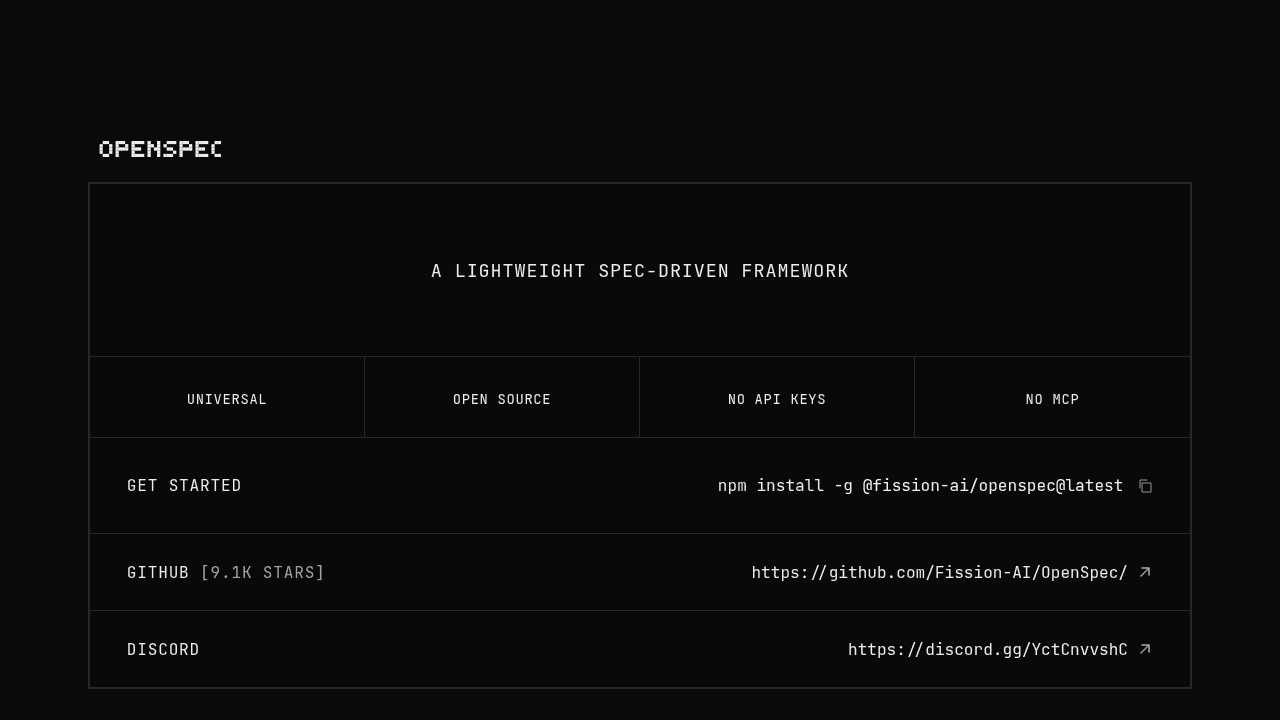
The Fission AI team was drowning in what they dubbed "vibe coding"—AI assistants generating entire modules from offhand chat messages, producing unpredictable and unreviewable results. The breaking point came during an urgent production patch when requirements, decisions, and testing steps existed nowhere except in ephemeral chat threads. With security and compliance stakes rising in their fast-paced AI-driven development environment, the team realized that even cutting-edge tools like Copilot, Claude Code, and Cursor struggled without shared, reviewable specifications. This fundamental disconnect between AI capability and human intent sparked the creation of OpenSpec on August 5, 2025.
The Brownfield Nightmare That AI Can't Navigate
Development teams managing evolving or legacy codebases face a unique challenge with AI coding assistants: the tools excel at greenfield projects but falter when maintaining existing systems. Requirements get buried in chat logs, fostering ambiguity and errors that undermine both productivity and trust. AI-generated code can quickly veer off-course in "brownfield" projects where maintaining and evolving existing features is mission-critical. According to the project documentation, "Without specs, AI coding assistants generate code from vague prompts, often missing requirements or adding unwanted features." This creates a vicious cycle where teams either avoid AI assistance entirely or spend more time correcting AI mistakes than writing code themselves.
From Production Panic to Spec-Driven Salvation
The Fission AI founder's eureka moment crystallized during that fateful production incident when an AI-generated patch went awry because no one could trace the decision-making process. The team devised a revolutionary three-phase workflow: propose, apply, archive—where every change is transparently reviewed and traced back to explicit, human-approved intent. Development moved at breakneck speed, with the public repository launching on August 5, 2025. Initial community feedback praised OpenSpec's "lean, beautifully simple organization" and ability to fit into existing projects with minimal overhead. As one podcast host noted, "OpenSpec... is designed to quickly and efficiently improve a building that's already standing... Its organization is just beautifully simple." The project hit a major milestone with the v0.13.0 release on October 22, 2025, adding integrations with four popular AI development tools and rapidly growing to over 9,000 GitHub stars.
The Two-Folder Revolution That Tamed AI Chaos
OpenSpec's breakthrough innovation enforces spec-driven workflow as a first-class primitive for AI development, aligning human and AI agents around mutually agreed specifications before any code is written. The technical architecture centers on a simple yet powerful two-folder model:
specs/ serves as the authoritative source of truth
changes/ handles proposal and active work phases
Single folder per change captures proposals, tasks, design notes, and spec deltas together
Plain TypeScript/JavaScript compatibility avoids vendor lock-in
Simple CLI commands (openspec propose, openspec archive) streamline adoption
Unlike competitors such as GitHub's Spec Kit, OpenSpec specializes in updating and maintaining existing systems rather than just greenfield development. The framework integrates natively with slash commands in Cursor, Claude, and Copilot, enabling frictionless adoption without requiring API keys. This architecture enables both deterministic code generation and auditable, reviewable changes—streamlining diffing, reviews, and compliance audits that traditional AI coding workflows struggle to provide.
Reshaping How Teams Think About AI Partnership
OpenSpec's lightweight approach has accelerated the broader movement from "chat-based" to spec-driven code generation across the AI development ecosystem. Real-world adoption stories from agile teams and indie developers show measurable improvements in productivity and auditability, particularly for teams integrating AI into mature codebases. Industry observers note that competitors, including GitHub's new Spec Kit, have begun mirroring OpenSpec's rigid spec-commit patterns for compliance and traceability. The trend toward portable, standardized specifications signals growing adoption in regulated sectors like fintech and healthcare, where auditable software delivery from human-AI hybrid teams is becoming essential. Explore the framework that's making AI assistants more predictable at OpenSpec.
Fission-AI/OpenSpec
Spec-driven development (SDD) for AI coding assistants.