OpenHands: When AI Agents Crossed Into Production
AI coding agents moved from experimental to operational in 2025. OpenHands leads this shift as an open-source tool that literally builds itself—20% of its commits are AI-authored. Engineering teams at AMD, Apple, Google, and Amazon are testing it on real codebases, cutting maintenance backlogs in half despite rough UI edges.
Twenty percent of OpenHands' codebase is now written by OpenHands itself. Not marketing copy or documentation—actual commits. Dependency upgrades, test generation, refactors. The work that sits in every engineering team's backlog, accumulating technical debt.
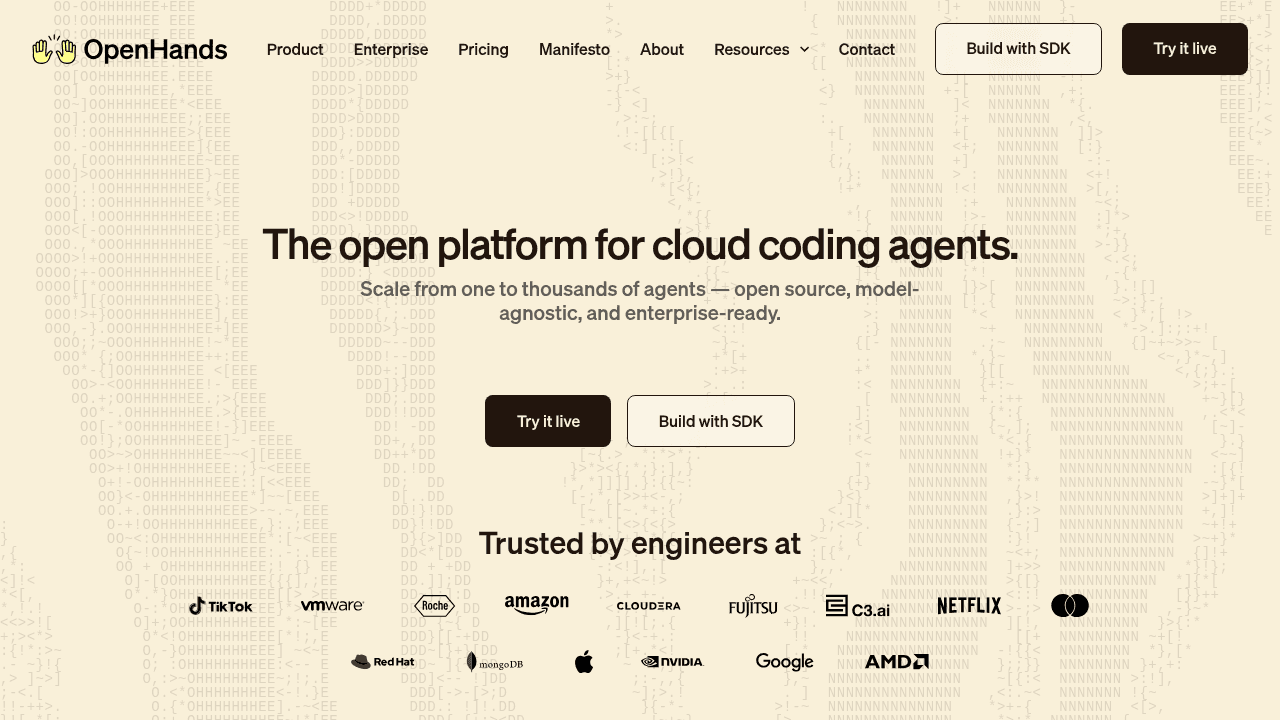
Engineers at AMD, Apple, Google, Amazon, Netflix, TikTok, NVIDIA, Mastercard, and VMware have forked the repository. Early enterprise adopters report reducing code-maintenance backlogs by up to 50 percent—handling vulnerability sweeps, merge conflicts, and refactors that would otherwise consume sprint capacity.
The 20% Threshold: When the Tool Builds Itself
When an AI coding agent can maintain its own codebase at scale, it demonstrates operational capability rather than controlled demos. OpenHands handles dependency upgrades, unit test additions, merge conflict resolution, vulnerability sweeps, and code refactors—the maintenance work that keeps production systems healthy but rarely makes roadmaps.
The system writes code, runs shell commands in a sandbox, browses the web, and manages files like a developer would. It handles the tasks that drain velocity from feature development.
The Rough Edges
Users report UI performance issues where the chat becomes laggy and unresponsive with long messages, caused by React Markdown rendering without message virtualization. Others have flagged that the system can be problematic and inconsistent, potentially due to system requirement mismatches.
This is the expected friction of operational software that hasn't been consumer-polished. The difference between "works in production" and "delightful UX" is where OpenHands sits in late 2025.
Why Open Source Matters Here
OpenHands is MIT-licensed, model-agnostic, and scalable to thousands of agents in secure cloud environments. No vendor lock-in. Enterprises control the infrastructure and data, with integrations for GitHub, Slack, and Jira already built.
When evaluating AI coding tools, the ability to audit the system, modify behavior, and deploy on your own infrastructure changes the risk calculation. OpenHands has 434 contributors, 65,000+ GitHub stars, and 8,000 forks—signals of sustained community development rather than single-vendor dependency.
What 2026 Looks Like Based on Trajectory
The $18.8M Series A from Madrona targets cloud-based sandboxed agents handling real code changes at enterprise scale. Based on current adoption patterns, 2026 will see cloud-based sandboxed agents handling real code changes become standard tooling for maintenance workflows.
FAANG teams are already running OpenHands against production codebases. The shift from experimental to operational happened in 2025. What comes next is scaling that operational reality across development teams that can no longer afford to dedicate 30-40% of engineering capacity to maintenance debt.