OpenClaw Has 1000+ Skills. Nobody Knew What to Build.
OpenClaw exploded in popularity with thousands of AI agent skills, but developers hit a wall: the docs showed capabilities without demonstrating practical use cases. A community-driven examples repository bridges that gap by showing real implementations—from B2B outreach automation to daily workflow improvements—that help developers move from 'this looks cool' to 'here's what I'll build.'
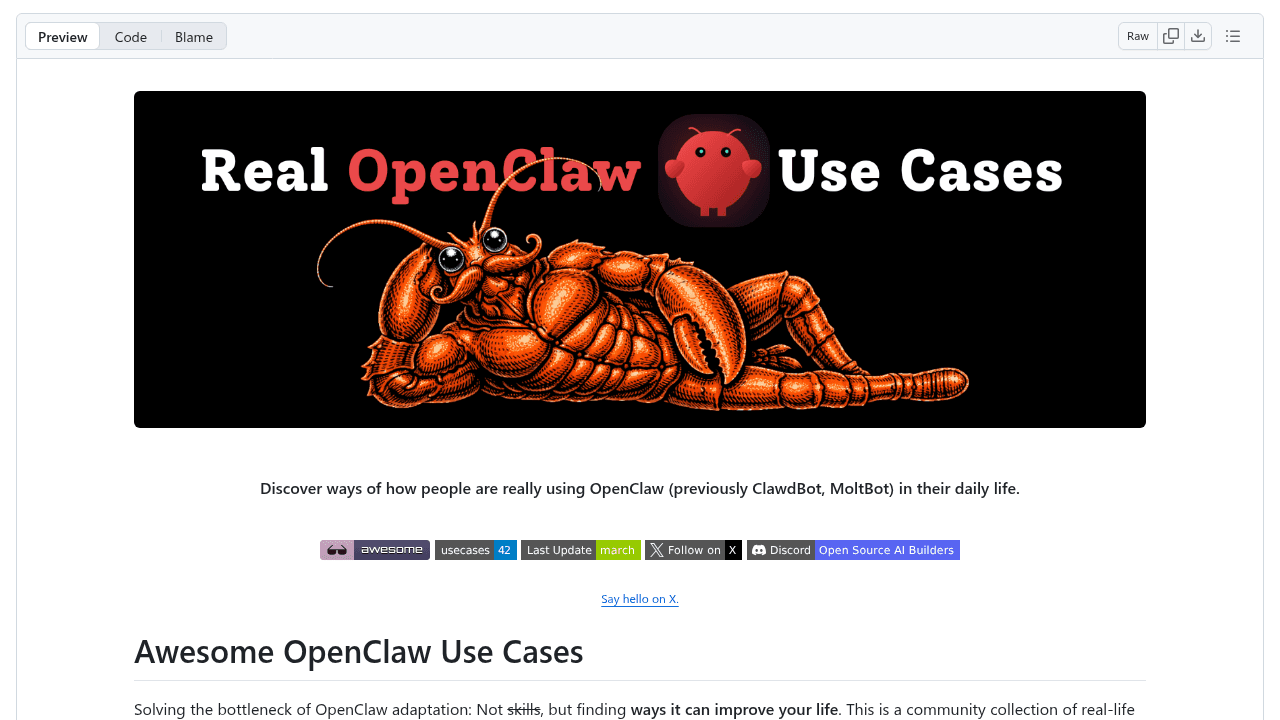
OpenClaw's technical documentation lists thousands of capabilities. Developers still asked the same question: "What do I actually build with this?"
The answer wasn't in the docs. It was missing entirely.
The Documentation Paradox
OpenClaw gained traction fast—particularly in China, where AI subsidies and economic pressures fueled adoption among developers facing high unemployment rates. The framework delivers: thousands of skills, extensive automation capabilities, and a growing community.
But capability lists don't spark imagination. A developer scanning through function names and parameter descriptions hits a wall. The technical reference showed what OpenClaw could do. It didn't show why anyone would want to.
That's the gap Hesam Sheikh identified. The awesome-openclaw-usecases repository doesn't add features or fix bugs. It shows real implementations—the bridge between "this looks interesting" and "here's what I'm going to build."
Why Examples Beat Features
Example-driven learning works because people need to see tools in context before understanding their value. A list of API endpoints is technically complete but pedagogically useless. Developers learn by pattern-matching: they see a use case similar to their problem, then adapt it.
The repository collects exactly that—concrete patterns developers can recognize and modify. Instead of inferring potential applications from abstract capabilities, they see working implementations and understand the framework's range.
What the Community Built
The use cases cover daily workflow automation, but one stands out: B2B founders using OpenClaw for automated outreach. The pattern is straightforward—research prospects on LinkedIn, draft personalized emails based on that research, schedule follow-ups based on responses. It's not revolutionary, but it's specific enough to be useful.
That specificity matters. "Automate your sales process" is vague. "Research LinkedIn profiles, generate context-aware emails, and handle follow-up scheduling" is a blueprint.
Other examples demonstrate similar concreteness: content generation workflows, data processing pipelines, customer support automation. Each one reduces the cognitive load of translating capabilities into applications.
The Performance Reality
OpenClaw's growth exposed some technical challenges. The framework has performance issues stemming from unlimited context accumulation—conversation history expands from 5K to 150K tokens across rounds, slowing responses. Users running OpenClaw with Ollama report slowdowns when context length saturates VRAM and overflows into system memory.
Security concerns are more serious. Weak defaults enabled prompt injection and data leaks significant enough that China restricted OpenClaw's use on government systems. These aren't hypothetical vulnerabilities—they're documented issues the community is actively addressing.
Competitors like NanoClaw positioned themselves around these gaps, emphasizing security and lightweight architecture. The pressure is pushing OpenClaw's development priorities toward stability and security hardening.
Why This Matters Now
OpenClaw's adoption curve is steep, particularly in markets where developers are experimenting with AI agents. As the user base scales, the "what do I build" problem compounds. New developers encounter the same friction, and without clear use case documentation, many abandon the framework before discovering its value.
The awesome-list approach distributes the solution-finding work across the community. Instead of one documentation team anticipating every use case, contributors share working implementations as they discover them. It's organic knowledge capture.
The Gap It Fills
Sometimes the most valuable contribution to an open source project isn't code. It's clarity.
OpenClaw provides the engine. The examples repository provides the map. Developers evaluating agent frameworks need both—raw capability and demonstrated application. One without the other leaves them guessing.
The technical documentation will keep improving. The skill library will keep expanding. But unless developers can quickly answer "what would I use this for," that growth won't translate to adoption. That's what this repository addresses—not by building new features, but by showing people what to do with the ones that already exist.
hesamsheikh/awesome-openclaw-usecases
A community collection of OpenClaw use cases for making life easier.