Open Design: The Local-First Alternative to Claude Design
Anthropic's Claude Design introduced elegant AI-powered design generation, but required cloud hosting and vendor commitment. Open Design emerged as a local-first alternative that supports multiple AI models, runs entirely on your machine, and lets you bring your own API keys. The philosophical divide isn't about better or worse—it's about hosted polish versus self-hosted control.
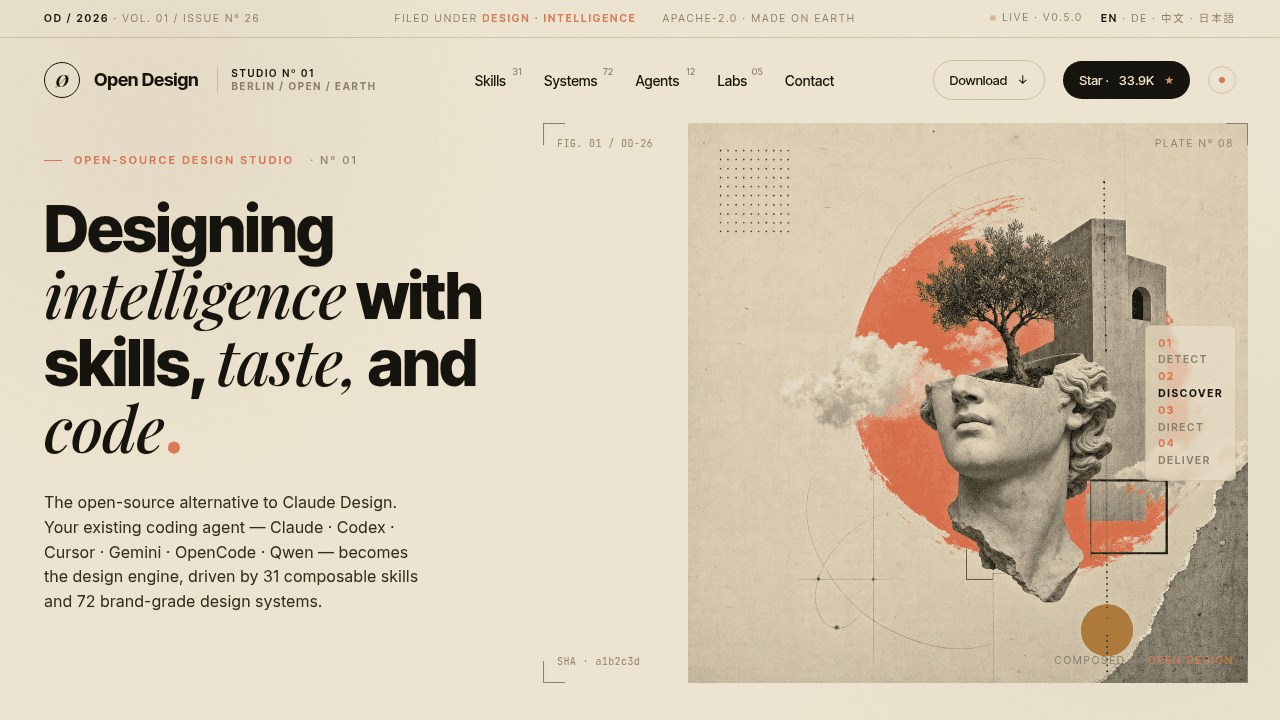
When Anthropic's Claude Design launched, it introduced something useful: AI-powered design generation that understood context. It also introduced mandatory cloud hosting, vendor lock-in, and recurring subscription costs. Open Design emerged as the response—a local-first alternative that runs on your machine, supports bring-your-own-key, and lets you choose from multiple AI providers.
The divide isn't about better or worse. Anthropic built a polished service optimized for teams who want to start designing immediately. Open Design serves developers who prioritize infrastructure control, data privacy, and avoiding vendor dependencies. Both approaches are valid.
Hosted elegance vs. local control
Claude Design offers what you'd expect from Anthropic: thoughtful UI, reliable hosting, minimal friction. You sign up, you design, you're done. Open Design takes the opposite approach. You download the tool, configure your API keys, choose your AI model, and run everything locally. One optimizes for convenience. The other optimizes for sovereignty.
The trade-off matters to teams with strict data privacy requirements, indie developers tired of subscription costs, and anyone building AI-powered products who's hit friction with proprietary tools. Open Design doesn't send your designs to third-party servers. It doesn't require ongoing payments. It doesn't lock you into a single AI provider.
What Open Design actually does
The technical scope is substantial: 19 skills, 71 design systems, and integration with eight coding agent CLIs including Go, Claude, OpenAI, and others. You connect your preferred AI model, specify your design requirements, and the tool generates locally. Developers are using it with Go subscription models for production design projects and integrating it into vibe coding workflows.
The BYOK approach means you're not paying Open Design—you're paying your AI provider directly. For teams already subscribed to Claude, OpenAI, or Go, this eliminates redundant costs. For developers experimenting with local models, it removes the subscription barrier.
The trade-offs
Open Design asks more of you upfront. The Windows installer is unsigned, triggering SmartScreen warnings—standard for open-source desktop apps, but jarring if you're used to enterprise software. Setup requires more effort than a hosted service: configuring API keys, selecting models, understanding the architecture. The UI lacks the polish of Anthropic's product.
You gain complete data privacy. No vendor lock-in. Choice of AI providers. Local execution without network dependencies. For teams where those factors matter—compliance-sensitive industries, privacy-focused startups, infrastructure purists—the trade-off is clear.
16,804 stars in May: What the momentum means
Open Design accumulated 16,804 GitHub stars in May 2025, including 14,000 in the first week at a rate of 1,400 stars per day. That velocity isn't just curiosity—it signals demand for local-first AI design tools. Developers are forking it, integrating it into workflows, and building on top of it.
The speed matters because it validates the bet: a meaningful portion of the developer community wants alternatives to hosted AI services, even when those services work well. Anthropic pioneered the concept. Open Design made it accessible for the self-hosted crowd.
Who this is for
Open Design serves developers building AI-powered products who've hit friction with vendor dependencies, teams with strict data privacy requirements, indie hackers avoiding recurring SaaS costs, anyone committed to local-first architecture. If you prioritize ease of use over infrastructure control, Claude Design remains a solid choice. If you prioritize control over convenience, Open Design offers that path.
The success of both tools suggests the market is large enough for multiple approaches. Hosted polish and self-hosted sovereignty aren't competing visions—they're answers to different problems.
nexu-io/open-design
🎨 Best DeepSeek Harness Design Plugin. The open-source Claude Design alternative. 🖥️ Local-first desktop app. 🖼️ Your coding agent becomes the design engine: prototypes, landing pages, dashboards, slides, images & video — real files, HTML/PDF/PPTX/MP4 export. 🤖 Claude Code / Codex / Cursor / DeepSeek Harness / OpenCode & 20+ CLIs via BYOK.