Obsidian CEO Fixes AI Agents Breaking on Markdown Edits
AI agents like Claude Code return success codes while producing corrupted Markdown and broken databases in Obsidian vaults. Obsidian CEO kepano diagnosed 13 silent failures in the CLI and released agent skills that teach AI how to handle Obsidian's flavor of Markdown, Bases databases, and JSON Canvas—bridging the gap between traditional CLI design and agent workflows.
Your AI coding agent reports success. Your Obsidian vault is corrupted. Commands return exit code 0 while producing malformed Markdown, broken database entries, or empty results. This is the documented behavior of Obsidian CLI 1.12 in 22.8% of tested scenarios.
The Silent Failure Problem
Silent failures look like this: an AI agent runs obsidian-cli search --vault MyVault "project" and gets exit code 0 with zero results. Not because the vault is empty, but because the agent didn't specify the right flags. Or it edits a .base file (Obsidian's database format), returns success, and leaves behind corrupted JSON that breaks the database on next load.
The CLI has 13 documented silent failures and 24 issues where default flags produce output that humans can spot and correct visually, but agents accept as valid data. When 42.1% of your command surface produces suboptimal results for automation, you have a mismatch problem.
Why AI Agents Can't Handle Obsidian
AI agents trained on generic Markdown don't understand Obsidian's flavor: [[wikilinks]] instead of [links](url), frontmatter that varies by plugin, nested tags with slashes, and dataview queries embedded in code blocks. They don't know that Bases databases store schema in JSON files separate from their .md entries, or that JSON Canvas whiteboards use a coordinate system that breaks if you edit nodes out of order.
The CLI was designed for humans who pipe output through jq and visually verify results. Agents need structured, predictable responses. They can't debug why a search returned nothing or recognize when Markdown formatting has been mangled by a write operation.
Eating Your Own Dog Food
Kepano, Obsidian's CEO, hit these failures while using Claude Code and Codex CLI to automate his own vault. Rather than rewrite the CLI—a breaking change affecting thousands of users—he built agent skills. Skills encode domain knowledge at the recipe layer: how to format wikilinks, validate Bases schemas before writing, parse Canvas JSON without corrupting positions, and wrap CLI calls with validation logic that catches silent failures before they propagate.
What Agent Skills Do
The repository contains 5 skills following the Agent Skills specification: Markdown formatting rules, Bases database operations, JSON Canvas manipulation, CLI wrapper logic with pre-flight checks, and vault structure conventions. These aren't runtime plugins—they're recipes that compatible agents ingest as instructions.
When an agent with Obsidian skills needs to add a database entry, it validates the schema exists, checks for required fields, formats the Markdown with proper wikilinks and tags, and runs the CLI command with flags that produce structured output. If a command returns empty data, the skill includes fallback logic: retry with different flags, verify the vault path, check for permission issues.
The Skills Layer
Skill repositories are trending 1.5 times faster than agent runtimes because they solve problems at the recipe layer rather than requiring new runtime capabilities. AGENTS.md provides general-purpose workflows, n8n-MCP handles API integrations, UI/UX Pro Max Skill teaches design patterns, Claude Mem manages context across sessions, GSD focuses on task decomposition. Obsidian-skills differentiates as the official collection from Obsidian's CEO, purpose-built for vault automation.
This isn't competition between tools. Agents can load multiple skill packs simultaneously. The shift from runtime wars to domain-specific skill libraries means developers spend less time debugging why their agent can't parse a file format and more time building workflows.
Using Obsidian Skills in Practice
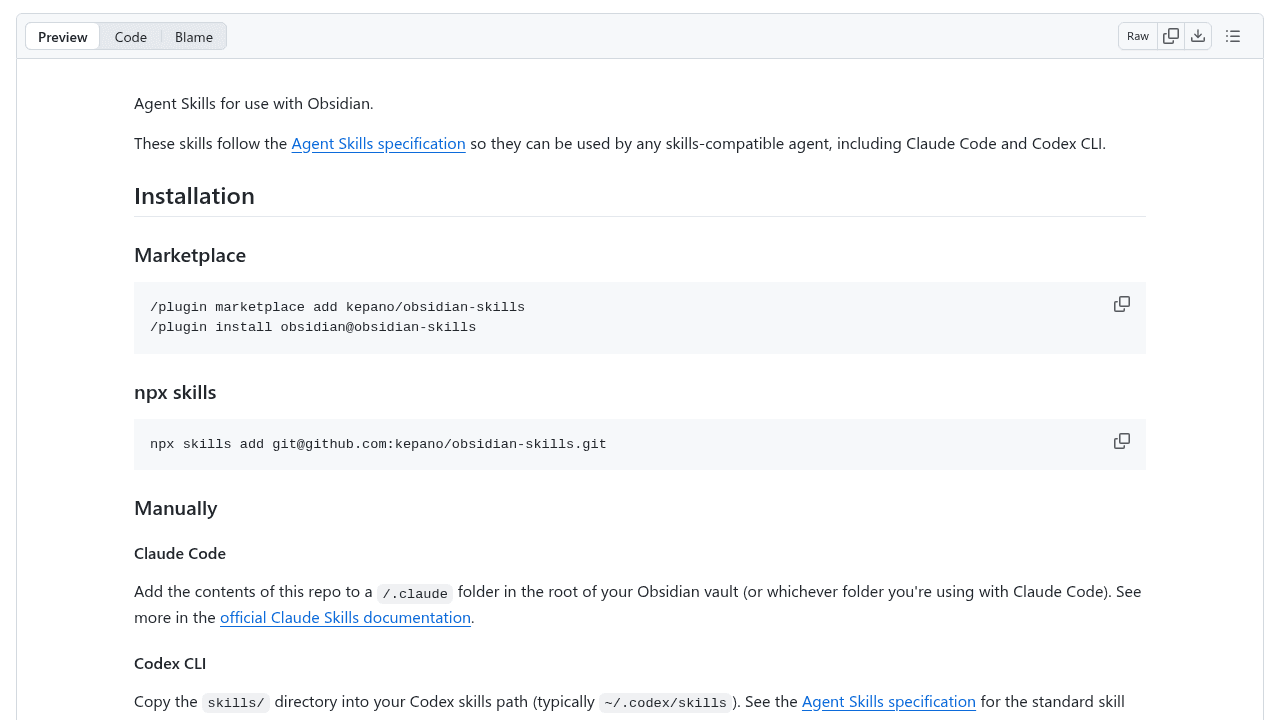
Integration follows the Agent Skills spec: point your agent at the repository URL or download the .skill files locally. Claude Code and Codex CLI are the primary use cases, but any agent supporting the specification can load them. Workflows that become reliable: automated daily notes with consistent frontmatter, building Bases databases from CSV imports, generating Canvas whiteboards from project hierarchies, and bulk editing vaults without manual verification.
With 15 open issues including Windows compatibility questions, the project is working through growing pains—typical for a repository at this stage. The core insight holds: AI agents need domain knowledge, and skills are cheaper to distribute than runtime patches.
kepano/obsidian-skills
Agent skills for Obsidian. Teach your agent to use Obsidian CLI and open formats including Markdown, Bases, JSON Canvas.