How One Developer Fixed n8n's 7,264-Workflow Discoverability Problem
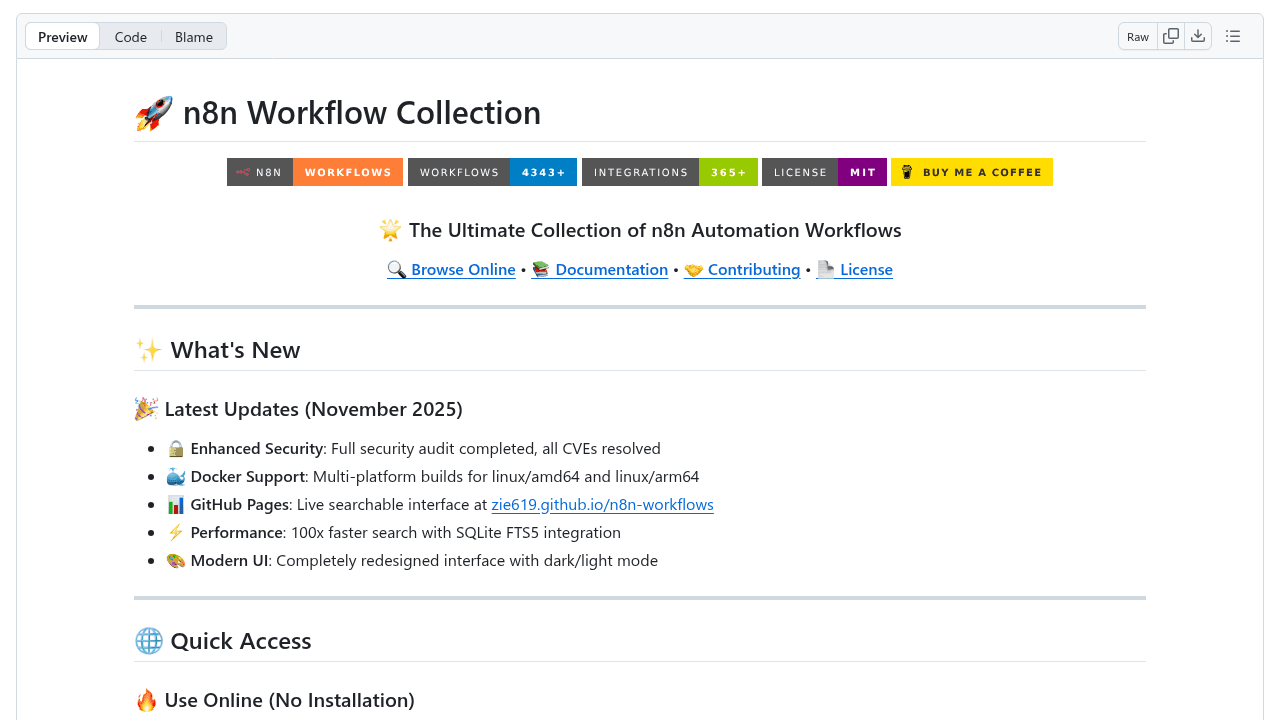
n8n has 365 integrations and 7,264 community workflows scattered across GitHub repos, forum threads, and personal blogs. Finding the right one meant manual hunting through untagged repositories. A developer built what the platform didn't: sub-100ms search across 2,057 curated workflows that you can drag-and-drop into your instance.
The Problem: Workflow Discovery Was Broken
n8n's strength became its weakness. Open-source, self-hosted automation attracted developers who built workflows everywhere—official template site, random GitHub repos, blog posts, Reddit threads. A threat intelligence workflow saving Vodafone £2.2 million might be three repos deep under "misc-automations."
Companies were betting infrastructure on n8n:
- Stepstone: 200+ mission-critical workflows
- Musixmatch: 47 engineering days saved in four months
- Delivery Hero: 200+ hours monthly efficiency gains
But finding reusable examples? Manual hunting. No unified search. No standardized naming. No way to filter by the 365 integrations. You needed a Slack-to-Airtable automation? Hope you guess the right search terms across five different platforms.
For a tool competing with Zapier (5,000 integrations) and Make (visual logic builder), discoverability was costing adoption.
The Solution: 2,057 Curated Workflows With Instant Search
Zie619 built the infrastructure n8n's platform was missing:
Technical Implementation:
- SQLite FTS5 for sub-100ms full-text search
- Automated categorization across 15 service categories (AI, CRM, DevOps, messaging, data processing)
- Intelligent naming conversion for 365 integrations
- GitHub Pages interface with drag-and-drop JSON import
The Workflow:
- Find your automation in <100ms
- Preview the node structure
- Drag JSON directly into n8n
- Deploy
No manual JSON wrangling. No version mismatches. Zero friction from discovery to deployment.
Why This Matters: Community Infrastructure vs. Platform Gaps
8 months. 38,000 GitHub stars. 3,500 forks. 671 watchers.
The repository got featured in the DevReady Podcast in June 2025. MCP servers integrated it via gitmcp.io for developer toolchains. CTOs referenced it in presentations. It became the answer to "Can n8n actually do this?" with "Here's exactly how."
The gap it filled wasn't just convenience—it was trust. When enterprises evaluate n8n against Zapier's per-action pricing or Make's complexity charges, they need proof that the 365 integrations actually work in production. Example workflows are that proof.
The platform economics:
- Zapier: $29-$103/month + per-task pricing
- Make: $9-$29/month + operation limits
- n8n: Self-hosted = $0, or cloud $20-$50/month
But cost advantages mean nothing if you can't find working examples. This repository made n8n's 365 integrations actually discoverable.
What Happens When Platforms Don't Solve Core Problems
30 contributors now maintain this repository. It powers enterprise workflows and appears in developer toolchains. The search still delivers sub-100ms results. Companies still evaluate n8n differently because it exists.
n8n hasn't built comparable search into their official platform. The community did.
This pattern repeats across developer tools: when platforms don't solve discoverability, community infrastructure emerges. GitHub stars (38K) measure the gap between what users need and what platforms provide.
The workflow count keeps growing. Because someone solved the problem platforms wouldn't.
Zie619/n8n-workflows
all of the workflows of n8n i could find (also from the site itself)