Microsoft's Free AI Agent Course: Production or Demo-Ware?
Most AI agent tutorials break the moment you ship them. Microsoft's new course claims to fix this with production-focused patterns—memory management, security, deployment, context engineering—not just toy examples. We examine whether 47,000 developers found the practical bridge from demo to production, or just another vendor-locked starting point.
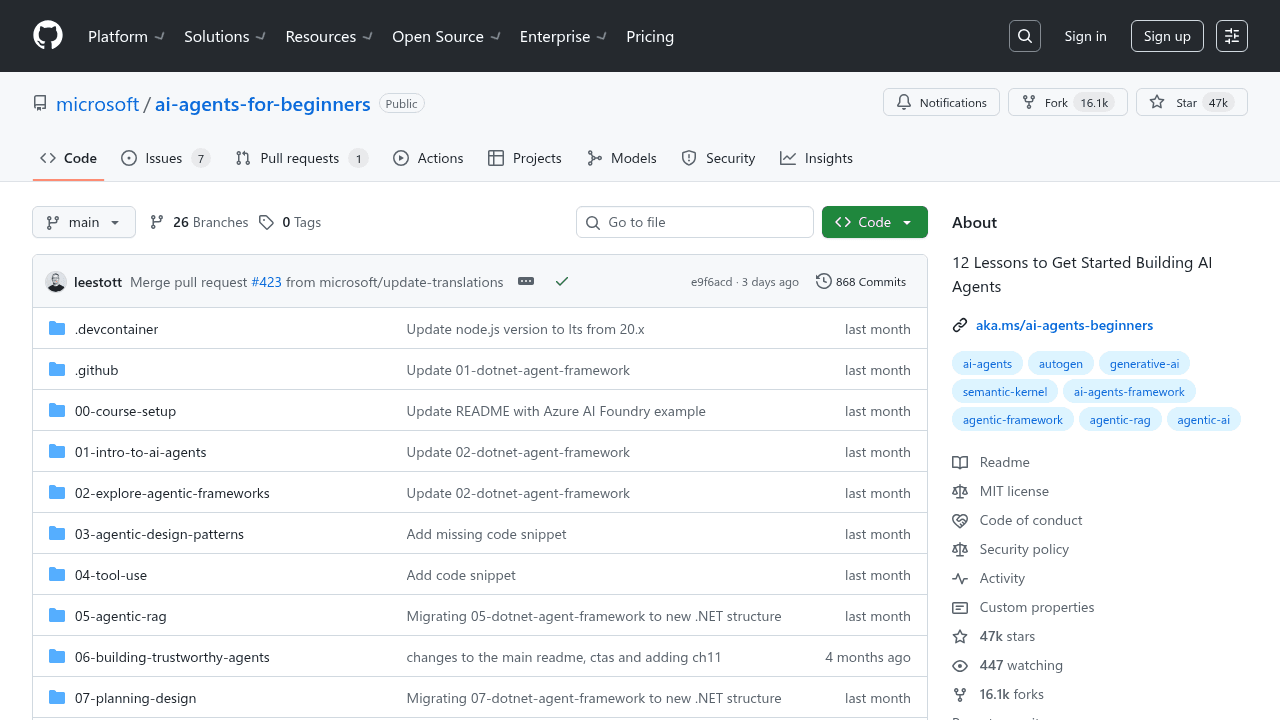
Every AI agent tutorial follows the same script: impressive demo, elegant code sample, then silence on what happens when you actually ship it. The prompt injection vulnerabilities, the context window explosions, the memory management nightmares—those show up later, in production, when the tutorial author is long gone.
Microsoft's new "AI Agents for Beginners" repository tries to flip that script. Created in November 2024, it's accumulated 47,000 stars and 16,000 forks in roughly a year. The pitch: stop teaching agent patterns in isolation, start teaching developers how to build agents that survive contact with real users.
The Demo-to-Production Gap Every AI Agent Hits
The community noise around AI agents has a consistent refrain: this stuff works great until you try to deploy it. Hacker News threads asking for "real examples of AI agents doing work" surface the same complaints—brittle tool chains, agents that hallucinate when context limits hit, security models that assume users won't try adversarial prompts.
Microsoft's course documentation explicitly targets developers who "understand LLMs conceptually but don't know how to actually build real AI agents." The curriculum focuses on the operational issues that break production agents: managing agent memory across sessions, engineering context windows that don't blow up costs, handling prompt injection and data exfiltration risks, deploying agents that don't require a PhD to monitor.
This isn't theoretical pattern-shopping. The repo covers agentic RAG, metacognition loops, multi-agent coordination, and emerging protocols like MCP (Model Context Protocol), A2A (Agent-to-Agent), and NLWeb—all framed around "how do you ship this without it falling over."
47,000 Stars in a Year: Why Developers Are Cloning This
The timing matters. Industry interest in agentic AI spiked in late 2024, driven by real-world enterprise deployments and mounting frustration with chatbot-level tooling. Microsoft positioned this repo as the official entry point for its developer tooling, integrating it with Microsoft Learn and its "Building Trustworthy AI Agents" blog series.
The technical stack removes friction that kills experimentation: GitHub Models Marketplace provides free LLM access, Azure AI Foundry handles backend orchestration, and code samples standardize on Microsoft Agent Framework and Semantic Kernel. For developers already in the Microsoft stack, it's a clear path from zero to deployed agent without stitching together five different vendor SDKs.
Syracuse University's career services lists it as a recommended course. Microsoft Learn built an entire show around it. That kind of institutional adoption doesn't happen for toy repos.
The Microsoft Stack Lock-In Trade-Off
The pragmatic read: this course teaches agents through a Microsoft lens. Azure AI Foundry, Semantic Kernel, AutoGen—the examples assume you're building inside Microsoft's tooling. That's deliberate. Reducing integration friction means accepting vendor lock-in.
Alternatives exist. LangChain offers framework-agnostic patterns. SuperAGI and standalone AutoGen provide different orchestration philosophies. The question is whether you value portability or velocity. This course optimizes for the latter.
Security Warnings: Agents Are Still Vulnerable
Microsoft's own "trustworthy agents" material, tied directly to this course, acknowledges the threat surface: internet-connected agents remain vulnerable to prompt injection, malicious tool use, and data exfiltration. The curriculum includes meta-prompting systems and threat modeling, but these are mitigations, not eliminations.
Security-focused AI newsletters consistently warn that agent examples are easy to manipulate. The course helps developers recognize those risks earlier, but shipping a production agent still requires dedicated security review beyond what a curriculum can provide.
Does This Finally Bridge the Gap?
This course raises the floor. Developers who complete it will build agents that handle memory, context, and deployment more competently than the typical "build a chatbot in 10 minutes" tutorial output. Whether that constitutes "production-ready" depends on your production environment.
For mid-to-senior developers in the Microsoft stack who've hit the wall between prototype and deployment, this is the most structured path currently available. For teams requiring vendor-agnostic architectures or operating outside Azure, the patterns are useful but the implementation examples may create more friction than they solve.
The demo-to-production gap hasn't disappeared. But 47,000 developers seem to think Microsoft narrowed it enough to matter.
microsoft/ai-agents-for-beginners
18 Lessons to Get Started Building AI Agents