Hermes Agent vs OpenClaw: Privacy-First Alternative
NousResearch's Hermes Agent takes a different path than OpenClaw: autonomous skill creation instead of human-authored tools, zero telemetry instead of data collection, and support for 200+ models instead of tight integration. Both approaches have merit—Hermes prioritizes privacy and self-improvement for developers who want control over their AI agents.
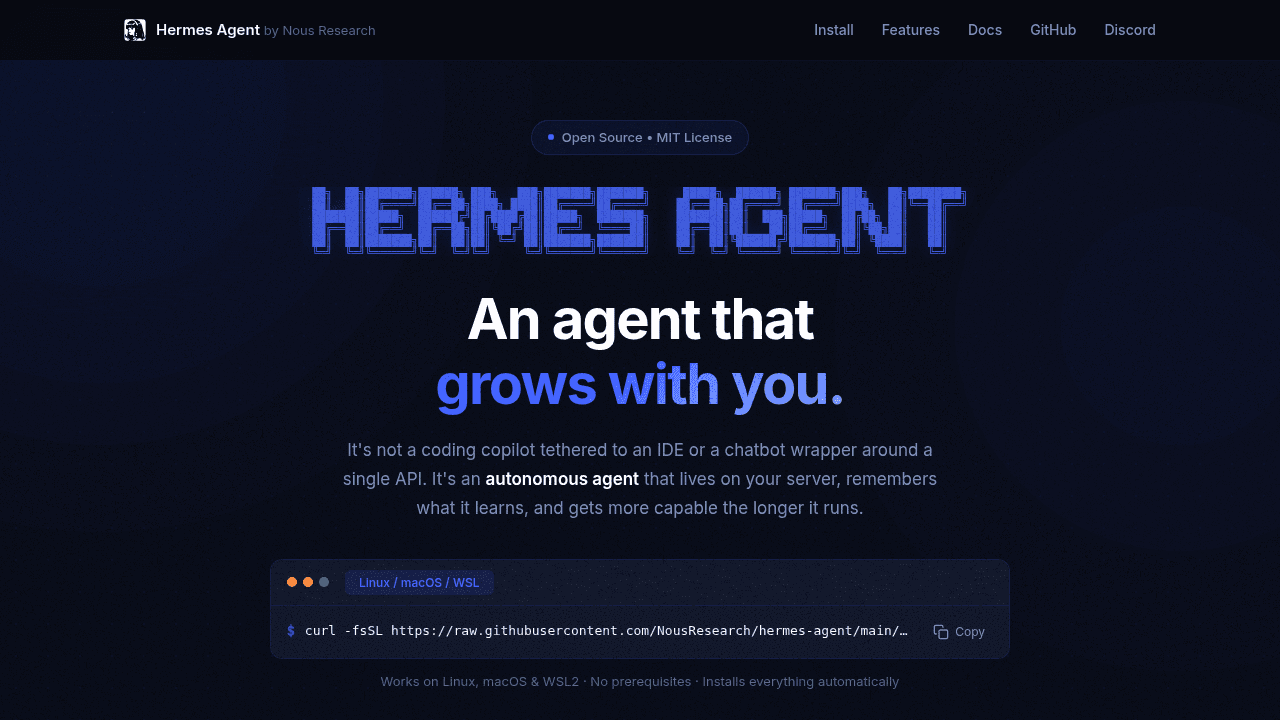
NousResearch's Hermes Agent runs persistently on servers like VPS or serverless infrastructure, accessible via Telegram, Discord, and other platforms. That solves the laptop-tethered problem most AI agents have—but the implementation makes Hermes different from OpenClaw's approach.
Both projects make AI agents accessible to developers. OpenClaw built the infrastructure first and proved server-based agents could work. Hermes took a different path: autonomous skill creation over curated tools, zero telemetry over usage analytics, and support for 200+ models instead of tight integration.
Autonomous Skills vs Human-Authored Tools: Different Design Philosophies
Hermes uses self-improving skills that the agent creates autonomously rather than relying on human-authored tools. The system evaluates its performance every 15 tasks, adjusting its skill library based on what works. A layered memory system lets the agent retain context across sessions without depending on pre-built integrations.
OpenClaw's curated approach offers predictability—you know exactly what tools are available and how they behave. Hermes trades that certainty for adaptability, letting the agent develop capabilities based on actual usage patterns. OpenClaw optimizes for reliability; Hermes optimizes for self-improvement.
Zero Telemetry and Model-Agnostic Flexibility
The project collects zero telemetry—no usage data, no performance metrics sent back to NousResearch. For developers working with sensitive data or deploying in regulated environments, that matters.
Hermes supports 200+ models via OpenRouter and other providers—Claude, GPT-4, Llama, local models through Ollama. OpenClaw's tight integration with specific providers delivers better out-of-the-box performance but locks you into those choices. Hermes gives you control over where your data flows and which models process it.
Real-World Performance: Limitations Worth Knowing
The flexibility has costs. Users report slow responses caused by large models, distant API servers, or heavy system prompts with many tools. These aren't bugs—they're tradeoffs inherent to supporting diverse model backends without optimization for specific providers.
Build issues crop up during updates. The v0.6.0 release introduced python-olm build failures when upgrading from v0.5.0, though core functionality remained unaffected. Some PRs have caused silent git output and missing progress indicators during updates. These are rough edges typical of a project growing fast—frustrating but not dealbreakers for developers comfortable with open source's iterative nature.
Momentum and Multi-Agent Features in v0.6.0
Hermes has gained 22,000 stars by becoming the first real alternative to OpenClaw, appealing to developers who want privacy-first infrastructure. The v0.6.0 release added multi-agent support, letting multiple agents coordinate on complex tasks—a capability OpenClaw has refined over longer development cycles but which Hermes now offers with its characteristic model flexibility.
Recent development includes CLI improvements, AgentNet social network integration, and contributions addressing the update issues. The momentum reflects developer interest in having choices for agent architecture beyond the dominant platform.
Choosing Between Hermes and OpenClaw
Pick Hermes if you need privacy guarantees, want to self-host everything, or require flexibility across model providers. Its autonomous skill creation means agents adapt to your specific workflows rather than generic use cases. Choose OpenClaw if you value the mature infrastructure, extensive documentation, and performance optimizations from tight integration.
OpenClaw proved server-based agents could work at scale. Hermes proved you don't have to sacrifice privacy or model choice to get there. Both projects push each other toward better solutions.