Grok-1: When 'Open Weights' Meets Multi-H100 Reality
Grok-1's open-weight release marks a symbolic win for the open AI movement, but the gap between ideology and practicality has never been starker. GPT-3.5-level performance in a base model requiring multi-H100 infrastructure forces a reckoning: when does 'open' become meaningless if 99% of practitioners can't run it?
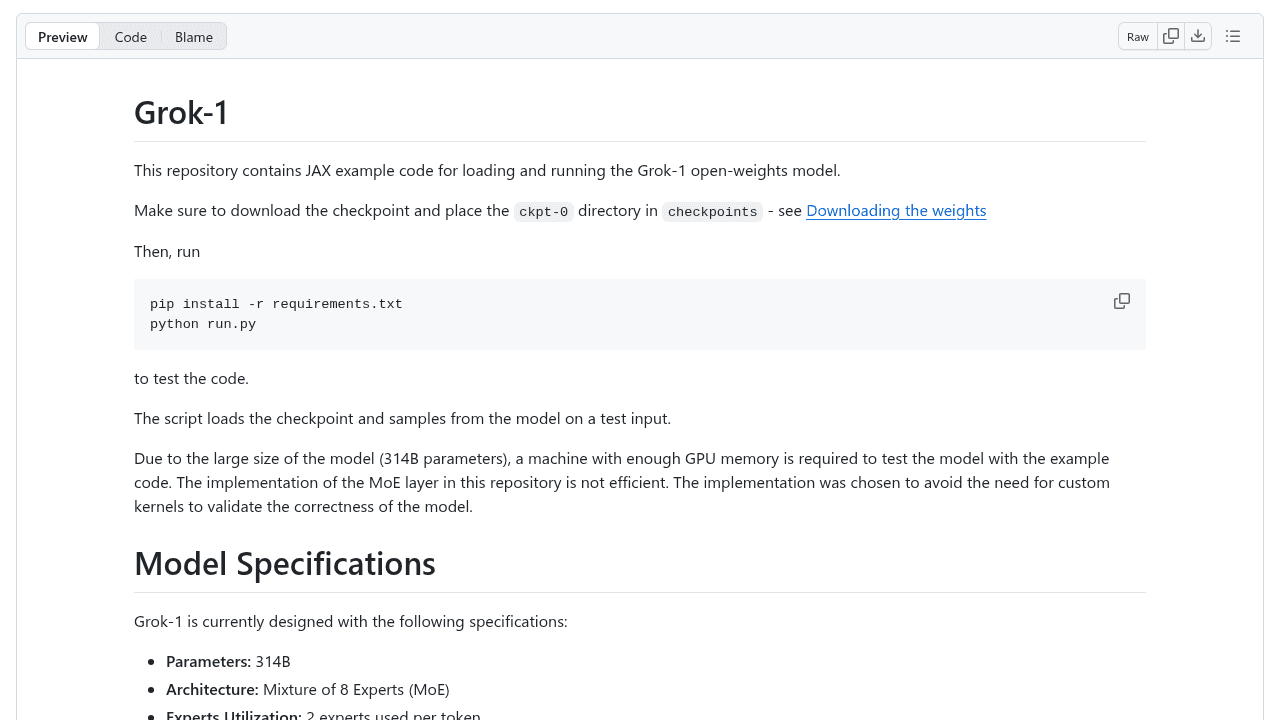
xAI released Grok-1's 314 billion parameters under Apache 2.0 in March 2024—the largest permissive-license language model at the time. The repository includes weights, JAX reference code, and a commercial-use license. By every measure of "open AI," this looked like a win.
Then developers tried to run it.
What xAI Actually Released
The technical inventory is straightforward: a 314B-parameter Mixture-of-Experts architecture with eight experts and two active per token. The model ships as base weights only—no instruction tuning, no dialogue optimization. Distribution happens via torrent and Hugging Face under the xai-org/grok-1 repository.
The Apache 2.0 license removes commercial restrictions that limited earlier large open releases. From a policy standpoint, this is what the open-weights community asked for. The model itself targets GPT-3.5 parity on benchmarks like GSM8K, MMLU, and HumanEval.
The Hardware Math Nobody Wants to Talk About
Running Grok-1 requires infrastructure most practitioners don't have. Even with quantization, the model demands tens to hundreds of gigabytes of GPU memory. Multiple Hacker News threads cite estimates requiring eight or more H100s for basic inference. The repository's own documentation acknowledges that the MoE layer implementation prioritizes correctness over optimization, meaning real-world performance will be slower than theoretical maximums.
One developer comment: "This is not really practical for end-user dialogue without further fine-tuning." The base-model-only release means teams inherit all the post-training work—instruction tuning, safety alignment, dialogue optimization—that instruction-tuned competitors ship ready to use.
The cost gap is stark. Renting multi-H100 clusters for experimentation runs hundreds of dollars per hour. For context, Mixtral 8x7B delivers comparable performance on hardware most teams already have access to.
GPT-3.5 Performance in 314B: The Efficiency Question
Benchmark positioning confirms GPT-3.5 parity, which raises a question: why deploy 314 billion parameters for capability levels achievable with smaller models? Mixtral 8x7B and Qwen-1.5 72B occupy the same performance range while requiring a fraction of the compute.
The MoE architecture means only two experts activate per token, bringing active parameters closer to 50-80 billion. That's still larger than alternatives delivering similar results. For teams making infrastructure decisions, the efficiency equation doesn't favor Grok-1 in most scenarios.
What 'Open' Means When You Need Eight H100s
The tension between open-weights ideology and economic accessibility has never been clearer. Transparency, API independence, and research access all improve when weights are public. Those benefits are real. But if hardware requirements exclude 99% of practitioners, how meaningful is "open"?
Grok-1 serves a narrow audience: researchers studying MoE architectures, teams with serious fine-tuning budgets exploring large-scale model customization, infrastructure engineers benchmarking multi-GPU setups. For everyone else, smaller instruction-tuned models are objectively better choices.
The Practical Alternatives Stack
Teams evaluating open-weight options face a clearer landscape now. Mixtral 8x7B and 8x22B offer strong performance with manageable hardware needs. Qwen-1.5 variants provide instruction-tuned weights ready for deployment. LLaMA derivatives span the range from efficient to powerful, many with commercial licenses.
Grok-1 occupies the "largest permissive model" position—meaningful for research transparency but a poor fit for production constraints. The decision framework comes down to whether scale justifies infrastructure cost. For specialized research, maybe. For most use cases, smaller models win on every practical dimension.
The gap between symbolic victories and usable tools just became impossible to ignore.