fhEVM: Run Smart Contracts on Encrypted Data
Public blockchains expose every transaction, trading strategy, and vote to the world. fhEVM brings fully homomorphic encryption to the EVM, letting contracts compute on encrypted data without breaking composability or forcing developers to abandon Solidity. Performance is the trade-off: 20 TPS versus thousands, but the coprocessor architecture makes it practical for applications where privacy isn't optional.
Every DeFi trade you make is visible on-chain before it settles. Every DAO vote is public before the poll closes. Every game state is readable by any bot with an RPC endpoint. This isn't a bug in Ethereum—it's the design. Public blockchains achieve consensus by making everything visible to validators, which means your trading strategies, voting choices, and financial positions are exposed by default.
fhEVM lets you run smart contracts on encrypted data without leaving the EVM. Contracts compute on ciphertexts using fully homomorphic encryption (FHE), encrypted state lives on-chain, and threshold decryption among validators reveals results only when needed. The developer experience: Solidity with new encrypted types like euint8 and ebool, Hardhat and Remix for tooling, and the same deployment flow you already use.
The Coprocessor Architecture: Why It's Practical Now
Earlier versions of fhEVM processed around 2 FHE transactions per second and required validators to run a modified EVM—a non-starter for L1s. Zama's coprocessor runs FHE operations off the main execution layer and posts results back. This removed the adoption barrier: instead of modifying every EVM chain, the coprocessor works with unmodified Ethereum and other EVM networks.
Performance improved roughly 10x, from ~2 TPS to close to 20 TPS for FHE transactions. That's still orders of magnitude slower than standard smart contract execution—FHE operations carry significant CPU and memory overhead. This isn't for high-frequency trading or applications where milliseconds matter. But for use cases where confidentiality isn't optional—sealed-bid auctions, private voting, confidential DeFi positions—the trade-off makes sense.
Production Deployments: Fhenix, Shiba Inu, Inco
Fhenix integrates fhEVM as an FHE Layer 2 rollup, enabling confidential transactions and privacy-preserving scaling for Ethereum. Shiba Inu is using fhEVM to build network state infrastructure for its community, including financial tools and metaverse components. Inco runs fhEVM as a modular blockchain providing "Confidentiality-as-a-Service" to multiple Layer 1 networks. Cypher (z1labs) embeds an fhEVM-based extension inside its chain for executing smart contracts over encrypted data.
Zama's fhEVM Coprocessor is live on Ethereum Sepolia testnet, letting developers run confidential smart contracts on non-FHE EVM chains. Mainnet deployment is planned after further testing. The archived fhevm-go library shows prior adoption at the protocol level by EVM maintainers integrating fhEVM into EVM-compatible blockchains.
fhEVM vs. ZK vs. TEE Privacy Solutions
Zero-knowledge proof systems like zk rollups and zkEVMs provide selective disclosure—you prove correctness of computations without revealing inputs. But they don't keep all contract state encrypted by default. TEE-based blockchains use trusted hardware to run confidential computations, often faster than FHE but at the cost of hardware trust assumptions.
fhEVM chose cryptographic security over performance. Encrypted state and computations happen via FHE and threshold decryption among validators, staying permissionless and decentralized. The cost is throughput: community discussions on Zama's forum show users grappling with resource demands when comparing implementations.
When is encrypted state worth the performance hit? If your application needs confidentiality and can tolerate limited throughput, fhEVM is available now. The 26K GitHub stars, live testnet deployments, and multiple integrations (Fhenix, Shiba Inu, Inco) signal traction. Zama's $73M raise and roadmap to make the internet "encrypted end-to-end" position fhEVM as the flagship blockchain technology in that plan.
Developer resources live in the fhEVM documentation, GitHub repos, and Sepolia testnet deployment. Hackathon workshops like ETHRome 2025 sessions on FHE smart contracts are expanding the builder community. The trade-off is clear: cryptographic privacy at the cost of throughput.
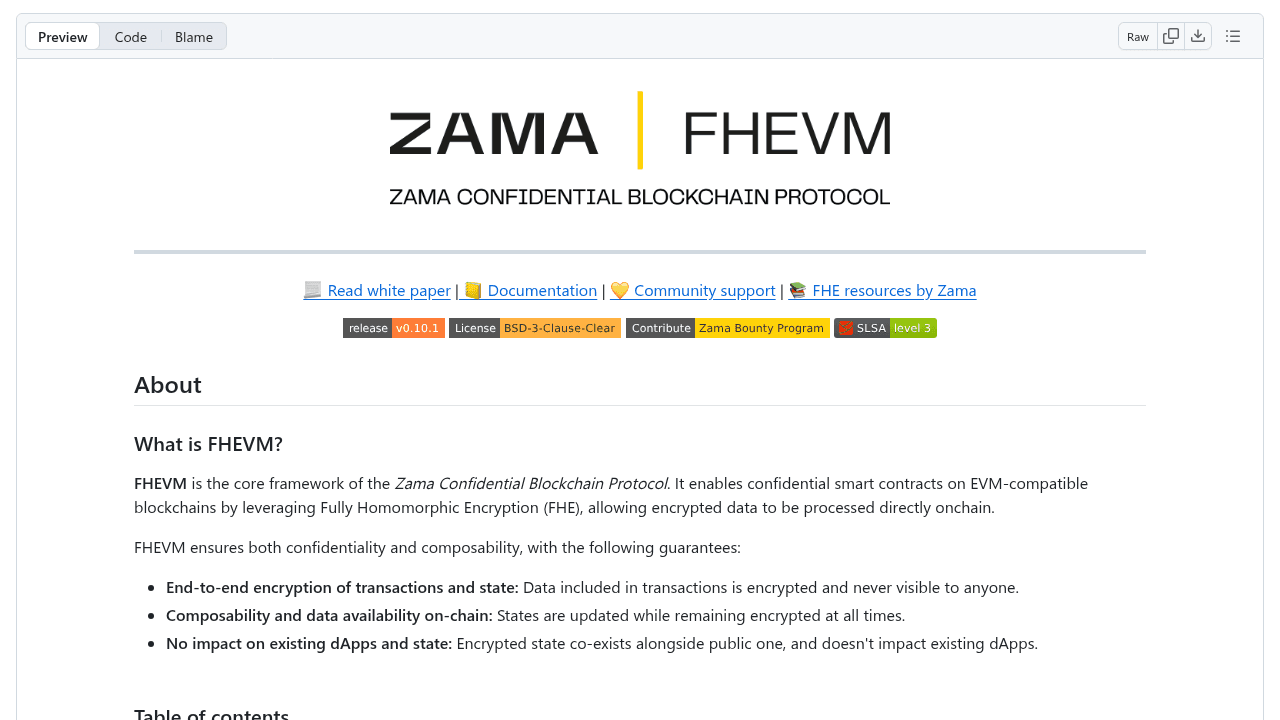
zama-ai/fhevm
FHEVM, a full-stack framework for integrating Fully Homomorphic Encryption (FHE) with blockchain applications