Free Claude Code: Route Any AI Model Through Claude's UI
Claude Code's interface became valuable enough that developers wanted it with any backend—not just Anthropic's paid API. This proxy fills that architectural gap by routing requests to free providers, local models, or existing subscriptions. The technical trade-offs are real, but so is the demand: 60K+ stars prove developers need this bridge.
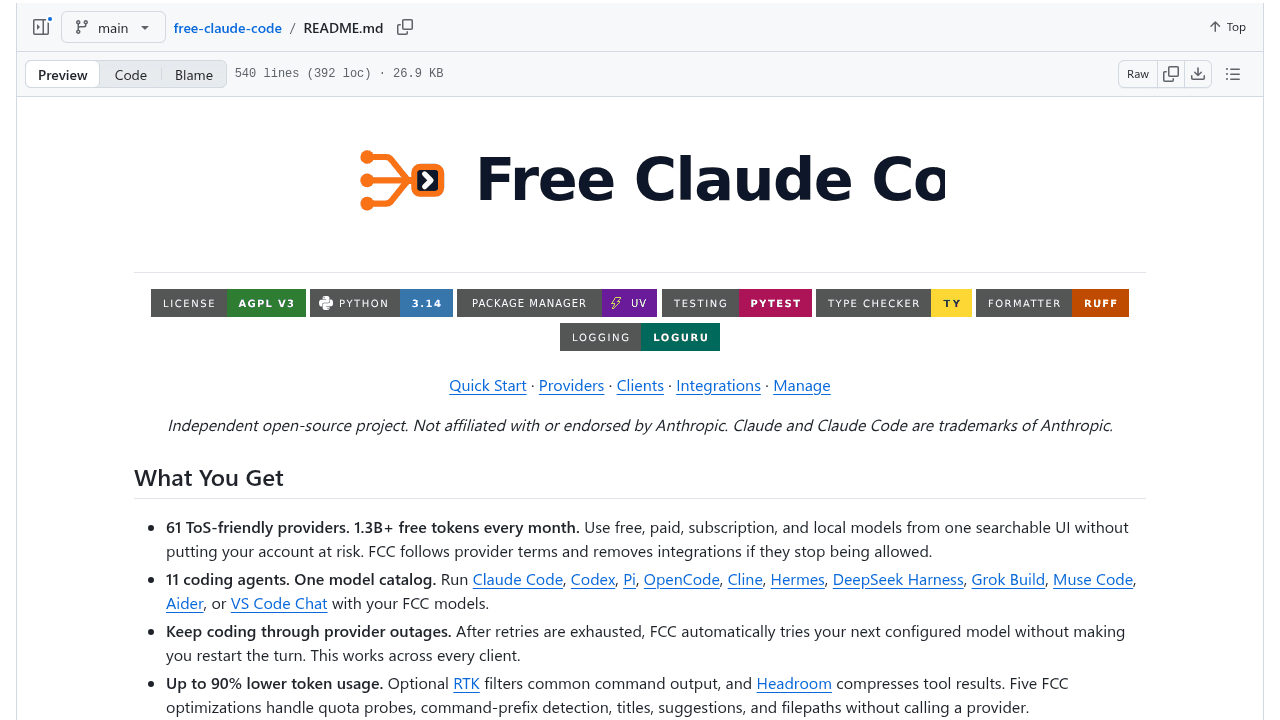
Claude Code shipped with one dealbreaker: you needed an Anthropic API key. Developers who wanted to route through OpenRouter, run local models, or use existing NVIDIA NIM subscriptions hit a wall. The interface was too good to abandon, so the community built a proxy that routes requests to whatever backend you've got—free tiers, subscription services, or llama.cpp running on your laptop.
The Hard Requirement Nobody Wanted
Claude Code's agent architecture depends on a direct connection to Anthropic's API. That's fine if you're paying for Claude Pro or have API credits, but it blocks anyone who wants cost control, local inference, or the ability to experiment with alternative models. The proxy sits between Claude Code and your chosen provider, translating requests and forwarding responses. Downstream forks now reproduce the configuration for NVIDIA NIM, DeepSeek, LM Studio, and other backends—evidence that the constraint affected more than a handful of developers.
How the Proxy Routes Requests
The mechanism is straightforward: intercept Claude Code's outbound API calls, rewrite them for the target provider's format, send the request, then translate the response back into what Claude Code expects. That middle layer handles authentication, endpoint mapping, and parameter translation.
The complexity emerges in edge cases. Newer Claude Code requests include inline system messages, which triggered HTTP 422 errors when the proxy initially allowed only user and assistant message roles. That required a code update to handle the broader message schema. This is the expected friction when you're reverse-engineering an interface to work with backends it was never designed for.
What Works (and What Breaks) Across Providers
Real-world usage reveals predictable failure modes. Model deprecations break things until users manually select a replacement—GLM4.7 stopped working mid-session for one user who had to switch models to continue. NVIDIA NIM's free tier rate limits hit hard when Claude Code fires repeated requests during a debugging session, causing slowdowns and rejected calls.
The proxy itself handles request routing reliably. Most problems trace to provider infrastructure (rate limits, model availability) or to differences between models rather than bugs in the translation layer.
The Quality Trade-Off With Non-Claude Models
Claude Code expects a model that can handle multi-file reasoning, precise tool calls, and long debugging sessions. Smaller or alternative models struggle with those demands: architectural reasoning across large codebases degrades, function-calling precision drops, and context management gets flaky. That's not a proxy failure—it's a reflection of what each model was trained to do. Claude excels at agentic coding workflows; a smaller local model optimized for chat completeness will underperform in the same harness.
The trade-off is explicit: you gain cost control and provider flexibility, but you accept variance in output quality. For exploratory work or simpler refactoring tasks, the variance is tolerable. For production debugging sessions where precision matters, the original Claude backend remains the stronger choice.
CodeRouter and the Fallback Strategy
CodeRouter takes a different approach—automatic fallback chains that prioritize local inference, then escalate through NVIDIA NIM and OpenRouter if the local model fails. Free Claude Code emphasizes breadth: one catalog spanning multiple coding agents and dozens of providers. Both projects address the same problem space without competing directly. CodeRouter optimizes for resilience; Free Claude Code optimizes for choice.
Why 60K Stars Matter
The repository's adoption signals something broader: developers value interface consistency enough to build infrastructure when vendors lock backends. This proxy respects both Anthropic's original work on Claude Code and the community effort to make that interface portable. It's glue code that makes open systems work—unsexy, necessary, and worth celebrating.
Alishahryar1/free-claude-code
Use Claude Code, Codex, VSCode, Pi, and OpenCode (and 6 other harnesses) for free (1.3B+ free tokens) from your terminal, app, IDE, or phone, and now from the browser with native browser sessions (multi-harness + multi-model) like OpenClaw (voice supported + ToS friendly)