ccundo: Operation-Level Undo for Claude Code
An analysis of ccundo, a tool that provides operation-level undo functionality for Claude Code. The article examines how it addresses the token economics and workflow challenges of AI-assisted development by enabling selective operation reversal without git reset collateral damage.
ccundo: Operation-Level Undo for Claude Code
Claude Code just refactored your authentication system. Ten seconds, 50 files. Thirty minutes later, you realize the API endpoints are broken.
Your options are terrible. Ask Claude to fix it—burn 100-500 tokens watching it guess what went wrong. Run git reset—lose the three bug fixes that came after the bad refactor. Manually restore files—spend 20 minutes hunting through session logs, copy-pasting code blocks.
ccundo gives you a fourth option: undo individual AI operations.
The AI Code Assistant Problem
AI coding assistants generate code faster than you can review it. Claude Code makes 50 changes before you finish reading the first diff. When one operation breaks—a refactor that kills existing functionality, a file deletion that cascades into import errors—you're stuck with damage control methods designed for human-paced development.
The token economics are brutal. Each "please revert that last change" costs 100-500 tokens as Claude rebuilds context and attempts fixes. For API users paying per token, a single bad refactor followed by three fix attempts costs more than the original feature request. Multiply that across daily mistakes, and ccundo stops being a convenience tool—it's cost control.
Git reset works, but it's blunt. Rewind to before the broken refactor, and you lose the logging improvements and security patch that came after. Manual file restoration means digging through Claude's session files, identifying which changes belong to which operation, and selectively copy-pasting. Twenty minutes gone.
How ccundo Works
ccundo reads Claude Code's session files directly, parsing them into discrete operations. Each refactor, file creation, or deletion becomes an atomic unit you can rewind independently.
ccundo list shows your operation history. ccundo undo reverts the last operation. ccundo undo 3 rewinds three operations with cascading logic—if operation 5 modified a file created in operation 3, rewinding operation 3 also reverts operation 5's changes to that file.
Concrete example: Claude refactored your auth system (operation 7), then fixed two unrelated bugs (operations 8 and 9). The refactor broke your API. Run ccundo undo 7—the auth changes disappear, the bug fixes remain.
Early Tool, Real Bugs
ccundo is two months old. It shows. Pull request #14 addresses a parsing bug where directories with dots in their names confuse the session file reader. Some users report ccundo list failing to detect active Claude Code sessions, forcing manual session file location.
The 1,268 GitHub stars in under two months suggest developers are willing to tolerate rough edges. The alternative—token waste, git reset collateral damage, manual tedium—is worse than occasional parsing failures.
Version Control for AI Workflows
Git was built for human developers making deliberate, reviewed commits. AI code generation operates at a different scale—hundreds of file changes per minute, exploratory refactors, rapid iteration.
File-level version control doesn't map to operation-level workflows. When Claude makes 15 changes across 30 files in a single "add user authentication" operation, you don't want to revert files—you want to revert the operation.
ccundo hints at what version control needs to become. As AI writes more code than humans, tools will need operation-level granularity, not just file-level snapshots. The shift mirrors how IDEs evolved from text editors—same core function, different workflow assumptions.
For now, ccundo is a fix for Claude Code users tired of wasting tokens on AI-generated mistakes. Long-term, it's a preview of how developers will manage code when humans do more reviewing than writing.
RonitSachdev/ccundo
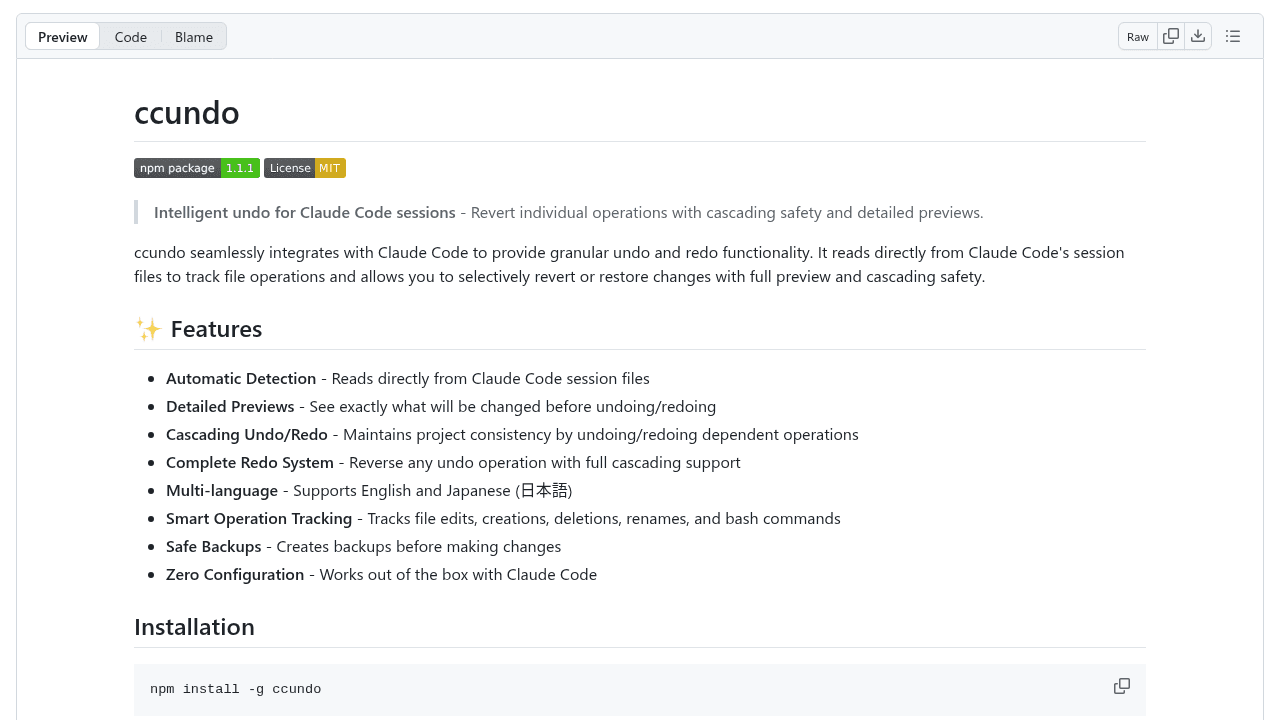
ccundo seamlessly integrates with Claude Code to provide granular undo functionality. It reads directly from Claude Code's session files to track file operations and allows you to selectively revert changes with full preview and cascading safety.