DeepTutor: Citation-Grounded AI Tutoring + Learner State
DeepTutor attempts something most AI tutors skip: combining retrieval-anchored explanations with stateful memory of what you've mastered. The HKUDS team supports LlamaIndex, GraphRAG, Obsidian, and five other backends while tracking learner progress across sessions—a technically ambitious architecture that's still working through orchestration costs, interface instability, and performance bottlenecks.
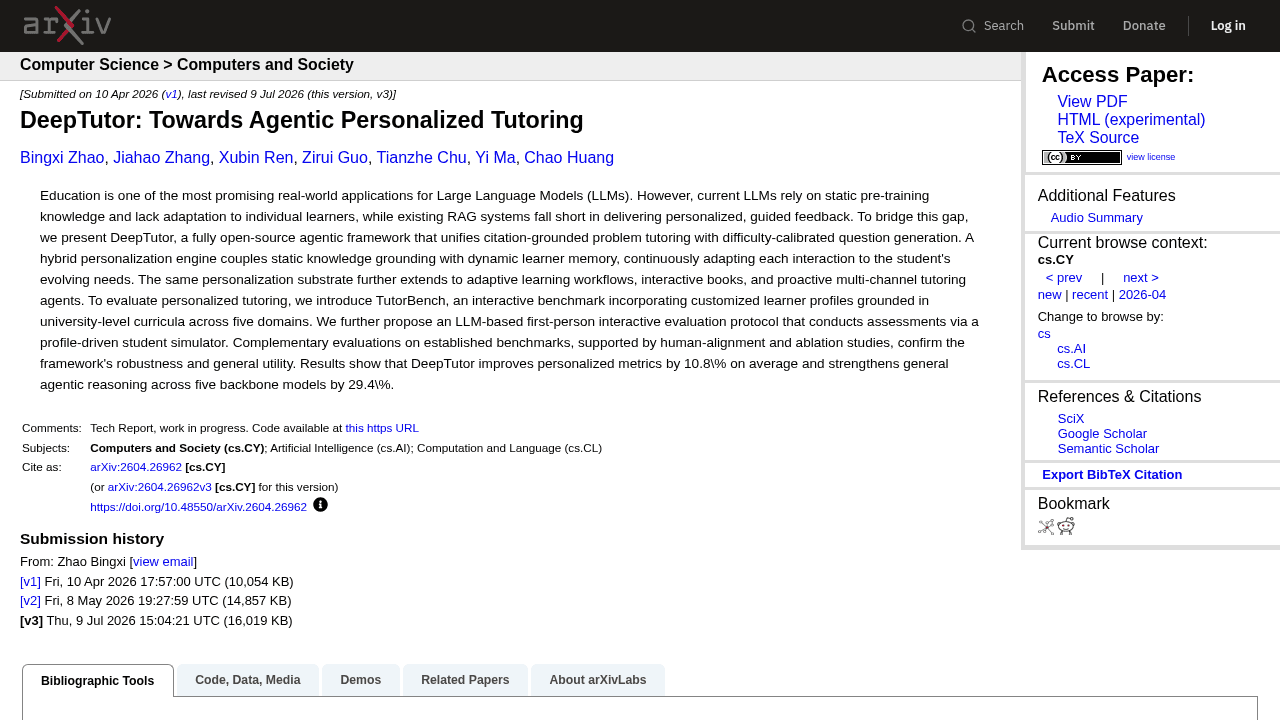
Most AI tutoring systems make a choice: either they ground explanations in cited sources (RAG-based) or they track what you've learned across sessions. DeepTutor, from the HKUDS research team, attempts both—combining static knowledge retrieval with dynamic learner memory so the system can adapt to a student's evolving understanding rather than treating each conversation as a blank slate.
The architecture supports eight different knowledge backends—LlamaIndex, PageIndex, GraphRAG, LightRAG, WeKnora, Tencent IMA, MarginNote 4, and linked Obsidian vaults—while maintaining a persistent learner model across all of them. That's harder than it sounds. Retrieval-augmented generation focuses on accurate, source-grounded responses. Stateful learner modeling focuses on adaptive difficulty and prerequisite tracking. Orchestrating both means balancing retrieval latency, memory overhead, and pedagogical logic in a single request flow.
The architectural gap: RAG or learner state, rarely both
Standard RAG tutors retrieve context from documents but treat each question independently. Conversational memory helps, but it's shallow—chat history isn't the same as modeling what a student has mastered. DeepTutor's bet is that difficulty-calibrated question generation anchored in citations becomes more effective when the system remembers which concepts a learner has already demonstrated fluency in. The cost is complexity: more state to manage, more backends to sync, more orchestration cost per interaction.
Where the complexity shows: fragmented lessons and orchestration costs
The GitHub issue tracker reflects the strain. Issue #1971 reports that Mastery Path lessons can fragment, progression can feel rigid, and orchestration costs can grow high enough that users spend time debugging the tutor instead of studying. Issue #1972 documents interface instability—content disappearing or reappearing, unexpected scrolling, unclear progress during long operations, and difficult recovery of cancelled messages. These are growing pains of a system juggling retrieval, generation, and learner state in real time.
Performance bottlenecks at scale
Supporting eight backends surfaces predictable scaling challenges. The issue tracker contains reports of low cache-hit rates, missing memory traces, package-lock inconsistencies, event-loop blocking during GraphRAG indexing, and quadratic disk growth during linked-folder synchronization. These are the kind of friction that emerges when a research-driven team prioritizes feature breadth over optimization in early releases.
MathTutorBench and AITutor-EvalKit: complementary evaluation tools
Two related projects are worth noting. MathTutorBench provides a benchmark for open-ended pedagogical capabilities of LLM tutors, measuring how well tutoring systems handle domain-specific reasoning. AITutor-EvalKit is a toolkit focused on evaluating pedagogical quality—rubric adherence, scaffolding, feedback clarity. DeepTutor is an end-user tutoring framework; these are eval layers. They complement each other rather than compete.
Release velocity: June–November 2025
Despite the challenges, the team shipped frequently. Between June and November 2025, releases added LightRAG, FAISS retrieval, learning workspaces, daily practice, research tools, narrated lessons, desktop previews, and localization. The v1.7.1 release in November introduced Open DeepTutor desktop previews and broader localization. That cadence suggests the team is treating performance and stability as iterative problems, not blockers.
Who should watch this
DeepTutor makes sense for EdTech engineers building personalized learning systems, AI researchers working on pedagogical agents, and teams wrestling with the problem of maintaining learner state across retrieval-grounded interactions. It's research-driven, not turnkey. The interface instability and orchestration costs are real, but so is the architecture. If you're exploring how to combine RAG with adaptive tutoring at scale, this is one of the few open frameworks attempting both.
HKUDS/DeepTutor
DeepTutor: Lifelong Personalized Tutoring. https://deeptutor.info/.