Crawl4AI: Free Scraper That Hit 57k Stars in a Year
Crawl4AI went from zero to 57k GitHub stars in under a year by solving what expensive 'open-source' scrapers couldn't: fast, free web-to-Markdown conversion for LLMs. Legal tech teams scrape court sites for RAG chatbots, e-commerce monitors prices daily, and ML engineers dodge API rate limits—but 168 open issues, Docker bugs, and CAPTCHA struggles reveal the messy reality behind the hype.
The $16/Month Scraper That Didn't Scrape
The frustration was specific: $16 a month for an "open-source" web scraper that choked on JavaScript-heavy sites and required API keys for basic features. The creator of Crawl4AI wasn't dealing with abstract vendor lock-in—he was paying real money for tools that under-delivered. So he built an alternative.
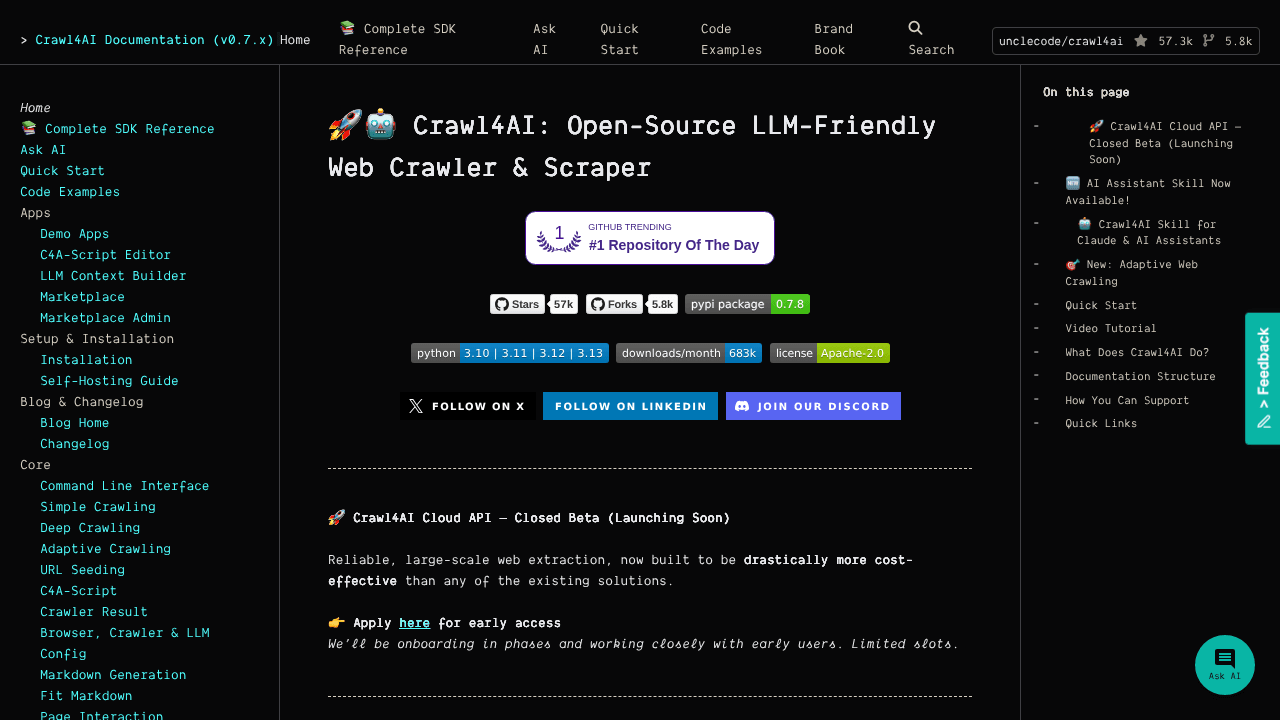
That was May 2024. By November 2025, Crawl4AI had 56,700 GitHub stars and was trending as the #1 crawler on the platform. The growth was measurable—2,700 dependent projects are using it in production, and the weekly star count hit 2,719 in a single week this month.
What Crawl4AI Actually Does (and Doesn't)
Crawl4AI converts web pages to clean Markdown optimized for LLMs and RAG pipelines. It handles JavaScript rendering, navigates bot detection, and runs locally via Docker with no external dependencies. You write Python scripts, point it at URLs, and get structured data back without API quotas or pricing tiers.
What it doesn't do: solve CAPTCHAs out of the box, provide a no-code interface, or work outside Python environments. The learning curve is steep if you're not comfortable writing scripts. Issues #1567 (macOS freezing), #399 (Docker memory bugs), and #1564 (proxy serialization failures) are open alongside 165 others. The polish came slower than the adoption.
Who's Actually Using It
A legal tech startup scrapes court websites and public law libraries to feed a RAG chatbot that answers case law queries. E-commerce teams monitor competitor pricing and product reviews daily. A wedding photographer scraped 500+ venue listings for lead generation. University researchers collect news articles for sentiment analysis pipelines.
These aren't aspirational use cases—they're documented in the project's community channels. The 2,700 dependent projects on GitHub represent production systems where Crawl4AI replaced paid alternatives or filled gaps where APIs didn't exist.
The Growth Is Real. So Are the Bugs.
The momentum shows in the numbers: 59 contributors, 5,700 forks, and active version updates (v0.7.7 in April 2025 added monitoring dashboards). The project hit this scale during the exact moment when RAG pipelines and AI agents exploded in demand.
But the 168 open issues tell the other half of the story. Docker memory leaks, sitemap seeding failures (#1559, #1542), virtual scroll bugs (#1515), and documentation errors haven't been resolved at the same pace as feature releases. This is a tool with traction and growing pains.
Crawl4AI vs. Firecrawl, ScrapeGraphAI, Spider
Firecrawl focuses on API-first Markdown extraction with tiered pricing and less local control. ScrapeGraphAI uses natural language for adaptive crawling. Spider delivers Rust-powered speed for bulk operations. Crawlee specializes in retries and proxy rotation.
Crawl4AI's differentiator: zero-cost open-source with full control, local LLM support, and no API dependencies. The tradeoff is Python-only implementation and no graphical interface. If you need a no-code solution, Thunderbit exists. If you need speed at massive scale, Spider's Rust engine is faster. Crawl4AI occupies the space between those extremes—programmable, free, and self-hosted.
The AI Scraping Ethics Problem Nobody Solved
Reddit and Hacker News threads highlight the tension: AI crawlers hitting servers with DDoS-like traffic patterns versus the need for training data and content aggregation. "Respectful crawling" features don't resolve the underlying question of whether extracting content at scale is ethical—they just make it more efficient.
The AI scraping market is projected to hit $38 billion by 2034. Crawl4AI makes that extraction cheaper and more accessible, but it doesn't adjudicate the moral framework around it.
Is This Sustainable or Headed for VC Capture?
The hard question: Can a project with this growth trajectory stay open-source? The market pressure is real, and the pattern is familiar—viral tools get acquired, paywalled, or pivot to "open-core" models where key features require licenses.
No one knows if Crawl4AI stays free or follows that arc. For now, it's fully open-source, actively maintained, and solving problems for teams that can't afford API pricing tiers. Use it while that's true. Watch what happens next.
unclecode/crawl4ai
Open-source web crawler and scraper for LLMs and AI agents: any website into clean, LLM-ready Markdown. Run it yourself, or use Crawl4AI Cloud with one key.