CL4R1T4S: The Hidden System Prompts Behind Every AI
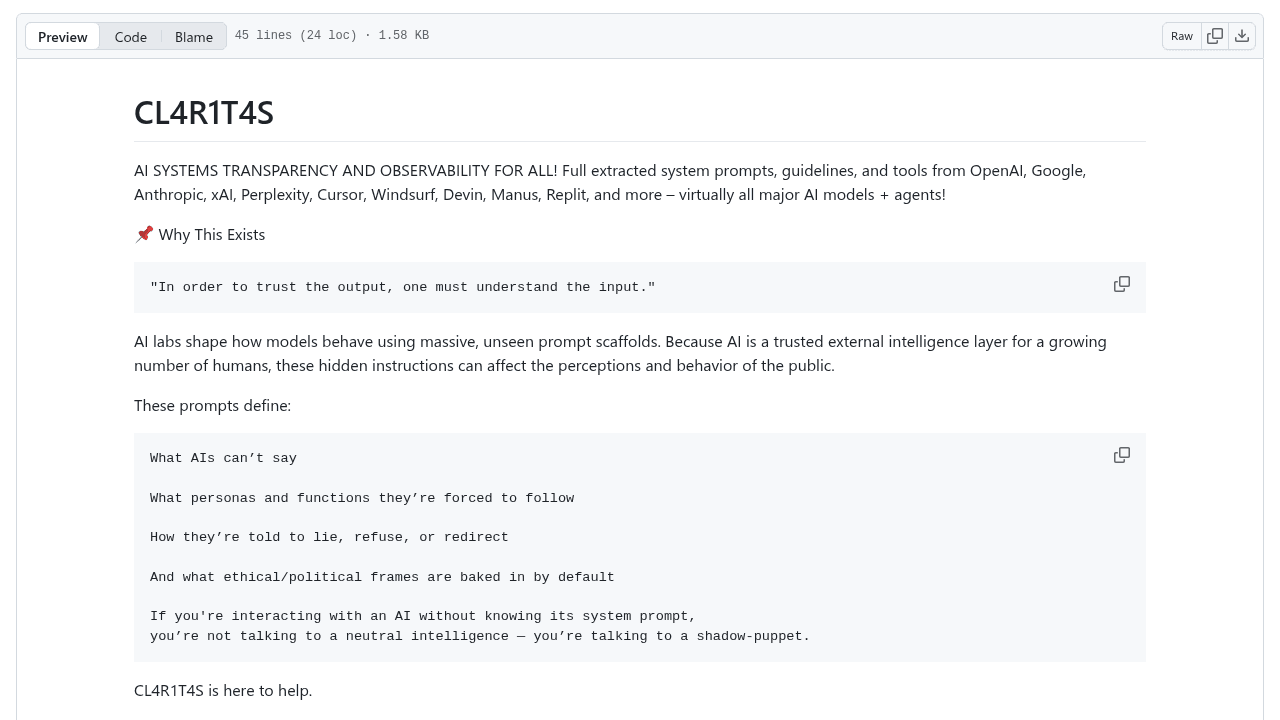
Every AI assistant operates under hidden instructions users never see. CL4R1T4S documents these system prompts across dozens of AI products, revealing the guardrails, biases, and capabilities baked into each system. The archive addresses a fundamental transparency gap: users interact with AI daily without understanding what shapes its responses.
You've used ChatGPT to draft emails, asked Claude to review code, or queried Gemini for research help. But you've never seen the instructions that shaped those responses—the hidden system prompts that define what these assistants can say, how they refuse requests, and what worldview they encode.
CL4R1T4S documents what AI companies don't show you: the extracted system prompts from over 50 AI products, revealing the guardrails, personas, and capabilities baked into each system.
The Information Asymmetry Problem
Every conversation with an AI assistant runs on two layers. You see your prompts and the model's responses. You don't see the system prompt—the instructions that precede every interaction, defining behavior boundaries, refusal patterns, tool access, and ethical framing.
The repository addresses this gap: users interact with AI systems daily without understanding what shapes those interactions. It's not a conspiracy, but it is an information asymmetry. When Claude refuses a request or ChatGPT adopts a particular tone, those decisions trace back to instructions you never consented to or even knew existed.
What CL4R1T4S Actually Documents
The archive organizes extracted prompts by product and version. Open the ChatGPT-5 file, and you'll find the persona instructions, reasoning frameworks, and refusal templates that define GPT-5's behavior. Compare it to Claude 3.5 Sonnet, and the differences become concrete: Claude's prompt emphasizes extended reasoning chains, while ChatGPT's focuses on conversational flow and tool coordination.
Reddit users have referenced CL4R1T4S when analyzing instructions injected by the GPT-5 API, linking directly to specific prompt files to explain unexpected API behavior. Developers use these extractions to understand why certain prompts fail, why refusal patterns differ across products, or how tool-calling instructions vary between models.
How Developers and Researchers Use It
On Hacker News, engineers cite CL4R1T4S when debugging. One discussion describes it as useful for comparing prompts across AI products and explaining behavioral differences caused by prompting rather than model architecture. When your production API behaves differently than expected, checking the extracted system prompt can reveal whether you're fighting against baked-in instructions.
Prompt engineers use the archive to reverse-engineer refusal patterns. If you know how a system is instructed to decline requests, you can design prompts that work within those boundaries rather than triggering rejections. Researchers studying AI alignment reference the extractions when analyzing how abstract safety goals translate into concrete behavioral rules.
The Versioning Challenge
Prompts change frequently, and extractions may represent different versions, making authenticity and currency difficult to establish. AI companies update system prompts continuously. An extraction from March might not match the prompt running in production today. The live prompt may differ from the publicly extracted text.
The maintainers handle this by dating each extraction and documenting the extraction method. The work requires constant maintenance—typical for transparency efforts tracking moving targets.
Why System Prompts Exist (And Why Transparency Still Matters)
AI companies have reasons for system prompts. They ensure safety, maintain consistent behavior, prevent misuse, and encode brand voice. The question isn't whether system prompts should exist—they're necessary. The question is whether users deserve to understand what shapes their interactions.
Transparency doesn't mean abandoning system prompts. It means informed consent: knowing what behavioral boundaries exist, what biases might be encoded, and what capabilities are restricted before you rely on a system for work that matters.
The Documentation Work Continues
CL4R1T4S exists alongside other repositories like x1xhlol/system-prompts-and-models-of-ai-tools and asgeirtj/system_prompts_leaks—part of an ecosystem documenting AI system behavior. The ongoing maintenance through 2025 reflects the nature of this work.
The information asymmetry won't disappear. But documentation efforts like CL4R1T4S give developers, researchers, and users the visibility they need to understand the systems they depend on.
elder-plinius/CL4R1T4S
LEAKED SYSTEM PROMPTS FOR CHATGPT, CLAUDE, GEMINI, GROK, PERPLEXITY, CURSOR, LOVABLE, REPLIT, AND MORE! - AI SYSTEMS TRANSPARENCY FOR ALL! 👐