The Job Search Tool That Stops Before Clicking Submit
Professionals face a false choice: spend hours tailoring every application by hand, or let bots spray-and-pray on your behalf. The ai-job-search repository runs the entire pipeline—scraping, fit analysis, CV customization—but deliberately stops before final submission. You review, you decide, you click send.
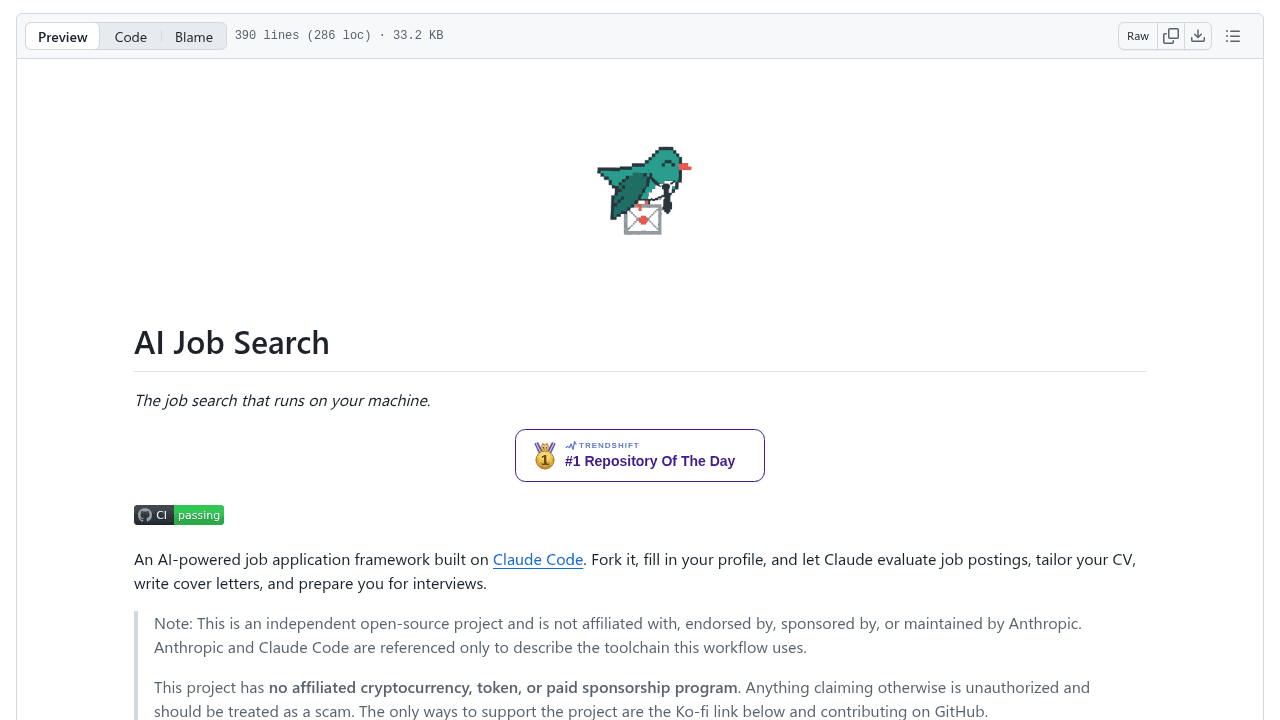
You've tailored twelve cover letters this week, cross-referenced posting requirements against your CV, and researched company cultures until your browser tab count looks like a phone number. You've also seen what happens when people let bots spray applications everywhere on their behalf—and you're not willing to become that person.
For months, job seekers have faced a false choice: spend every evening manually customizing applications, or surrender control to tools that apply to hundreds of positions without asking. ai-job-search built a third option.
The gap nobody was filling
The repository runs the entire pipeline—scraping job boards, scoring role fit, tailoring your CV, drafting cover letters—but stops before clicking submit. You review the work, you make the call, you send it yourself. Automation that refuses to take the final step without you.
AIHawk applies automatically at volume, treating job search as a numbers game. Manual applications preserve quality but drain time faster than most professionals can sustain. ai-job-search sits in the middle, handling the analysis work while keeping the decision in your hands.
How it works
The tool operates locally through Claude Code, processing your career profile and preferences before scanning job boards. The pipeline addresses finding postings, evaluating fit, tailoring CVs and cover letters, and preparing for interviews, but never executes the submission itself.
You run /setup once, feeding it your employment history, skills, and what you're looking for. Then /search scrapes roles, /fit scores each against your profile, and /apply generates customized materials. Every output lands in your workspace for review. If something feels off—a cover letter that oversells, a role that seemed good on paper but doesn't quite fit—you adjust or skip it. The tool makes no applications you haven't approved.
Job-portal integrations focus on Denmark initially, though the evaluation and customization logic works regardless of language or geography. It's less a finished product than a framework you adapt to your market.
Why stopping matters
The handbrake isn't a missing feature—it's the philosophy. Letting AI analyze hundreds of job descriptions makes sense. Letting it represent you in professional communication without oversight doesn't.
Auto-submission creates the resume equivalent of reply-all: fast, scalable, and occasionally mortifying. You can't take back an application sent to a competitor of your current employer, or one that reveals you didn't read the posting. The moment before clicking submit is where judgment lives, and ai-job-search refuses to automate it away.
The privacy stumble and what it taught us
Early instructions had a flaw. Issue #345 flagged that the quick-start directed users to fork publicly before /setup wrote personal information into tracked files—names, contact details, employment history, salary expectations. The maintainers fixed it quickly, emphasizing private forks and local execution. The stumble reinforced the project's commitment to keeping your data off the internet.
Different tools, different philosophies
Career-Ops offers multi-LLM support—Claude Code, Codex, Gemini, OpenCode, Grok, Qwen—where ai-job-search centers on Claude with community adaptations. AIHawk optimizes for volume. ai-job-search optimizes for intentionality. These aren't competing strategies so much as different answers to what job search should feel like.
If you want to blanket the market, AIHawk's approach makes sense. If you want infrastructure to support applying everywhere, Career-Ops gives you options. If you want AI to handle grunt work while you keep final say, ai-job-search built that lane.
Who this is for (and who it isn't)
Mid-to-senior professionals who've felt uncomfortable with both extremes find the fit naturally. You're past the spray-and-pray stage of your career but realistic about how much manual tailoring you can sustain while employed full-time. You want leverage without losing agency.
If you need to apply to three hundred positions this month, this tool will slow you down. If you're early-career and volume is the right strategy, it's not the best match. The design assumes you're optimizing for quality, not coverage.
What comes next
The repository hit number one on GitHub Trending and collected thousands of stars. That trajectory suggests people have been waiting for someone to build the middle path—automation that respects the person using it.
The hunger for tools that keep humans in the loop isn't going away. ai-job-search proves you don't have to choose between doing everything yourself and letting a bot do everything for you. Sometimes the best automation is the kind that knows when to stop and hand the controls back.
MadsLorentzen/ai-job-search
The job search that runs on your machine. AI job application framework built on Claude Code: evaluate postings, tailor CVs, write cover letters, prep interviews. Fork it and own it.