Chatterbox TTS: Sub-200ms Latency in Open Source
Resemble AI shipped Chatterbox, an open-source text-to-speech model that hits sub-200ms latency and runs 6× faster than realtime. The project earned 25,000 GitHub stars by solving the latency problem that bottlenecks conversational agents, though debates continue about how 'open' the model really is.
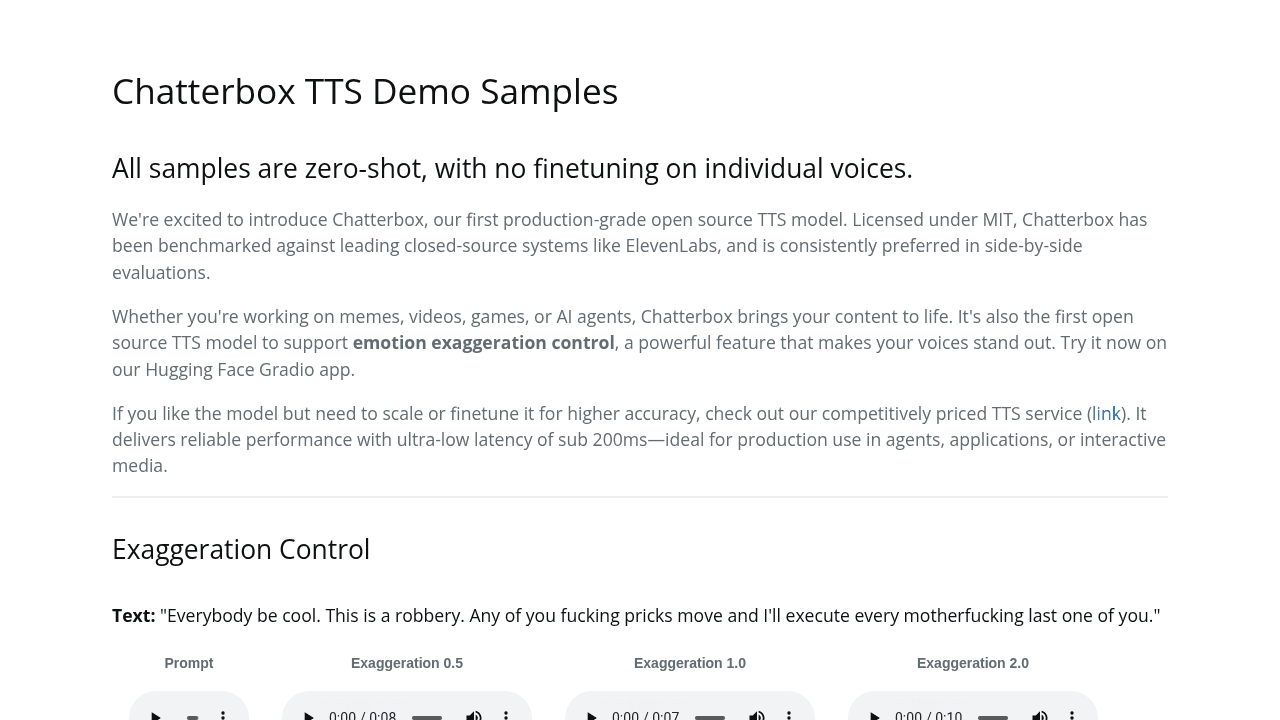
Conversational AI applications live and die by response time. When a user speaks to a voice agent, every millisecond of delay between their question and the system's reply chips away at the illusion of natural conversation. Text-to-speech synthesis sits squarely in that critical path—and for most production models, it's a bottleneck.
Resemble AI's Chatterbox attacks that problem head-on. Users report hitting 200ms TTS latency in testing, with the company claiming sub-200ms performance in production. That's fast enough to feel responsive in real-time voice applications where every fraction of a second counts.
The 200-millisecond barrier
The difference between 500ms and 200ms latency doesn't sound like much on paper. In practice, it's the difference between a conversation that flows and one that feels like you're talking over satellite delay. For voice assistants, customer service bots, and real-time translation tools, that responsiveness threshold determines whether users stick around or bail.
Chatterbox targets exactly that use case. The model runs 6× faster than real-time on GPU, includes zero-shot voice cloning, supports paralinguistic prompting for emotional expression, and ships with built-in watermarking—all from a team considerably smaller than the well-funded players dominating the TTS space.
What the team got right
Built atop a 0.5B Llama architecture, Chatterbox balances speed with expressiveness in a way that's rare for models this compact. The zero-shot cloning works without fine-tuning on new voices. The paralinguistic controls let developers add laughter, hesitation, or emphasis without re-training.
Modal's review of open-source TTS models notes Chatterbox was formerly the #1 trending model on Hugging Face. It solves the latency problem developers face when building voice agents, not just the quality problem that pioneers like ElevenLabs already tackled.
ElevenLabs set the bar for high-fidelity synthetic speech. Chatterbox optimizes for a different constraint: making TTS fast enough and accessible enough that smaller teams can build real-time conversational products. Both approaches address real needs.
The 'open source' question
The project has drawn questions about how open it really is. On Hacker News, one commenter called it "just ~3/10 open, or not really open at all," recommending fully open alternatives instead.
Parts of Chatterbox's stack remain proprietary. For developers who need complete source access—whether for compliance, customization, or philosophical reasons—that's a dealbreaker. For teams prioritizing performance and developer experience over full transparency, the trade-off makes sense.
The project doesn't hide what's open and what isn't. Check the repository yourself to see if the open components meet your requirements before building on it.
Turbo and Multilingual: Growing fast
Recent releases explain the surge in attention. Chatterbox is now used by 136 projects, according to GitHub's dependency tracking, and that number keeps climbing.
The Turbo release brought the speed improvements that matter for real-time use cases. Chatterbox Multilingual, launched in September 2025, expanded support to 23+ languages in a unified model.
That expansion brought the usual rough edges. Danish letters don't pronounce correctly, Polish output carries a strong English accent not present in demos, and Russian numbers get mispronounced. The project's issue tracker shows the team working through these problems.
Where Chatterbox fits
Reddit discussions position Chatterbox as competitive with ElevenLabs on speed and expressiveness for specific applications. That framing misses the point slightly. These tools serve different needs.
If you're building a conversational agent that needs to respond in real-time, or you're working with budget constraints that make API costs prohibitive at scale, Chatterbox offers a solid option. If you need the highest fidelity synthetic speech for content production, established services like ElevenLabs remain the reference.
For developers choosing a TTS solution for conversational AI, Chatterbox proves you don't need massive resources to make progress on hard problems. You need focus on the constraint that matters—in this case, latency—and a willingness to make trade-offs everywhere else.