ByteDance Open-Sourced Coze Studio: AI Agent Platform
ByteDance released Coze Studio as open-source on July 25, 2025—their internal platform for building AI agents with visual workflows, plugins, and knowledge bases. We compare it to n8n, Dify, and FastGPT, examine what makes the all-in-one approach different, and look at the growing pains reported by early adopters.
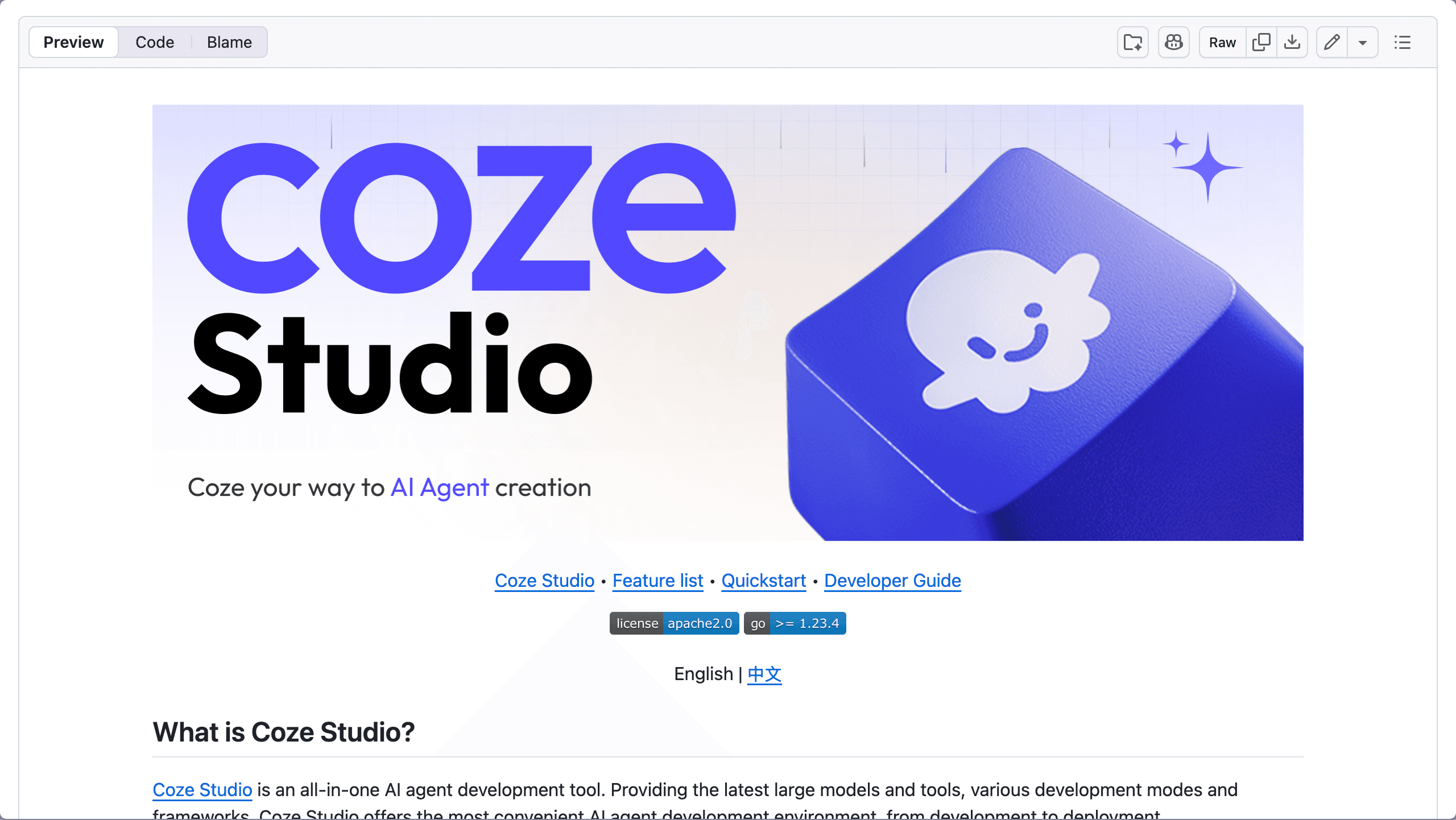
ByteDance made an unexpected move on July 25, 2025, releasing Coze Studio as open source—the same platform they've been using internally to build AI agents. Within days, the project collected over 1100 GitHub stars and attracted more than 20,000 developers testing an approach to agent development that bundles visual workflows, plugin systems, and knowledge bases into a single platform.
The decision stands out because major tech companies rarely share their internal AI infrastructure this openly. ByteDance could have kept Coze Studio proprietary or offered it only as a paid service. Instead, they're contributing production-grade tooling that joins a community of strong specialized players already working in this space.
What ByteDance Just Released
Coze Studio tackles the complexity of AI agent development through visual, no-code and low-code interfaces. Developers get tools for creating agents, debugging multi-step workflows, managing plugin integrations, and deploying knowledge bases—all from one environment rather than stitching together separate services.
The platform handles the full agent lifecycle: design conversational flows in a visual editor, connect external APIs through pre-built plugins, index documentation into searchable knowledge bases, and deploy without managing infrastructure. For teams building customer support bots or internal automation tools, that integrated approach removes friction points where different systems would normally need integration work.
The All-in-One Approach vs. Specialized Tools
Coze Studio enters a landscape where developers often combine multiple tools. n8n handles general automation, Dify focuses on LLM application development, and FastGPT specializes in enterprise knowledge base Q&A. Each excels in its domain—n8n brings mature workflow automation with hundreds of integrations, Dify offers battle-tested LLM orchestration, and FastGPT delivers enterprise-grade document retrieval.
Coze's differentiation comes from bundling those capabilities. Where you might previously connect n8n for workflows, Dify for LLM logic, and a separate vector database for knowledge retrieval, Coze offers those pieces in a unified interface. That reduces configuration overhead and makes it easier to trace how data flows from knowledge base through workflow to agent response.
The tradeoff: specialized tools often go deeper in their specific domains. Teams needing advanced workflow logic might prefer n8n's maturity. Organizations requiring enterprise compliance features might lean toward FastGPT's established security model. Coze bets that integration convenience outweighs depth in any single area for many use cases.
What Developers Are Building (and Breaking)
Early adoption reveals both momentum and growing pains. Developers have noted poor embedding and recall capabilities in the knowledge base feature, which affects one of the platform's core promises. Others found that the frontend consumes excessive resources, failing to run on machines with 16GB memory—a barrier for developers without high-spec hardware.
Security researchers identified a low-severity vulnerability in versions up to 0.2.4, though the attack complexity is high and the impact limited to low-level information disclosure.
These issues are typical for a project scaling from internal use to public release. Knowledge base tuning often requires iteration based on diverse real-world content. Resource optimization takes time when hardware assumptions shift from controlled internal environments to varied developer setups. The fact that users are reporting specific, technical issues suggests real engagement rather than superficial testing.
Why This Matters for the Open-Source AI Community
ByteDance's decision to open-source production tooling rather than monetize it exclusively signals confidence in open collaboration as a development model. When a company operating at ByteDance's scale contributes internal infrastructure, it validates the approaches smaller projects have been pioneering and potentially accelerates what the entire community can build.
For developers evaluating agent platforms, Coze Studio adds a viable option with backing from a company that's battle-tested the code in production. The bundled approach won't replace specialized tools for every use case, but it offers a legitimate alternative for teams prioritizing integration simplicity over maximum depth in any single capability.
The early issues will likely resolve as the community stress-tests edge cases ByteDance's internal use didn't expose. Rough edges get smoothed through distributed testing and contribution, not just core team effort.
coze-dev/coze-studio
An AI agent development platform with all-in-one visual tools, simplifying agent creation, debugging, and deployment like never before. Coze your way to AI Agent creation.