BitNet: Microsoft's 1.58-Bit LLM Cuts Costs 55-82%
Running LLMs at scale drains budgets and compute. BitNet uses ternary weights to slash memory, energy, and costs—but current models need careful evaluation. We examine Microsoft's efficiency claims, real-world adoption on Raspberry Pi and WSL2, the confusion over '1-bit' terminology, and whether extreme quantization trades accuracy for infrastructure savings.
Cloud bills for LLM inference hurt. A single model serving traffic at scale costs thousands monthly in compute, and edge devices like Raspberry Pis can't handle multi-gigabyte weight files. Energy consumption makes it worse—data centers running transformer models burn electricity at rates that make deployment financially and environmentally untenable for most teams.
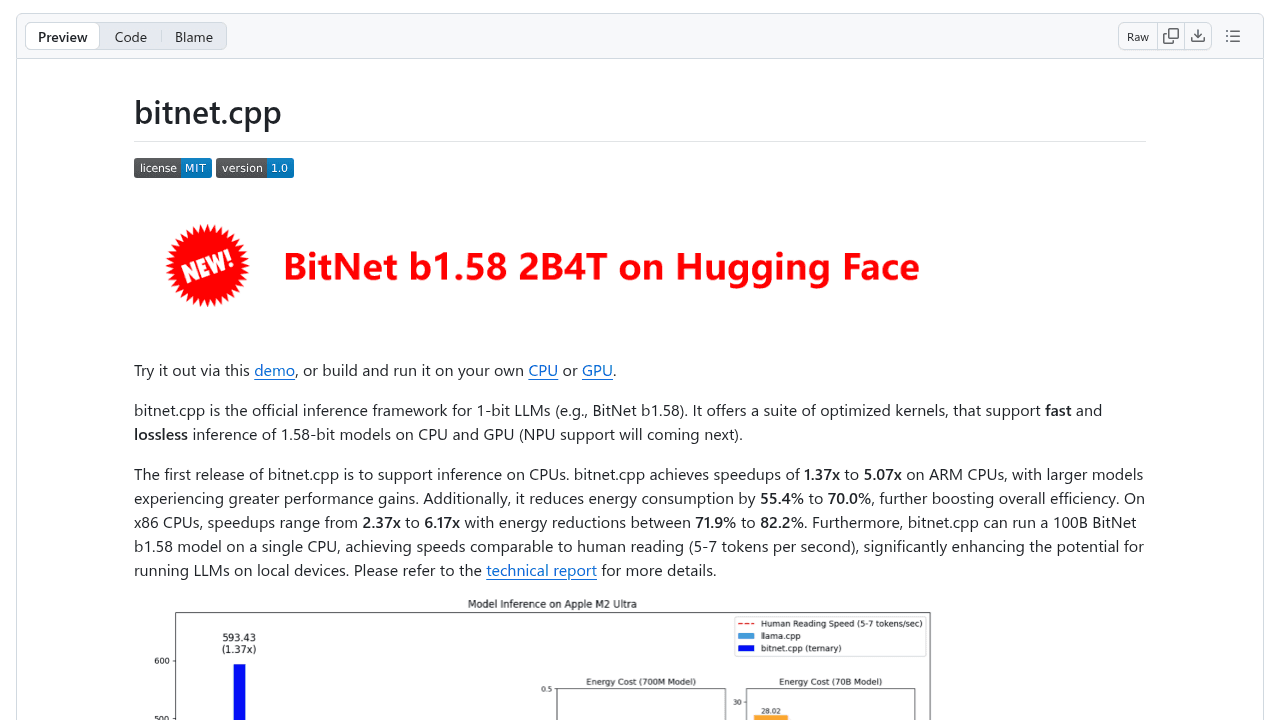
Microsoft's BitNet framework compresses model weights to 1.58 bits. The company's benchmarks show 1.37×–5.07× speedups on ARM CPUs, 2.37×–6.17× speedups on x86, and energy reductions of 55–82% compared to baseline inference. For engineers dealing with cloud bills or trying to fit models onto constrained hardware, those numbers matter.
What BitNet Actually Is (and Isn't): Ternary Weights, Not True 1-Bit
The terminology creates confusion. BitNet doesn't use binary weights—it uses ternary values: {-1, 0, +1}. That's 1.58 bits per weight on average, not a true 1-bit representation. YouTube skeptics have questioned whether "1-bit LLM" is marketing-driven framing, and Hacker News discussions highlight the confusion between ternary parameters and binary quantization.
The distinction matters because BitNet cannot run efficiently on standard deep learning libraries like llama.cpp. Its specialized kernels are built for ternary models trained from scratch, not post-training quantized versions of full-precision weights. That's the core differentiator: bitnet.cpp provides fast and lossless inference of 1.58-bit models by implementing lookup table methodologies that generic quantization frameworks can't handle efficiently.
Real-World Adoption: Raspberry Pi, WSL2, and Hobbyist Experiments
People are running BitNet in practice. Adafruit's tutorial on local LLMs for Raspberry Pi walks through using bitnet.cpp on edge hardware. A practitioner's guide on ADaSci demonstrates inference workflows, and a Dev.to walkthrough covers installation on WSL2. Third-party projects like Electron-BitNet provide GUI wrappers for chat-mode inference and benchmarking.
These aren't enterprise deployments—they're exploratory. But the existence of step-by-step guides and hobbyist experimentation shows this isn't vaporware.
The Skepticism: 'Technology Demo' Criticism and Accuracy Trade-Offs
Hacker News commenters have called current BitNet models "a technology demo, not a model you'd want to use." The core trade-off is straightforward: ternary weights require much larger model sizes to match full-precision quality. The BitNet README itself acknowledges that tested models are "dummy setups used in a research context to demonstrate inference performance," not production-grade deployments.
A YouTube review titled "I Installed And Tested Microsoft Bitnet So You Don't Have To!" describes the release as "controversial," promising to "expose the truth behind the hype." The efficiency gains are real, but so are the limitations.
Momentum and Timeline: From v1.0 to GPU Kernels in 13 Months
Development has moved fast. BitNet 1.0 launched in October 2024, followed by BitNet a4.8 (4-bit activations) in November, an edge inference paper in February 2025, an official 2B parameter model on Hugging Face in April, and GPU inference kernels in May. InfoQ's April coverage and multiple Hacker News threads drove visibility in engineering communities.
Should You Evaluate BitNet? Decision Framework for Engineers
Extreme quantization makes sense for cost-sensitive inference pipelines and edge deployments where memory footprint matters more than absolute quality. It doesn't make sense for quality-critical applications where accuracy loss is unacceptable. Test with your workload, compare against llama.cpp for standard quantization, and measure the size-versus-quality trade-off with your own models. BitNet is actively developed but still research territory—approach it as a promising efficiency lever, not a drop-in replacement.
microsoft/BitNet
Official inference framework for 1-bit LLMs