Why Your AI System Fails at 3am (And How to Debug It)
Most AI courses teach theory or framework usage, but skip the middle ground where production systems fail and engineers can't diagnose why. A GitHub project with 55K stars addresses this gap by teaching implementation from scratch before introducing libraries—targeting the specific failure modes practitioners encounter at 3am.
Your production model's loss curve diverged overnight. The API still responds, but outputs have degraded. You open the PyTorch codebase, stare at abstraction layers you've never questioned, and realize you can't explain what's actually breaking. You know enough ML theory to pass interviews and enough framework syntax to ship features—but the diagnostic middle ground remains a black box.
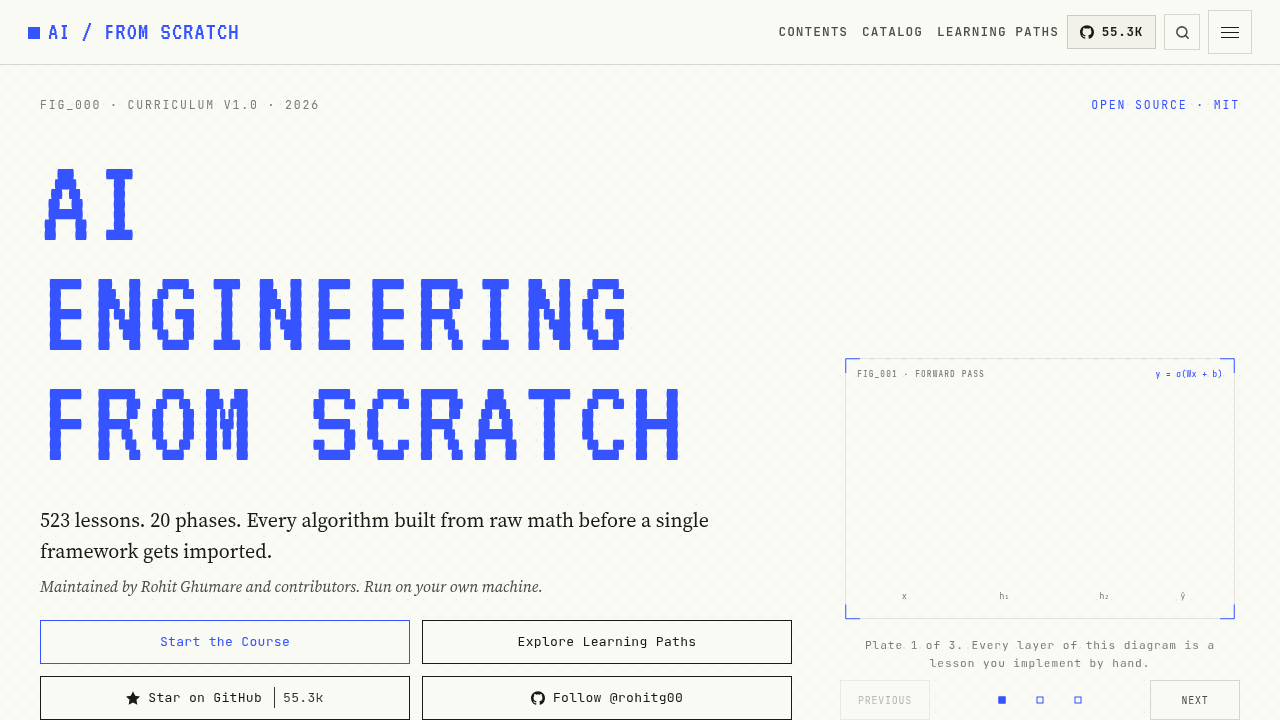
This gap between using AI systems and understanding their failure modes is what AI Engineering from Scratch targets. The 55,000-star GitHub repository doesn't replace academic coursework or framework tutorials. It addresses the moment when mid-level engineers hit production problems they can't diagnose: divergent loss curves, inefficient tokenization, duplicated context, and hallucinating agents that surface only after deployment.
Build It First, Then Use the Library
The approach: implement each algorithm from scratch to understand its failure modes, then learn the production library. Want to debug a transformer's attention mechanism? Write the matrix operations yourself first. Encountering unexpected token splits? Build a tokenizer before reaching for Hugging Face's abstractions.
This methodology addresses the diagnostic literacy problem. When abstractions leak—and in production ML, they always do—engineers who've only called library functions can't trace the failure backward. Those who've implemented the underlying algorithm at least once can form hypotheses about what's breaking and where.
The curriculum spans 20 phases covering mathematics, classical ML, deep learning, vision, NLP, speech, transformers, generative AI, reinforcement learning, LLMs, multimodal systems, agents, autonomous systems, production infrastructure, and safety. The breadth is ambitious—435 lessons in total—but the organizing principle remains practical: each phase builds diagnostic understanding of a production failure category.
The repository also ships as an installable skills package for AI coding agents, extending the "learn by building" philosophy to agent-assisted development workflows.
The AI-Generated Content Question
Hacker News commenters raised concerns about AI-generated or AI-assisted content in the lessons, questioning both quality and pedagogical value. Teaching methodologies vary, and learners should assess whether the content matches their expectations for depth and authorship. The project's goal stands on its own, but the discussion is worth considering alongside the curriculum's structure.
Where This Fits in the Learning Landscape
This project exists alongside established alternatives. Fast.ai prioritizes rapid iteration and practical deployment. Andrej Karpathy's Neural Networks: Zero to Hero emphasizes conceptual clarity through video lectures. Andrew Ng's Deep Learning Specialization offers structured academic progression. Hugging Face courses focus on ecosystem mastery. Full Stack Deep Learning targets production infrastructure.
Each serves different learning curves and styles. The 55,000 stars suggest the "build from scratch, then use libraries" approach resonates for engineers at a point in their journey—past beginner tutorials but not yet comfortable diagnosing production failures. These resources complement each other; most practitioners will use several.
Who This Actually Serves
The target is narrow: engineers who've shipped AI features but can't explain why they work or fail. Not beginners who need foundational theory. Not researchers optimizing novel architectures. The practitioners in the middle who encounter courses that either overwhelm with theory or jump straight to model fitting without building diagnostic intuition.
When your production model degrades at 3am, can you form a hypothesis about whether the problem lives in data preprocessing, training dynamics, inference optimization, or prompt engineering? If that question feels uncomfortable, the gap this repository addresses might be worth exploring.
rohitg00/ai-engineering-from-scratch
Learn it. Build it. Ship it for others.