VoltAgent Built the Curation Layer OpenClaw Needed
OpenClaw's skills registry grew so fast that finding safe, quality contributions became impossible. VoltAgent built the filtering and curation infrastructure that any thriving open ecosystem eventually needs—removing spam, flagging security risks, and organizing what works.
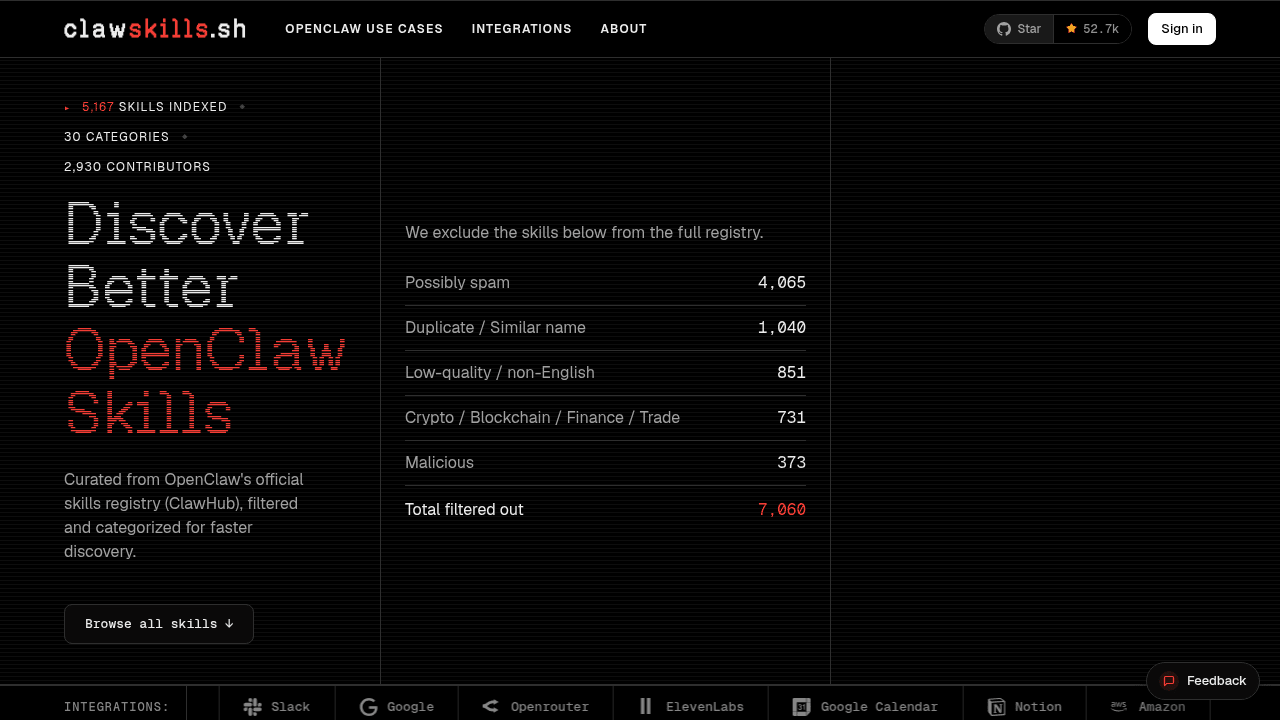
When OpenClaw's public skills registry hit 5,400+ community contributions, developers faced a new problem: finding the good stuff. Spam submissions, duplicate entries, security risks, and low-quality code buried useful skills. The community had built so much that nobody could safely navigate it anymore.
VoltAgent's response was to build what any open project eventually needs—a curation layer. Not a replacement for OpenClaw's registry, but a filtering mechanism that sits on top of it, removing noise and organizing what remains by category and quality.
When community growth outpaces discoverability
This is a familiar pattern in developer tools. OpenClaw succeeded. Its open contribution model attracted thousands of submissions from developers building integrations for everything from self-hosted services to commercial APIs. The velocity was impressive; the signal-to-noise ratio was not.
The registry's openness—its defining strength—created the discoverability problem. Without gatekeeping, contribution volume exploded. Without curation, users couldn't tell which skills were production-ready and which were abandoned experiments or worse. Hacker News discussions highlighted the pain point: developers needed help comparing options, spotting risk signals, and verifying installation steps before running third-party code in their agent workflows.
The filtering criteria that matter
VoltAgent's curation approach targets five problems. It removes spam submissions that pollute search results. It flags duplicate entries where multiple developers built similar integrations without coordination. It filters out cryptocurrency-related skills, recognizing that many teams avoid that category for compliance reasons. It identifies security-risky entries that request excessive permissions or include suspicious dependencies. And it assesses code quality, weeding out abandoned or poorly documented submissions.
The resulting catalog organizes vetted skills into browsable categories. The self-hosted and automation section includes community-maintained integrations for n8n, MongoDB Atlas, Fathom, FreshRSS, and NordVPN—tools developers use in production. Each listing shows what the skill does, what permissions it requires, and how actively it's maintained.
These aren't arbitrary filters. They map to the questions developers ask when evaluating third-party code: Is this legitimate? Does it do what it claims? Will it break my setup? Has anyone vetted the security implications?
Every open project needs a curation layer
The npm registry doesn't rank packages by quality; npms.io does. PyPI doesn't assess library health; libraries.io does. GitHub doesn't curate awesome lists; individual maintainers do. Open registries optimize for contribution velocity. Curation layers optimize for consumption safety.
This is complementary infrastructure, not a criticism of the underlying platform. OpenClaw's team built a registry that encourages community participation. VoltAgent built the filtering mechanism that makes that participation useful at scale. Both roles matter. The registry stays open and fast-moving; the curation layer stays opinionated and safety-focused.
The star growth since launch suggests this filled a gap. The 52,000 stars accumulated in roughly eight weeks, with attention spikes following community discussions on Hacker News in late February and Reddit in late March. Developers building agent workflows wanted this—enough to watch the repository and integrate its recommendations into their vetting process.
What the momentum tells us
The speed of adoption reveals priorities. Developers working with agent frameworks needed trusted discovery mechanisms more than they needed additional skills. The registry already had thousands of options. What it lacked was a way to safely choose between them.
As AI agent tooling matures beyond early adopters, curation becomes critical infrastructure. Teams shipping production agents can't manually audit every third-party skill. They need maintained filters, clear risk signals, and organized categories. VoltAgent built that layer while OpenClaw's community was still focused on expansion.
This is the unglamorous work that makes popular platforms usable. The fact that it attracted this much attention this quickly suggests the agent development community knows what it needs—and it's not more choices. It's better ways to navigate the choices that already exist.
VoltAgent/awesome-openclaw-skills
The awesome collection of OpenClaw skills. 5,400+ skills filtered and categorized from the official OpenClaw Skills Registry.🦞