VoiceStudio: Local Voice AI That Runs On Your Hardware
VoiceStudio brings ElevenLabs-quality voice AI to local hardware—no accounts, no API keys, no cloud dependencies. A solo developer built a fully-featured alternative with voice cloning, dubbing, transcription, and integrations for Twilio, n8n, and MCP clients. The project's 83K stars and active development through 2026 show what's possible when open-source ambition meets local-first principles.
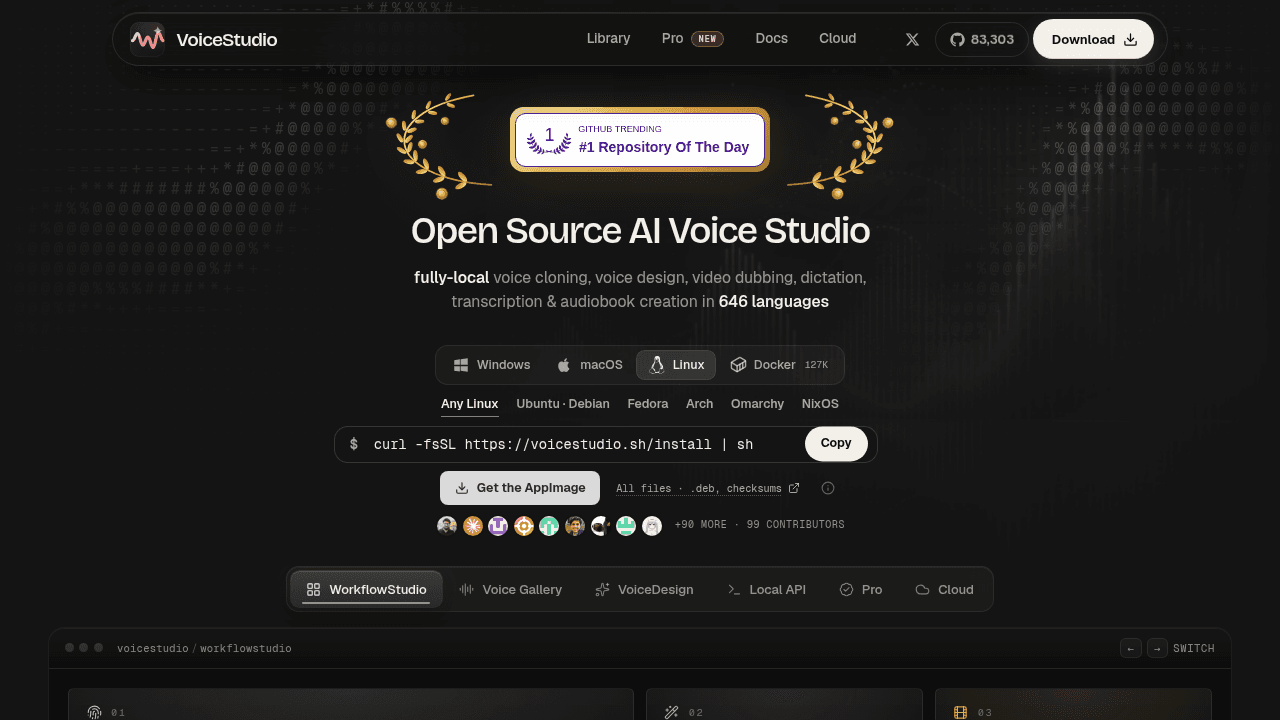
A solo developer just shipped what commercial AI companies insist requires cloud infrastructure: production-quality voice cloning that runs entirely on your laptop. VoiceStudio handles voice cloning, dubbing, transcription, and audiobook production without an account, API key, or data leaving your network.
ElevenLabs set a high bar for voice AI quality—their commercial service delivers consistent, expressive output that convinced developers cloud processing was the only path to that fidelity. VoiceStudio proves sophisticated models can work on consumer hardware, though the trade-offs are real and documented.
What VoiceStudio Actually Does
The feature set reads like a commercial service: voice cloning from recordings, synthetic voice design, multi-language dubbing, dictation, transcription, and audiobook production. Instead of locking users into one engine, VoiceStudio supports multiple TTS, ASR, and LLM engines through a local Model Catalogue. Everything stays on your hardware; remote services remain optional.
This matters for privacy-conscious developers. Your training recordings, generated audio, and project files never touch someone else's servers. No usage metering. No rate limits imposed by external APIs. For teams working with sensitive content—internal training materials, unreleased media, confidential communications—the control is worth the installation complexity.
Built for Real Integration
The engineering depth shows up in the integrations. VoiceStudio exposes versioned HTTP, WebSocket, JSON-RPC, CLI, and MCP transports so other applications can use its local speech services. The project ships with working examples for Twilio phone calls, Claude Code, Cursor, MCP clients, the OpenAI-compatible API, and n8n workflows.
That's infrastructure thinking, not toy-project scope. You can hook VoiceStudio into your existing automation, route phone calls through local TTS, or let AI coding agents speak responses—all without external dependencies.
The Performance Reality
Local AI means real hardware constraints. The documentation is transparent about this: CPU generation runs several times slower than GPU execution, first generation after startup lags while models load lazily, and memory pressure can make the backend temporarily unreachable. An earlier performance regression caused Whisper transcription to run unnecessarily on every generation before version 0.3.15, producing high CPU usage.
The issue tracker reflects the reality of cross-platform distribution: macOS Intel architecture mismatches, Windows runtime failures, DLL-load errors. These aren't signs of careless work—they're the friction of shipping AI models across different hardware. The transparency here is more useful than polish; developers evaluating local AI need honest performance expectations.
Active Development
The momentum is visible. Between September and October 2025, the project added Electron desktop distribution, cross-language cloning, mobile previews, and continuous releases through October 23. Recent Hacker News attention shows the developer community is paying attention.
Eighty-three thousand stars don't accumulate around vaporware. They reflect developers who value the option to run voice AI locally, even with the installation overhead and performance trade-offs.
What This Means for Local-First AI
VoiceStudio isn't trying to replace ElevenLabs—commercial services will always win on convenience and consistent performance. But it proves you can run sophisticated voice models on your own hardware with production integrations intact. For developers who prioritize data control over convenience, that option matters.
The project is a reminder that "cloud-scale AI" and "local AI" serve different philosophies, not different capability tiers. Both approaches have their place. VoiceStudio chose the harder path—and pulled it off.
debpalash/VoiceStudio
VoiceStudio is the open-source, fully-local ElevenLabs alternative — voice cloning, voice design, video dubbing, dictation, transcription & audiobook creation in 646 languages.