Train a GPT Model in 2 Hours on a Gaming GPU for $3
Training language models has been locked behind enterprise GPU budgets and framework abstractions. MiniMind collapses both barriers: 2 hours, one gaming GPU, $3, and pure PyTorch code that exposes every step from tokenizer to RLAIF. 36k developers are using it to learn how LLMs actually work.
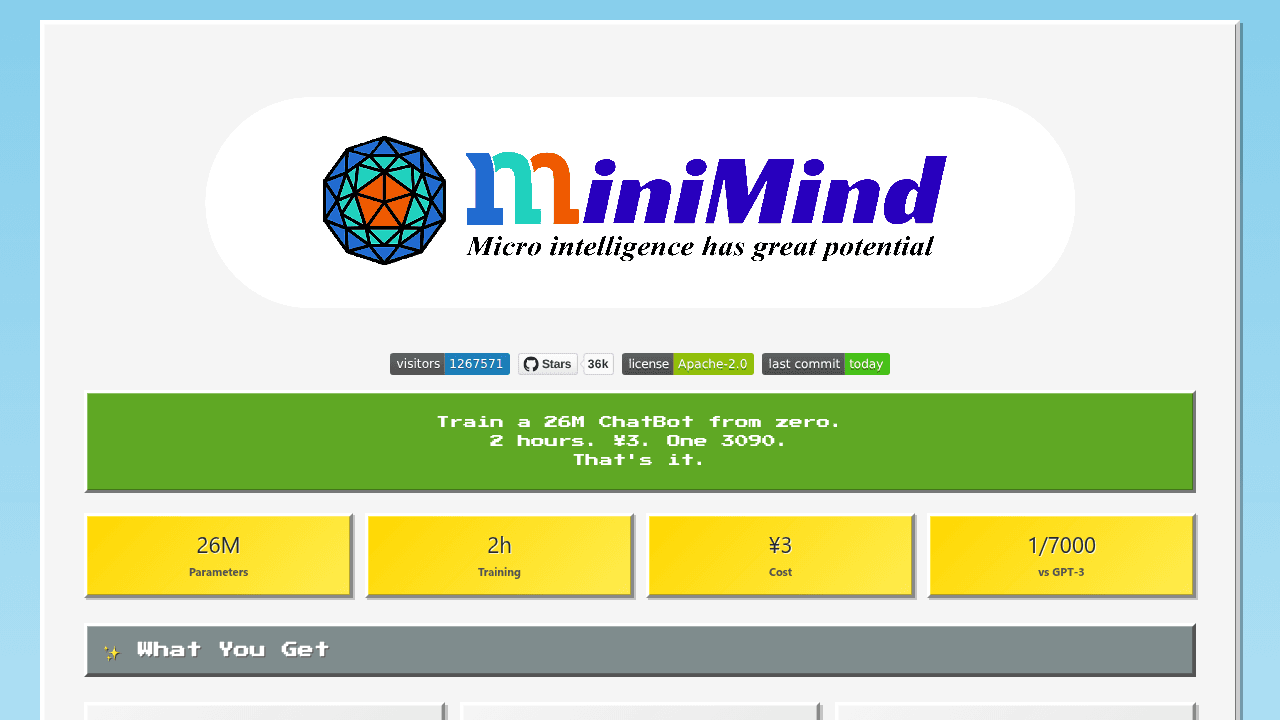
A 26-million-parameter GPT model trains from scratch in two hours on a single NVIDIA RTX 3090, costing roughly 3 RMB—about the price of a coffee. MiniMind runs what used to require enterprise GPU clusters on gaming hardware most ML practitioners already own.
The project delivers a complete pipeline: tokenizer, pre-training, supervised fine-tuning, and RLAIF post-training with DPO, PPO, GRPO, and SPO implementations. Every component uses pure PyTorch with zero framework abstraction, exposing the mechanics that libraries like transformers and TRL abstract away. For engineers learning how language models work, that transparency is the point.
What MiniMind Actually Delivers
Two hours of training time means iteration cycles that don't require overnight runs. The 26M-parameter scale keeps memory footprints manageable while demonstrating the full architecture—attention mechanisms, positional encodings, layer normalization, the entire transformer stack. Models export to llama.cpp, vllm, ollama, and Llama-Factory for inference, with pre-trained checkpoints available on Hugging Face and ModelScope.
The project includes implementations of mixture-of-experts architectures, knowledge distillation from larger models, and YaRN for extended context windows. These are native PyTorch implementations, not simplified versions.
Why Pure PyTorch Matters for Learning
Framework abstractions optimize for productivity, not teaching. Fine-tuning through the Hugging Face library means you never see how DPO preference learning computes reward signals or how PPO's clipped objective function prevents policy collapse. MiniMind's framework-free approach trades convenience for clarity—every forward pass, every gradient update, every sampling strategy sits in readable code.
That educational value comes with friction. No high-level APIs mean more boilerplate, more manual tensor management, more opportunities for bugs. But for junior ML engineers moving past tutorials, seeing the unabstracted implementation teaches what frameworks hide.
What You Can (and Can't) Build With 26M Parameters
Small models have hard limits. The base Zero model struggles with English coherence and produces fragmented responses on anything beyond simple queries. Post-training with RLHF increases politeness and verbosity but slightly reduces factual accuracy compared to the supervised fine-tuning baseline—a known tradeoff in alignment work.
These constraints become useful in a learning context. A 26M-parameter model trains fast enough for rapid experimentation. You can run ablation studies, test hyperparameter configurations, or implement custom training objectives without waiting days for results. Full observability of internal states becomes practical when you're not debugging billions of parameters across distributed infrastructure.
From nanoGPT to Production: How MiniMind Compares
Andrej Karpathy's nanoGPT and MinGPT demonstrated the value of minimal GPT implementations. MiniMind extends that approach through the full post-training pipeline—supervised fine-tuning, direct preference optimization, proximal policy optimization, and newer algorithms like GRPO and SPO. The project's 36,000+ stars since July 2024 suggest it fills a gap between educational projects and production frameworks that require institutional resources.
Updates through 2025 add MiniMind2 series models and expand the RLAIF implementation portfolio. That development momentum indicates sustained community interest in accessible LLM training infrastructure.
Who Gets to Build AI When Training Costs $3
When financial barriers drop, participation changes. Junior engineers without cloud GPU budgets can now iterate on real language models using consumer hardware. Students can implement research papers without grant funding. Hobbyists can experiment with novel architectures on weekend projects.
When a gaming GPU becomes sufficient infrastructure for end-to-end LLM training, the constraint moves from access to compute toward access to knowledge and time. That's a different kind of barrier—but one that learning-focused projects like MiniMind address by making the underlying mechanics visible rather than convenient.
jingyaogong/minimind
🚀🚀 「大模型」2小时完全从0训练26M的小参数GPT!🌏 Train a 26M-parameter GPT from scratch in just 2h!