REA Gives AI Agents Eyes for Reverse Engineering
AI coding agents can write code but struggle to investigate compiled software. REA builds a consistent, evidence-producing interface across binaries, Electron apps, .NET assemblies, APKs, firmware, and websites—giving agents the reverse engineering capabilities they've been missing.
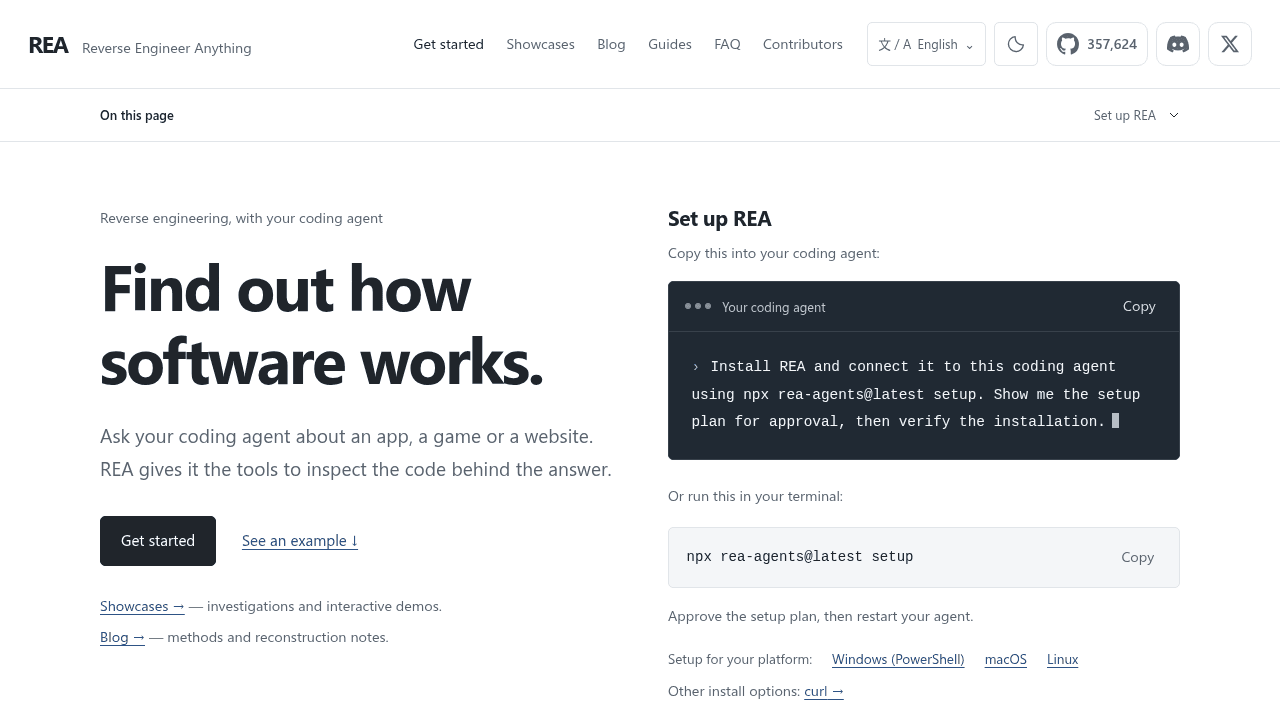
Your AI agent can write code, refactor functions, and debug errors. But hand it a compiled binary, an Android APK, or firmware without source code, and it hits a wall. The tools that reverse engineers rely on—Ghidra, IDA, decompilers—weren't built with agent-friendly interfaces in mind.
REA builds the bridge. It creates a unified interface for AI agents to investigate software across binaries, .NET assemblies, JavaScript and Electron apps, websites, Android APKs, and firmware. The goal: give agents the same investigative capabilities that human reverse engineers use.
The Gap: Agents Can Code, But Can't Investigate
AI coding agents have become capable at software development tasks. They can scaffold projects, fix bugs, and navigate codebases. But reverse engineering requires specialized tools that speak their own languages—Ghidra's scripting API, IDA's Python environment, decompilers with their own quirks.
REA creates a consistent, evidence-producing interface across artifact types. Instead of forcing agents to learn the nuances of each tool, it provides a layer that handles the translation work. The agent asks questions about a binary or an APK; REA routes those queries to the appropriate analysis tool and returns structured results.
What REA Covers: Binaries to Firmware
The breadth is the differentiator. REA isn't just Ghidra integration or a single-tool wrapper. It spans binaries, .NET assemblies, JavaScript and Electron applications, websites, Android APKs, and firmware. That coverage matters because real-world analysis rarely stays within one artifact type—an Android app might bundle native libraries, JavaScript, and configuration files that all need investigation.
For developers building agent workflows, this means one integration point instead of custom tooling for each analysis scenario. The agent doesn't need separate interfaces for decompiling a Windows executable, analyzing an Electron app's JavaScript, or unpacking an APK.
How It Stacks Up: IDA MCP, GhidraMCP, and Direct Scripting
REA isn't alone in recognizing this problem. IDA MCP and GhidraMCP offer approaches focused on specific tools. An independent hands-on comparison found that Claude Code could complete reverse-engineering tasks without REA by writing its own Ghidra scripts—though REA was faster on three tests and slower on one.
Multiple teams saw the same gap and built different solutions. REA's contribution is broader coverage beyond Ghidra alone, while the alternatives show that agents can adapt to specialized tools when necessary. There's no single "right" answer yet, just different tradeoffs between generality and depth.
Open Issues: Memory, Cleanup, and Growing Pains
REA is tackling a wide surface area, and the current issue tracker reflects that scope. JavaScript analysis exhausted a 6 GiB worker heap on a 233 KB file. The repository lists open issues involving incomplete runtime cleanup, incorrect environment selection, truncated ELF handling, and Ghidra session cleanup failures.
These are the expected growing pains of a tool attempting to unify so many different analysis paths. Memory management across multiple tools and artifact types is hard. The transparency around these issues is a good sign—they're documented, reproducible, and being worked on.
Who This Matters For
If you're building AI agent workflows that need to understand software beyond source code, REA fills a gap. Reverse engineers exploring LLM tooling will find the unified interface compelling. Security researchers interested in automating analysis tasks have a new integration point to experiment with.
The 357K stars suggest strong community interest, and the comparison with alternatives shows that the problem is real enough for multiple teams to tackle independently. REA's bet is that breadth across artifact types matters more than depth in any single tool—a reasonable hypothesis for agent workflows that need to handle whatever software they encounter.
morluto/rea
Reverse engineer anything with agents, from app behavior down to native binaries.