Matt Pocock's Skills: Teaching AI Agents to Debug Themselves
AI coding assistants often misunderstand intent, producing code that compiles but misses the mark. Matt Pocock's skills repository formalizes engineering discipline—static types, TDD, deliberate debugging—into feedback loops that help agents course-correct. We examine how 274k stars reflect demand for structured workflows, address controversies around skill bloat and secret exposure, and compare complementary approaches like Obra's Superpowers.
You ask Claude to add a loading spinner to your checkout form. Three seconds later, it ships twelve lines of perfect TypeScript—animation easing curves included. You merge it. Two hours later, a user reports the purchase button stops working when clicked twice. The agent solved the wrong problem: you wanted a checkout spinner, but it built a button-state spinner that blocks the submission handler. The code compiled. The types checked. The misalignment went unnoticed until production.
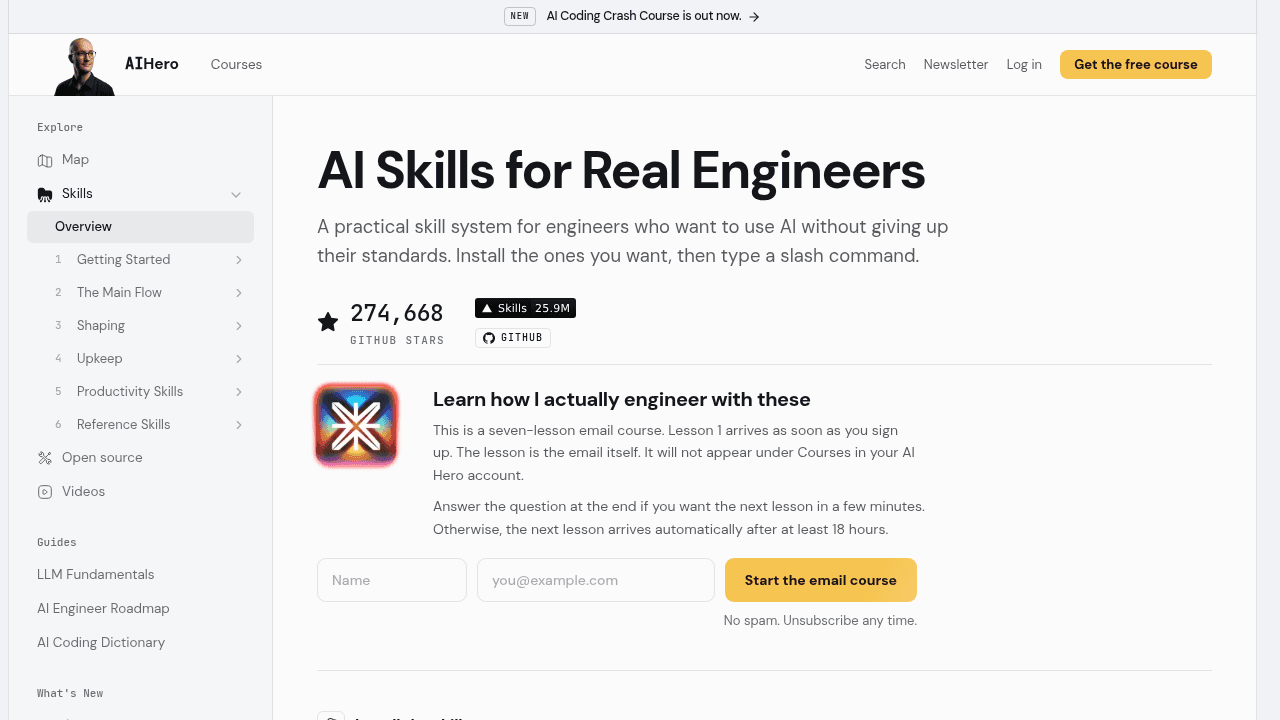
Pocock's skills repository treats this failure as an engineering-discipline problem. When agents lack the intuition to ask clarifying questions before implementation, the solution is to encode feedback loops directly into their workflows. Static types, browser access, automated tests, TDD red-green-refactor cycles, and structured debugging become checkpoints where intent mismatches surface before they reach users. The repository's 274k stars suggest developers recognize the pattern: working code isn't enough when the agent solved a problem you didn't actually have.
Engineering Discipline as a Correction Mechanism
TDD exists to catch human errors. Pocock repurposes it as an agent-alignment tool. A test that specifies "checkout spinner appears during API call, disappears on response" forces the agent to confront whether its implementation matches the actual requirement. Type errors become explicit signals that an agent's mental model diverged from yours. Browser testing catches visual misalignments that pass static analysis. Each workflow skill acts as a tripwire: if the agent's code doesn't satisfy the constraint, the feedback arrives immediately instead of in a post-merge bug report.
The framework formalizes what experienced developers already do intuitively. Where a senior engineer might catch intent drift during code review, agents generate code faster than humans can review it. Structured workflows shift the correction earlier in the cycle.
Real Adoption and Custom Integrations
The repository ships as the managed mattpocock-skills plugin through Claude Code's official marketplace. Developers report combining skills into custom pipelines: one user layers grill-with-docs, spec workflows, and ticket handling with specialist subagents across Claude Code and Hermes Agent. Teams are building production toolchains around these patterns.
Growing Pains: Skill Bloat and Secret Exposure
Users loading too many skills report sluggish setups and confusion, finding that smaller curated sets perform faster and remain easier to understand. The repository also has an open issue requesting secret-redaction rules—handoff workflows could otherwise copy API keys, tokens, or environment variables into generated documents. These are the expected rough edges of formalizing tribal knowledge into shareable tooling. As Hacker News commenters noted, reusable public skill sets often feel too specific to their authors, while the most valuable instructions remain organization- and project-specific.
Complementary Approaches and Prescriptive Opinions
Obra's Superpowers takes a more prescriptive stance, providing structured brainstorming, worktree management, planning, and subagent-driven development workflows. Where Pocock's repository offers modular feedback loops, Superpowers prescribes an end-to-end methodology. Teams juggling legacy codebases may prefer Pocock's composable skills, while greenfield projects might benefit from Superpowers' opinionated structure. Both reflect the same insight: as agents generate more capable code, the need for structured feedback increases rather than disappears.
From Implicit Practice to Explicit Instruction
The repository's contribution is making implicit engineering discipline explicit enough for agents to follow. Pocock turned "check your types before committing" into machine-readable workflow steps. The tension remains between reusable public patterns and the context-specific tribal knowledge that drives real teams. For organizations watching agents ship working code that solves the wrong problems, the framework offers a practical mitigation: treat every workflow constraint as a correction opportunity, and surface misalignment before it reaches production.
mattpocock/skills
Skills for Real Engineers. Straight from my .agents directory.