177 Scientific Skills That Make AI Agent Code Trustworthy
AI agents generate scientific code fast, but scientifically defensible code requires validation protocols, authoritative identifiers, and domain conventions. K-Dense externalizes 177 skills spanning biology, chemistry, medicine, and physics into modular, reusable components that bridge the gap between runnable and publishable.
AI agents can write scientific code in seconds—but scientifically defensible code, with proper validation, domain conventions, and authoritative identifiers, is a different challenge.
K-Dense Scientific Agent Skills externalizes 177 domain-specific procedures into modular components that bridge the gap between "code that runs" and "code scientists can trust to publish." The skills span biology, chemistry, medicine, physics, engineering, Earth science, data analysis, and scientific communication—each encoding procedural knowledge that general-purpose AI doesn't inherently know.
The Gap Between Runnable and Publishable
When an agent generates a pharmacokinetic model, does it know to apply ICH M10 validation guidelines? Does it use authoritative organism identifiers from NCBI Taxonomy rather than common names? Does it flag known caveats in statistical tests?
The repository addresses this gap: moving from executable code to scientifically defensible analysis. These aren't generic Python functions—they're codified domain conventions that computational scientists acquire through years of literature review and peer feedback.
Modular, Discoverable, Progressively Loadable
Rather than baking domain knowledge into monolithic prompts or relying on stateless tool-calling, K-Dense externalizes procedural knowledge into files that agents progressively load. Skills are discoverable at runtime, reusable across different agent hosts, and maintainable through standard version control.
A skill for organism identification teaches agents to query NCBI databases with proper error handling. A pharmacokinetic modeling skill includes exposure-response fitting with convergence diagnostics. An analytical method validation skill implements ICH M10 tolerance checks with intermediate-precision calculations.
Real Usage: Clinical Trials, Genetics, Literature
K-Dense's own infrastructure demonstrates adoption: self-hosting Multica with imported Scientific Agent Skills for clinical-trial analysis, human-genetics workflows, literature synthesis, and scheduled task orchestration. The library includes contributions from external organizations—Outpost Bio's Waypoint microbiome foundation models and Rowan Scientific's chemistry skill—evidence that the modular architecture supports third-party contributions.
Open Issues as Quality Signals
Two repository issues deserve attention as transparent quality control.
Issue #328 reports that the analytical-method-validation skill rejects results exactly on inclusive ICH M10 tolerance limits because of floating-point comparison, and can calculate intermediate-precision degrees of freedom greater than N−1.
Issue #330 documents that the pkpd-modeling logistic exposure-response script falsely reports non-convergence for exposure values scaled by 100 or 1,000, and estimates standard errors using a quasi-Newton Hessian approximation rather than Fisher information.
These are edge cases typical of numerical scientific software. The fact they're surfaced publicly, with specific reproduction steps and statistical context, reflects the rigor computational scientists expect from research code.
Claude Scientific Skills and Other Alternatives
Claude Scientific Skills provides ready-to-use scientific skills for research, engineering, analysis, and writing. It shares the same insight: codifying scientific methodology into reusable modules makes AI agents more trustworthy.
K-Dense differentiates by migrating from Claude-specific naming to compatibility with any agent supporting the open Agent Skills standard, and by broader domain coverage across eight disciplines. Both projects push the same direction.
What's Missing: Task-Level Evaluation
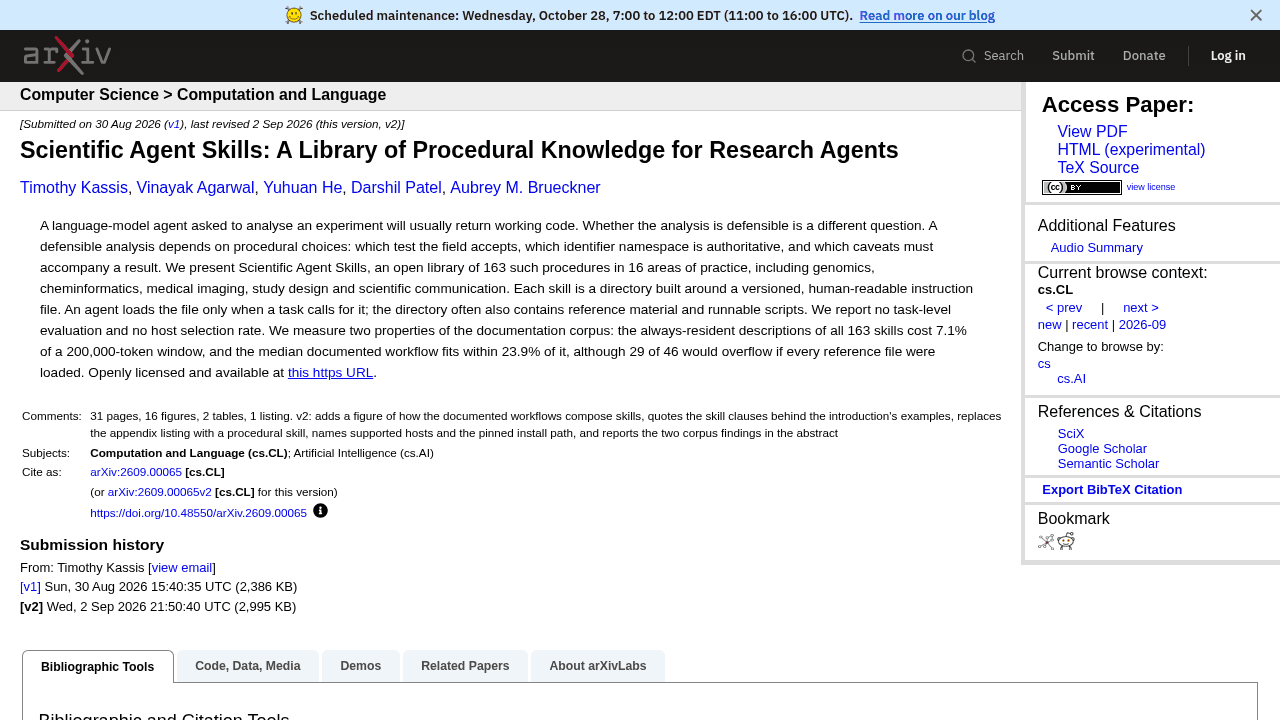
The accompanying research paper reports no task-level evaluation and no measurement of how often agents select the skills. Documentation-corpus measurements don't establish end-to-end performance. This limitation is typical of infrastructure work—the contribution is architectural, not empirical.
Momentum: 54K Stars, 250K Scientists
The repository has grown to 54,582 stars and is used by more than 250,000 scientists, with expansion from the earlier 163-skill paper corpus to 177 skills. The numbers suggest that computational scientists recognize the need for procedural knowledge that turns agent-generated code into publishable research.
K-Dense-AI/scientific-agent-skills
Turn any AI agent into an AI Scientist. The #1 Agent Skills library for science, used by 250,000+ scientists worldwide. 177 ready-to-use validated skills plus 100+ scientific databases covering biology, chemistry, medicine, and drug discovery. Compatible with Cursor, Claude Code, Codex, Pi, Antigravity, and the open Agent Skills standard.